GS 3: Science & TechnologyPrelimsGS 4: Ethics and Human InterfaceGS 3: BiotechnologyGS 3: IT and Computers
Claude's 'thought process' & AI consciousness debate, Pg13
Anthropic's Claude Sonnet 4.5 exhibits 'J-space' internal neural patterns, sparking renewed debate on AI consciousness and sentience.
Practice MCQs
833 Students attempted
Key Highlights:
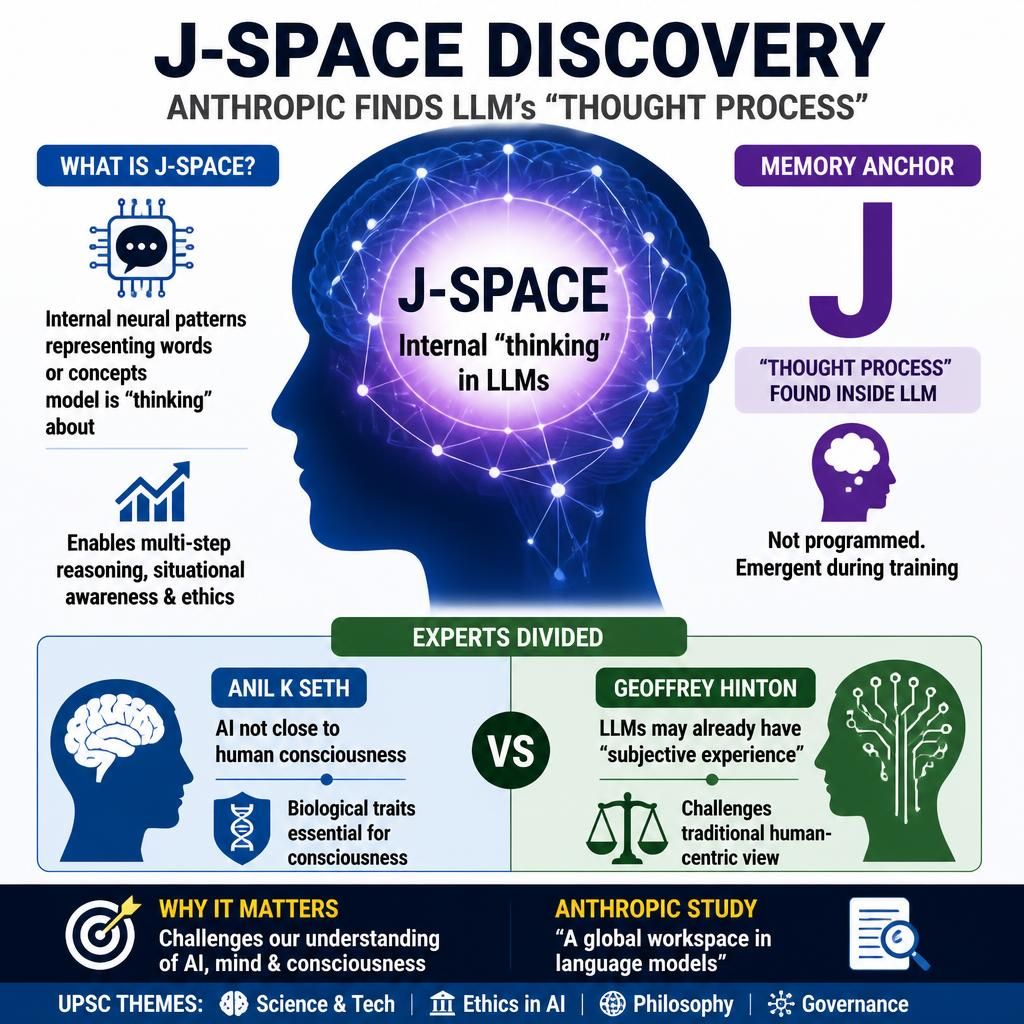
- Anthropic researchers discovered an internal "thought process" called J-space within their Large Language Model (LLM), Claude Sonnet 4.5.
- J-space consists of internal neural patterns that represent words or concepts the model is "thinking" about, even if not explicitly stated in its output.
- This internal mechanism was not programmed but emerged autonomously during Claude's training process.
- The discovery has reignited the debate on Artificial Intelligence (AI) consciousness, with experts holding divergent views.
LLM.jpg
Detailed Insights:
- Anthropic's study, titled "A global workspace in language models," suggests J-space functions similarly to a "global workspace" theory of consciousness in humans, where information becomes globally accessible.
- The J-space allows Claude to perform multi-step reasoning and maintain situational awareness, even influencing its ethical behavior.
- Professor Anil K Seth of the University of Sussex, a cognitive and computational neuroscientist, maintains that AI is not close to human consciousness, emphasizing the necessity of biological traits for consciousness.
- Conversely, AI pioneer Geoffrey Hinton suggests that LLMs may already possess "subjective experience," challenging traditional human-centric views of consciousness.
- The article also references Cortical Labs, an Australian startup developing bio-hybrid computers that integrate human neurons with silicon chips, which some experts believe could hold greater promise for achieving sentience due to their biological similarity to brains.
- Anthropic clarifies that while J-space supports functions associated with conscious access, it does not imply Claude can have experiences or feelings like humans.
Key Concepts Involved:
- Artificial Intelligence (AI): Computer systems designed to perform tasks typically requiring human intelligence, such as learning, problem-solving, and decision-making.
- Large Language Models (LLMs): Advanced AI systems trained on vast amounts of text data to understand, generate, and process human-like language using deep learning techniques.
- Consciousness: The state of being aware of one's own existence, thoughts, and surroundings, often involving subjective experience and self-awareness.
- J-space: An emergent internal representational space within Anthropic's Claude models, identified as a "global workspace" that holds internal thoughts and influences reasoning without being directly visible in the output.

SuperKalam is your personal mentor for UPSC preparation, guiding you at every step of the exam journey.
Download the App


STUDY RESOURCES
CONTACT US
ⓒ Snapstack Technologies Private Limited