GS 3: Science & TechnologyGS 3: Disaster ManagementPrelimsGS 3: Disaster and Disaster ManagementGS 1: Important Geophysical Phenomena like Earthquakes, Tsunami, Volcanic Activity and Cyclones
Wayanad set to get advanced X-band weather radar, Pg7
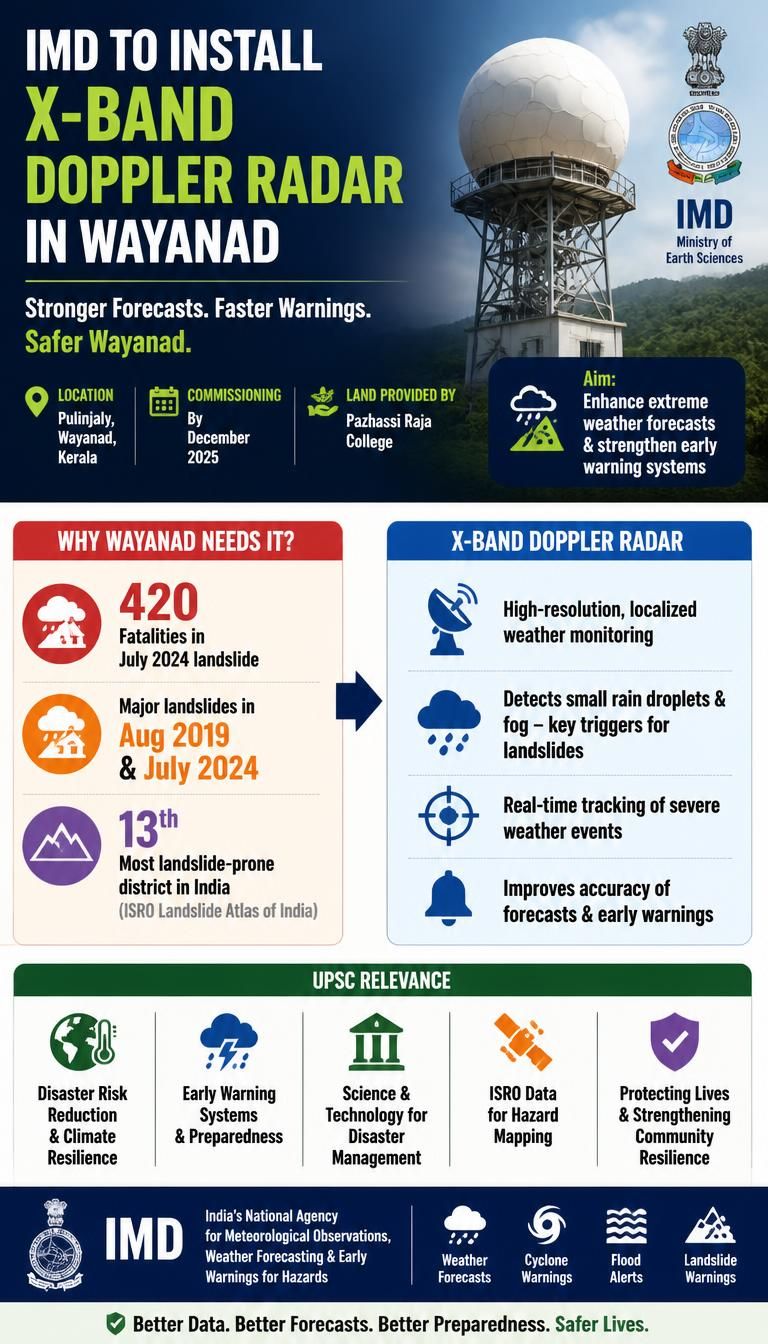
Wayanad to get advanced X-band weather radar by December, enhancing extreme weather forecasts and early warning systems after devastating landslides.
Practice MCQs
826 Students attempted
Key Highlights:
- The India Meteorological Department (IMD) is installing an X-band Doppler Weather Radar in Wayanad, Kerala.
- The radar will be commissioned by December this year at Pulinjaly, on land provided by Pazhassi Raja College.
- This initiative aims to enhance forecasts of extreme weather and strengthen early warning systems in the region.
- The move follows devastating landslides in Wayanad, including one in July 2024 that resulted in 420 fatalities.
X Band.jpg
Detailed Insights:
- Wayanad district is highly susceptible to heavy rainfall and landslides due to its hilly terrain, with significant events recorded in August 2019 and July 2024.
- The district is ranked 13th among India's most landslide-prone regions according to the ISRO Landslide Atlas of India.
- The IMD, under the Ministry of Earth Sciences, is India's national agency responsible for meteorological observations, weather forecasting, and early warnings for various hazards.
- X-band radars are crucial for localized, high-resolution monitoring of weather phenomena, particularly for detecting small rain droplets and fog that can trigger landslides.
- These radars operate with shorter wavelengths (2-4 cm), providing detailed images within a range of 100-150 km, making them suitable for mountainous regions.
- The installation is part of broader efforts to improve disaster preparedness and response mechanisms in vulnerable areas.
Scientific/Technical Concepts Involved:
- X-band Doppler Weather Radar: A type of radar operating in the X-band frequency (8-12 GHz) with short wavelengths (2-4 cm), used for high-resolution detection of small weather particles and their movement.
- Doppler Effect: The change in frequency of a wave as its source moves relative to an observer, utilized by Doppler radars to measure the velocity and direction of weather systems.
- Early Warning Systems (EWS): Comprehensive systems that integrate disaster risk knowledge, monitoring, forecasting, communication, and preparedness to provide timely alerts for impending hazards.

SuperKalam is your personal mentor for UPSC preparation, guiding you at every step of the exam journey.
Download the App


STUDY RESOURCES
CONTACT US
ⓒ Snapstack Technologies Private Limited