GS 2: GovernanceGS 3: Environment & EcologyGS 3: EconomyPrelimsGS 3: Indian Economy, Planning, Mobilization of Resources, Growth, Development and Employment
To cut gas imports, Cabinet gives nod to Rs 24K-cr biogas scheme ‘GOBARdhan’, Pg9
Cabinet approves Rs 23,731 crore GOBARdhan scheme to boost compressed biogas production, reduce gas imports, and promote clean energy transition.
Practice MCQs
826 Students attempted
Key Highlights:
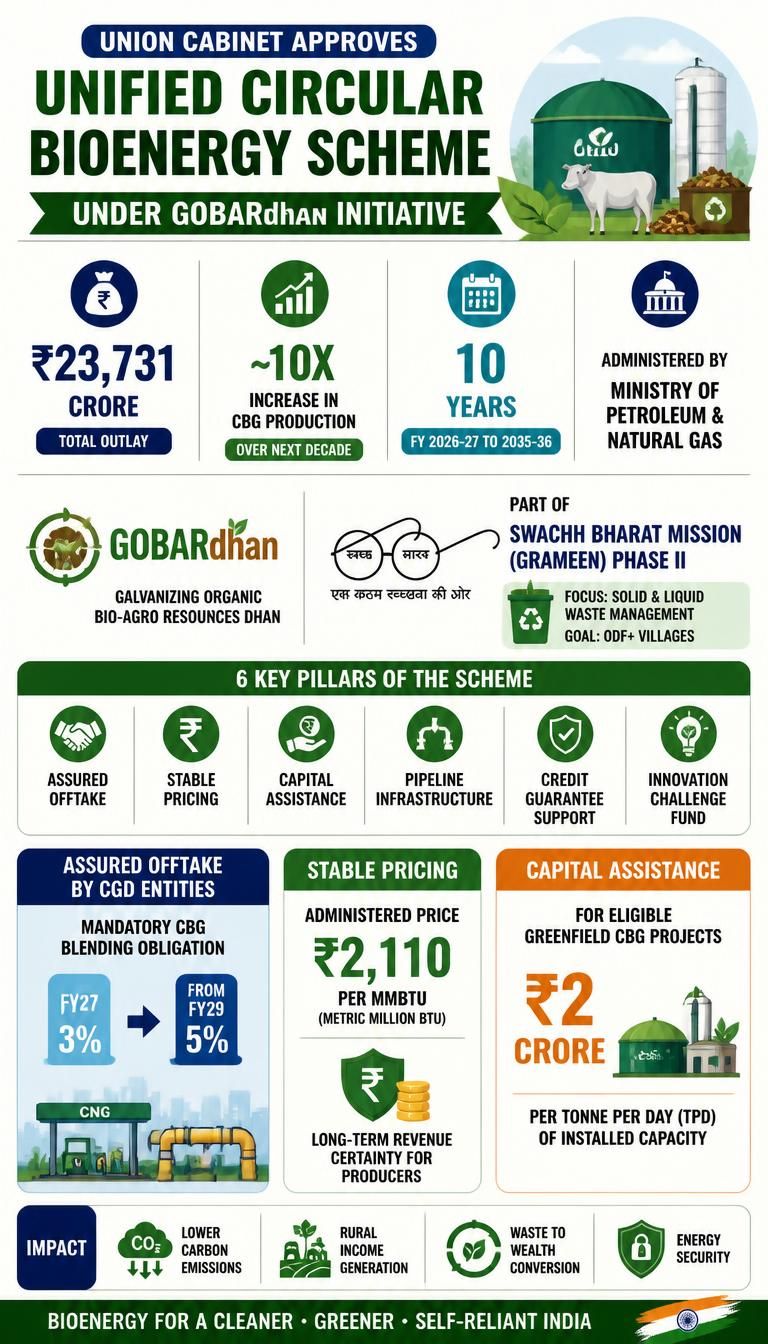
- The Union Cabinet approved GOBARdhan, the National Circular Bioenergy Scheme, with an outlay of Rs 23,731 crore.
- The scheme will be implemented over 10 years, from 2026-27 to 2035-36.
- Its primary goal is to increase domestic Compressed Biogas (CBG) production by nearly 10-fold.
- The Ministry of Petroleum and Natural Gas is responsible for implementing the scheme.
- The initiative aims to reduce India's dependence on natural gas imports and promote clean energy transition.
Gobardhan.jpg
Detailed Insights:
- GOBARdhan seeks to mobilize large-scale private investment in the CBG sector through assured offtake and stable administered pricing.
- CBG is a purified and compressed form of biogas, chemically similar to Compressed Natural Gas (CNG), suitable for vehicle and industrial fuel.
- The scheme addresses critical challenges in the CBG segment, including unorganized feedstock supply, high capital expenditure, and weak offtake.
- It leverages India's abundant agricultural residue, cattle dung, and municipal organic waste to produce clean fuel and organic manure.
- The scheme builds upon previous government initiatives such as the Sustainable Alternative Towards Affordable Transportation (SATAT) program.
- A dedicated CBG offtake assurance framework mandates blending obligations for City Gas Distribution (CGD) entities.
- CBG blending obligations are set at 3% (2026-27), 4% (2027-28), and 5% (2028-29 onwards) for CNG and Piped Natural Gas (PNG) segments.
- A stable administered CBG price of Rs 2,110 per Metric Million British Thermal Unit (MMBTU) ensures long-term revenue visibility for producers.
- Eligible greenfield CBG projects will receive capital assistance of up to Rs 2 crore per tonne per day of installed capacity.
Key Concepts Involved:
- GOBARdhan: A government initiative to convert organic waste into Compressed Biogas (CBG) and organic manure, promoting a circular bioeconomy.
- Compressed Biogas (CBG): A purified and compressed form of biogas, primarily methane, used as a renewable and clean fuel alternative to natural gas.
- Sustainable Alternative Towards Affordable Transportation (SATAT): An initiative launched in 2018 to establish a robust ecosystem for CBG production and its use as a green fuel.
- City Gas Distribution (CGD): The network and infrastructure responsible for supplying natural gas to domestic, commercial, and industrial consumers in specific geographical areas.

SuperKalam is your personal mentor for UPSC preparation, guiding you at every step of the exam journey.
Download the App


STUDY RESOURCES
CONTACT US
ⓒ Snapstack Technologies Private Limited