GS 2: GovernanceGS 1: Indian SocietyGS 2: Social JusticePrelimsGS 2: Government policies and interventions for development in various sectors
The challenge for school consolidation: Balancing access and quality education, Pg17
India's school consolidation debate intensifies as 94,000 government schools close, challenging policymakers to balance access, quality, and demographic shifts.
Practice MCQs
826 Students attempted
Key Highlights:
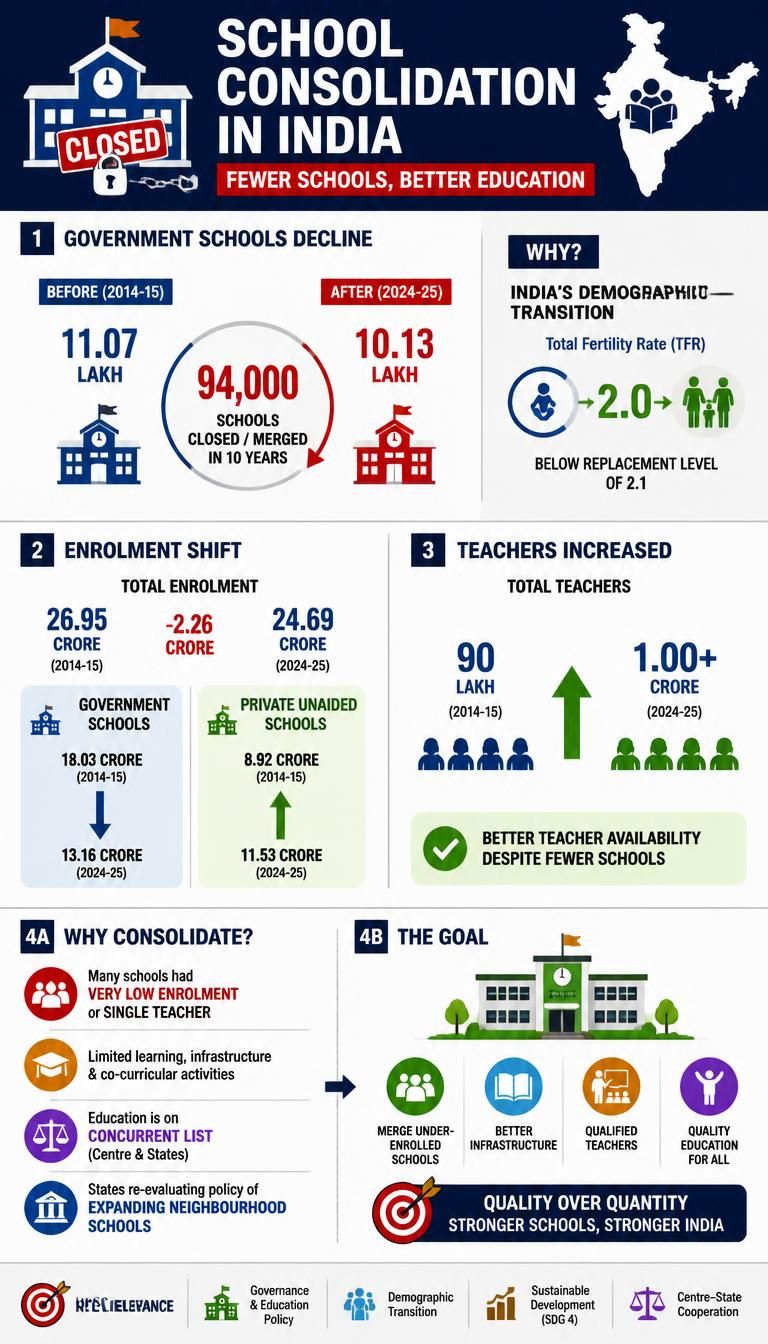
- Approximately 94,000 government schools have been closed or merged across India over the past decade, as highlighted in a NITI Aayog report.
- This decline in government schools, from 11.07 lakh in 2014-15 to 10.13 lakh in 2024-25, coincides with an increase in private unaided schools.
- Overall student enrolment decreased by 2.26 crore to 24.69 crore between 2014-15 and 2024-25, with government school enrolment falling while private school enrolment rose.
- The number of teachers in schools increased from 90 lakh to over one crore during the same period, improving teacher availability despite fewer schools.
- The consolidation is largely attributed to India's demographic transition, with the Total Fertility Rate (TFR) falling to 2.0, below the replacement level of 2.1.
School.jpg
Detailed Insights:
- The policy of expanding neighborhood schools, a long-standing focus, is now being re-evaluated by states where education is on the Concurrent List.
- Data from the Unified District Information System for Education Plus (UDISE+) reflects a nuanced story of declining enrolment and school numbers.
- Many government schools previously operated with very low enrolment or a single teacher, hindering comprehensive education and co-curricular activities.
- School consolidation aims to merge these under-enrolled institutions into better-equipped composite schools, offering improved infrastructure and qualified teachers.
- While consolidation can enhance educational quality and resource utilization, it raises concerns about equitable access for young children, girls, and students in remote areas due to increased travel distances.
- The success of school consolidation depends on balancing quality, efficiency, and equitable access, requiring provisions for safe transport and data-driven decision-making.
Key Concepts Involved:
- NITI Aayog: A policy think tank of the Government of India, providing strategic and technical advice on economic policy.
- Concurrent List: A list in the Seventh Schedule of the Indian Constitution, allowing both the Union and State governments to legislate on subjects like education.
- Total Fertility Rate (TFR): The average number of children born to a woman over her lifetime, indicating population growth trends.
- Unified District Information System for Education Plus (UDISE+): A comprehensive data collection system for school education in India, providing statistics on schools, enrolment, and teachers.

SuperKalam is your personal mentor for UPSC preparation, guiding you at every step of the exam journey.
Download the App


STUDY RESOURCES
CONTACT US
ⓒ Snapstack Technologies Private Limited