GS 2: GovernanceGS 3: Science & TechnologyGS 2: International RelationsGS 3: EconomyPrelims
The Beijing model of innovation, Pg10
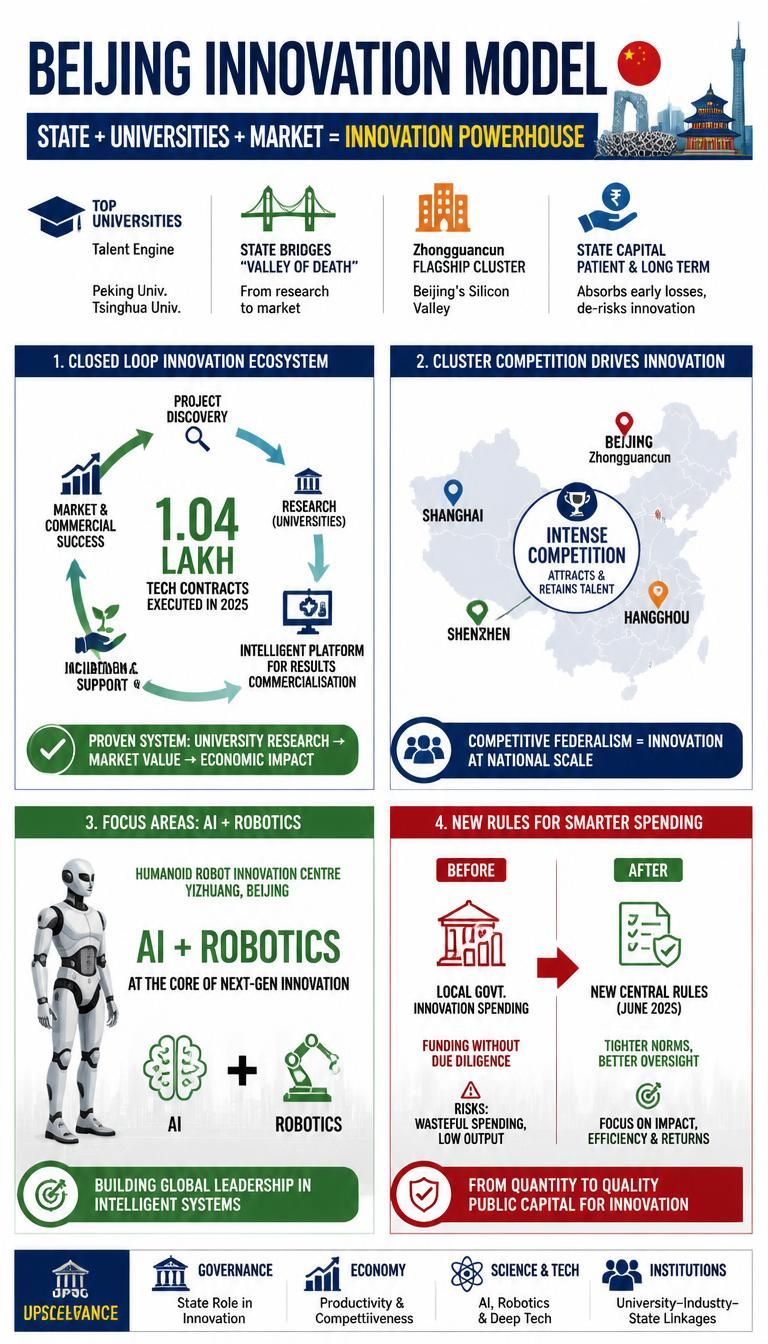
Beijing's unique innovation model integrates state, universities, and private enterprise, leveraging strategic investment and industrial policy to drive rapid tech commercialization.
Practice MCQs
826 Students attempted
Key Highlights:
- Beijing's innovation model integrates research universities, startups, the market, and the state to foster technological advancement.
- Top research institutions like Peking University and Tsinghua University are central to the city's talent concentration.
- The state actively intervenes to bridge the "valley of death" between early research and commercialization.
- Zhongguancun is a leading tech innovation cluster in Beijing, comparable to those in Shenzhen, Shanghai, and Hangzhou.
- The state provides both hard infrastructure and capital, including direct state-backed investments, to support innovative companies.
- Beijing's current innovation drive focuses heavily on AI and robotics, with the Humanoid Robot Innovation Centre in Yizhuang playing a key role.
- Chinese regulators issued new rules in June to tighten local government spending on innovation funds, addressing concerns about wasteful expenditure.
Beijing Innovation Model.jpg
Detailed Insights:
- Yang Xiuling of the Beijing Municipal Commission of Development and Reform describes the innovation ecosystem as a "closed loop from project discovery to incubation".
- An "intelligent platform for results commercialisation," managed by tech managers, helps translate university research into viable commercial ventures.
- This platform successfully executed 1.04 lakh tech contracts in 2025, demonstrating its effectiveness in connecting technology with market needs.
- Intense competition among different innovation clusters across China drives the national innovation ecosystem, particularly in attracting and retaining talent.
- The state's provision of capital helps absorb initial losses and offers patient, long-term support, which is often unavailable from traditional venture capital.
- New regulations from the central government aim to curb wasteful spending by local governments, which often invest in projects without sufficient due diligence.
- The Humanoid Robot Innovation Centre in the Yizhuang industrial cluster operates on a hub-and-spokes model, channeling talent to various robotics companies.
- The focus for humanoid robots is shifting from industrial applications to daily use scenarios, with healthcare identified as a major area of future demand.
- Lingyi iTech, a company in Yizhuang, plans to significantly scale up humanoid robot production to 1 lakh units by 2028 and 5 lakh by 2030.
- China's industrial policy includes state subsidies for land, policy support, and tax incentives, alongside crucial intellectual and talent support.
Key Concepts Involved:
- Valley of Death (Innovation): The critical stage where early-stage research struggles to secure funding and development to become a commercially viable product.
- Zhongguancun: A major technology hub and science park in Beijing, recognized as a leading center for innovation and entrepreneurship in China.
- State-backed Venture Capital: Investment funds provided or guaranteed by the government to support startups and innovative enterprises, often to de-risk investments.
- Hub-and-Spokes Model: A network structure where a central entity (hub) coordinates and distributes resources or information to multiple peripheral entities (spokes).

SuperKalam is your personal mentor for UPSC preparation, guiding you at every step of the exam journey.
Download the App


STUDY RESOURCES
CONTACT US
ⓒ Snapstack Technologies Private Limited