GS 2: GovernanceGS 3: EconomyPrelimsGS 3: Storage, Transport and Marketing of Agricultural ProduceGS 2: Parliament and State Legislatures
House panel flags fertilizer shortage, calls for proper mechanism to address it, Pg13
Parliamentary panel flags recurring fertilizer shortages, urging a permanent joint command for real-time coordination and better last-mile distribution to farmers.
Practice MCQs
826 Students attempted
Key Highlights:
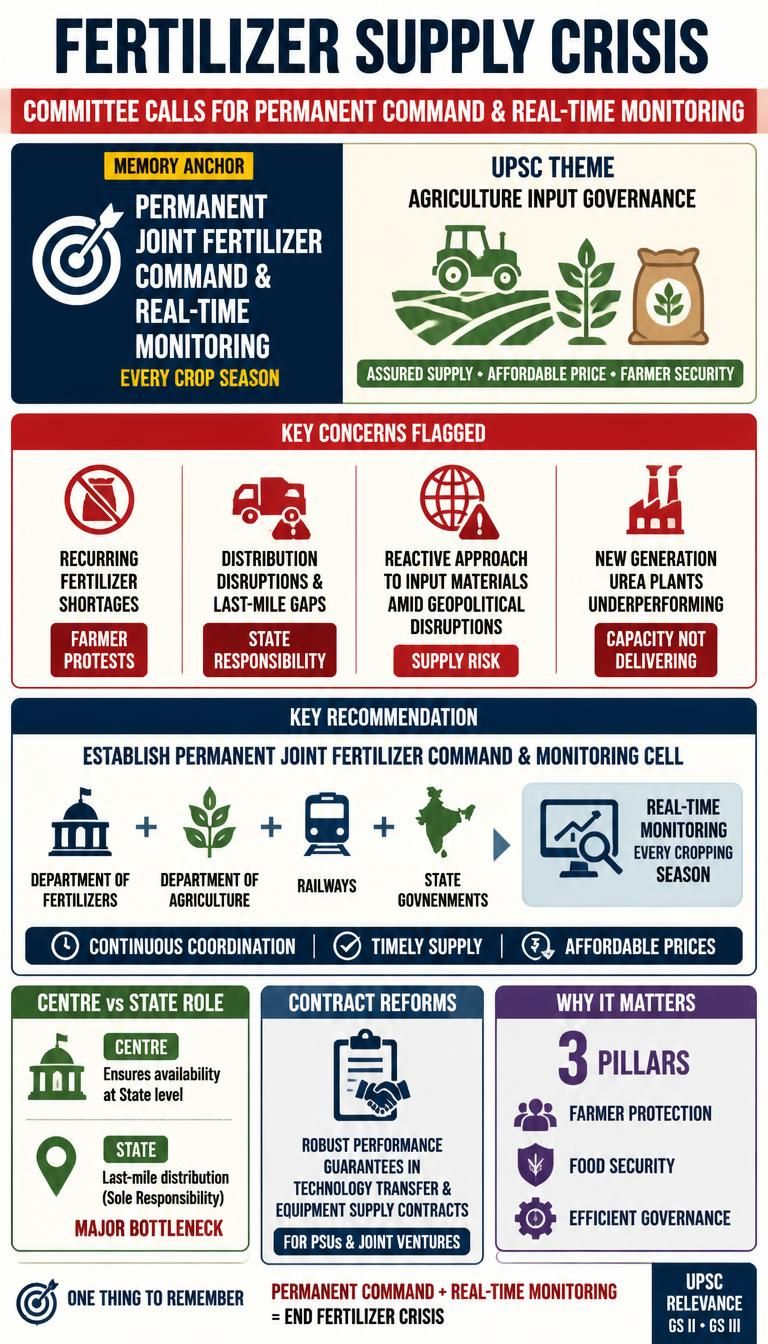
- The Parliamentary Standing Committee on Chemicals and Fertilizers flagged recurring fertilizer shortages, farmer protests, and distribution disruptions.
- It recommended establishing a permanent joint fertilizer command and monitoring cell for continuous, real-time coordination of supply during every cropping season.
- The panel criticized the Union government's "reactive" approach to securing input materials for fertilizer production, especially during geopolitical disruptions.
- It highlighted the persistent underperformance of new generation urea plants and issues with last-mile distribution, which is largely treated as a State responsibility.
- The committee called for robust performance guarantees in future technology transfer and equipment supply contracts for fertilizer Public Sector Undertakings (PSUs) and joint ventures.
Fertiliser.jpg
Detailed Insights:
- The report, titled "Alignment of logistics for efficient fertilizer movement and availability at affordable prices...", was tabled in both Houses of Parliament.
- The proposed joint fertilizer command and monitoring cell would comprise the Department of Fertilizers, Department of Agriculture, Railways, and State governments.
- The committee noted that the Centre's role is limited to ensuring State-level availability, with last-mile distribution being solely a State responsibility, contributing to supply bottlenecks.
- Interventions to ensure input material supply during the West Asia conflict were deemed "largely reactive" due to the absence of a pre-existing contingency framework for critical maritime chokepoints like the Strait of Hormuz.
- The panel recommended an urgent plant-wise diagnostic assessment of underutilised diammonium phosphate (DAP) units to identify and address production constraints.
- Incorporating robust performance guarantees aims to ensure that financial consequences of technology failure are borne by suppliers, not the public exchequer.
Key Concepts Involved:
- Parliamentary Standing Committee: A committee of Members of Parliament that examines bills, budgets, and policies of various ministries, including the Ministry of Chemicals and Fertilizers.
- Joint Fertilizer Command and Monitoring Cell: A proposed inter-departmental body designed to ensure seamless, real-time coordination of fertilizer supply across different government entities.
- Last-mile distribution: The final stage of delivering products from a distribution hub to the end-user, often a critical challenge in rural supply chains.
- Strait of Hormuz: A vital maritime chokepoint connecting the Persian Gulf to the Gulf of Oman, through which a significant portion of the world's oil and gas trade passes.

SuperKalam is your personal mentor for UPSC preparation, guiding you at every step of the exam journey.
Download the App


STUDY RESOURCES
CONTACT US
ⓒ Snapstack Technologies Private Limited