GS 2: GovernanceGS 2: PolityGS 2: Social JusticePrelimsGS 2: Important Aspects of Governance, Transparency and Accountability
Arrest Occurs at the Moment of Detention, Says SC, Pg1
Supreme Court rules arrest begins at the moment of detention, not formal recording, triggering 24-hour production rule to curb human rights violations.
Practice MCQs
840 Students attempted
Key Highlights:
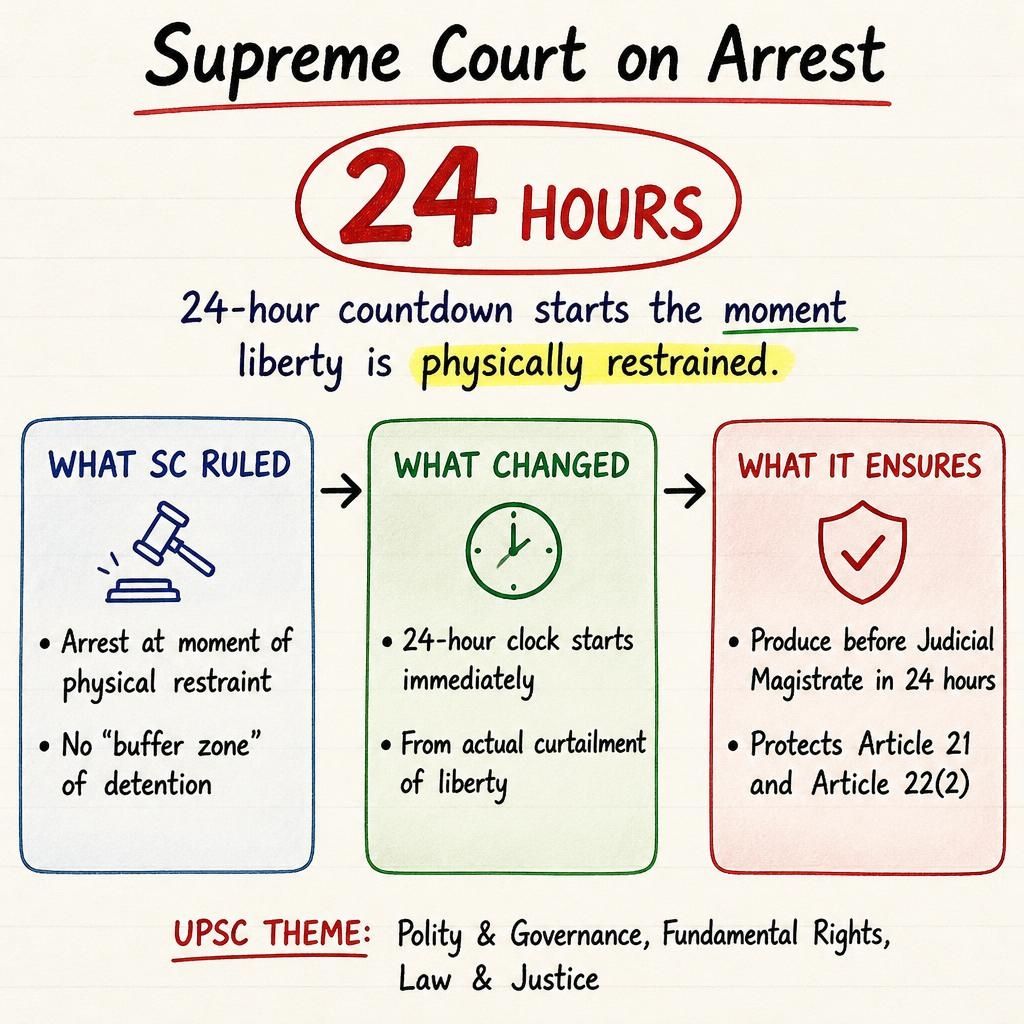
- The Supreme Court ruled that an arrest occurs the moment an official physically restrains an individual's liberty.
- This ruling immediately triggers the 24-hour countdown for producing the arrested person before a Judicial Magistrate.
- A Bench headed by Justice Ujjal Bhuyan stated that the previous ambiguity in defining arrest led to human rights violations.
- The Court declared that any "buffer zone" of detention before formal arrest is unconstitutional.
SC on Arrest.jpg
Detailed Insights:
- The term 'arrest' is not explicitly defined in major penal statutes, including the Indian Penal Code, Code of Criminal Procedure, or the Bharatiya Nagarik Suraksha Sanhita.
- Law enforcement agencies previously calculated the 24-hour period from the time of formal arrest, often after days of unrecorded detention.
- This practice allowed for the use of third-degree measures and forced confessions during the unrecorded detention period.
- Article 22(2) of the Constitution mandates that an arrested person must be produced before a Judicial Magistrate within 24 hours, excluding travel time.
- The Court emphasized that the 24-hour timeline commences from the actual date and time a person's liberty is curtailed, not from a later formal arrest.
- It directed Magistrates to immediately release any person found to have been detained beyond 24 hours without proper production.
- The ruling reinforces the fundamental rights to life and personal liberty enshrined in Article 21 of the Constitution.
Key Concepts Involved:
- Arrest: As per the Supreme Court, it is the moment an official restrains an individual's liberty, triggering the 24-hour production rule.
- Article 22(2) of the Constitution: A fundamental right mandating the production of an arrested person before a Judicial Magistrate within 24 hours.
- Judicial Magistrate: A judicial officer responsible for overseeing legal proceedings and ensuring the rights of arrested persons.
- Article 21 of the Constitution: Guarantees the fundamental right to protection of life and personal liberty to all persons in India.
- Bharatiya Nagarik Suraksha Sanhita: A new criminal procedure code enacted in India, replacing the Code of Criminal Procedure, 1973.

SuperKalam is your personal mentor for UPSC preparation, guiding you at every step of the exam journey.
Download the App


STUDY RESOURCES
CONTACT US
ⓒ Snapstack Technologies Private Limited