GS 2: GovernanceGS 2: PolityGS 3: EconomyPrelimsGS 3: Indian Economy, Planning, Mobilization of Resources, Growth, Development and Employment
Why are States divided over the mining amendment?, Pg8
New mining amendment sparks federalism debate as States challenge Centre's expanded powers over mineral taxation, impacting fiscal autonomy and revenue generation.
Practice MCQs
833 Students attempted
Key Highlights:
- The Mines and Minerals (Development and Regulation) Amendment Act, 2026 expanded the Centre's regulatory powers over mining and mineral-bearing lands.
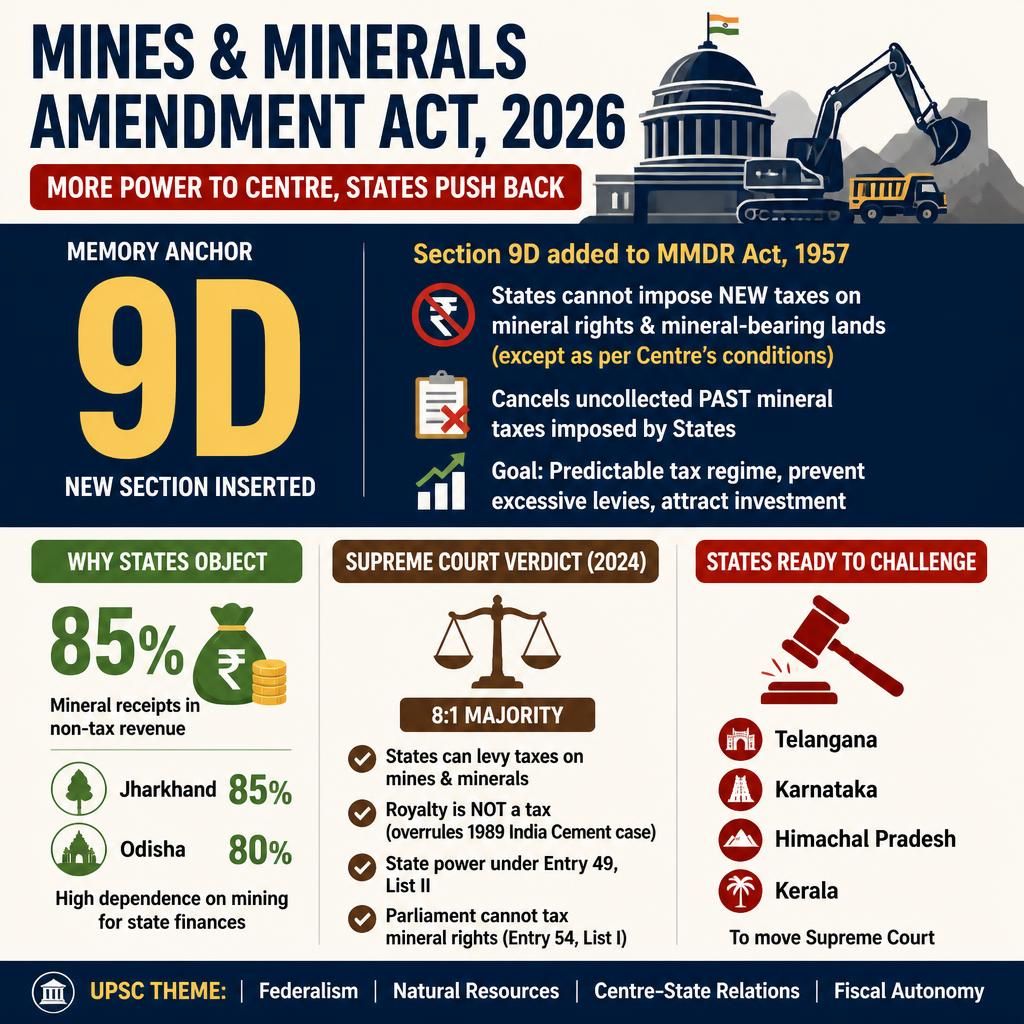
- The amendment restricts States from imposing new taxes on mineral rights and mineral-bearing lands, except under conditions prescribed by the Union government.
- It also cancels uncollected past mineral taxes imposed by States before the Act came into force.
- This legislative change has led to a division between the Centre and several States, impacting the fiscal autonomy of mineral-rich States.
- The Supreme Court, in a 2024 ruling, affirmed States' power to tax mineral rights and mineral-bearing lands, which contradicts aspects of the new amendment.
MMDR Amendment.jpg
Detailed Insights:
- The Mines and Minerals (Development and Regulation) Amendment Act, 2026 inserted Section 9D into the parent Mines and Minerals (Development and Regulation) Act, 1957.
- The Centre justifies the amendment by citing the need for a predictable tax environment, preventing excessive levies, and encouraging long-term investment in the mining sector.
- States like Jharkhand and Odisha are highly dependent on mineral-related receipts, which constitute 85% and 80% of their non-tax revenue, respectively.
- The Supreme Court, in its 8:1 majority judgment on July 25, 2024, in the case of Mineral Area Development Authority & Anr. v. M/s Steel Authority of India & Anr., held that States possess the power to levy taxes on mines and minerals.
- This ruling clarified that royalty is not a tax, thereby overturning the 1989 India Cement Ltd. v. State of Tamil Nadu judgment.
- The Court affirmed that State legislatures are competent to levy tax on mineral-bearing land under Entry 49 of List II and can use mineral produce or royalty as a measure for taxation.
- It also stated that Parliament cannot impose taxes on mineral rights under Entry 54 of List I.
- Several non-NDA ruled States, including Telangana, Karnataka, Himachal Pradesh, and Kerala, are planning to challenge the amendment in the Supreme Court.
- This conflict highlights the ongoing push and pull in Indian federalism regarding legislative jurisdiction and fiscal resources.
Key Concepts Involved:
- Fiscal Federalism: The division of financial powers and responsibilities between central and state governments.
- Union List (Entry 54): Grants Parliament power to regulate mines and mineral development in the public interest.
- State List (Entry 23): Empowers State governments to regulate mines and minerals, subject to central legislation.
- State List (Entry 49): Grants States the power to tax lands and buildings, including mineral-bearing lands.
- State List (Entry 50): Allows States to tax mineral rights, subject to limitations imposed by Parliamentary law on mineral development.

SuperKalam is your personal mentor for UPSC preparation, guiding you at every step of the exam journey.
Download the App


STUDY RESOURCES
CONTACT US
ⓒ Snapstack Technologies Private Limited