GS 3: Science & TechnologyPrelimsGS 3: BiotechnologyGS 3: Science and Technology in Everyday LifeGS 2: Health Sector
Trio Wins Medicine Nobel For ‘Controlling’ Neurons With Light, Pg1
Three scientists win Nobel Prize in Medicine for optogenetics, a revolutionary technique controlling neurons with light, aiding research into neurological disorders.
Practice MCQs
833 Students attempted
Key Highlights:
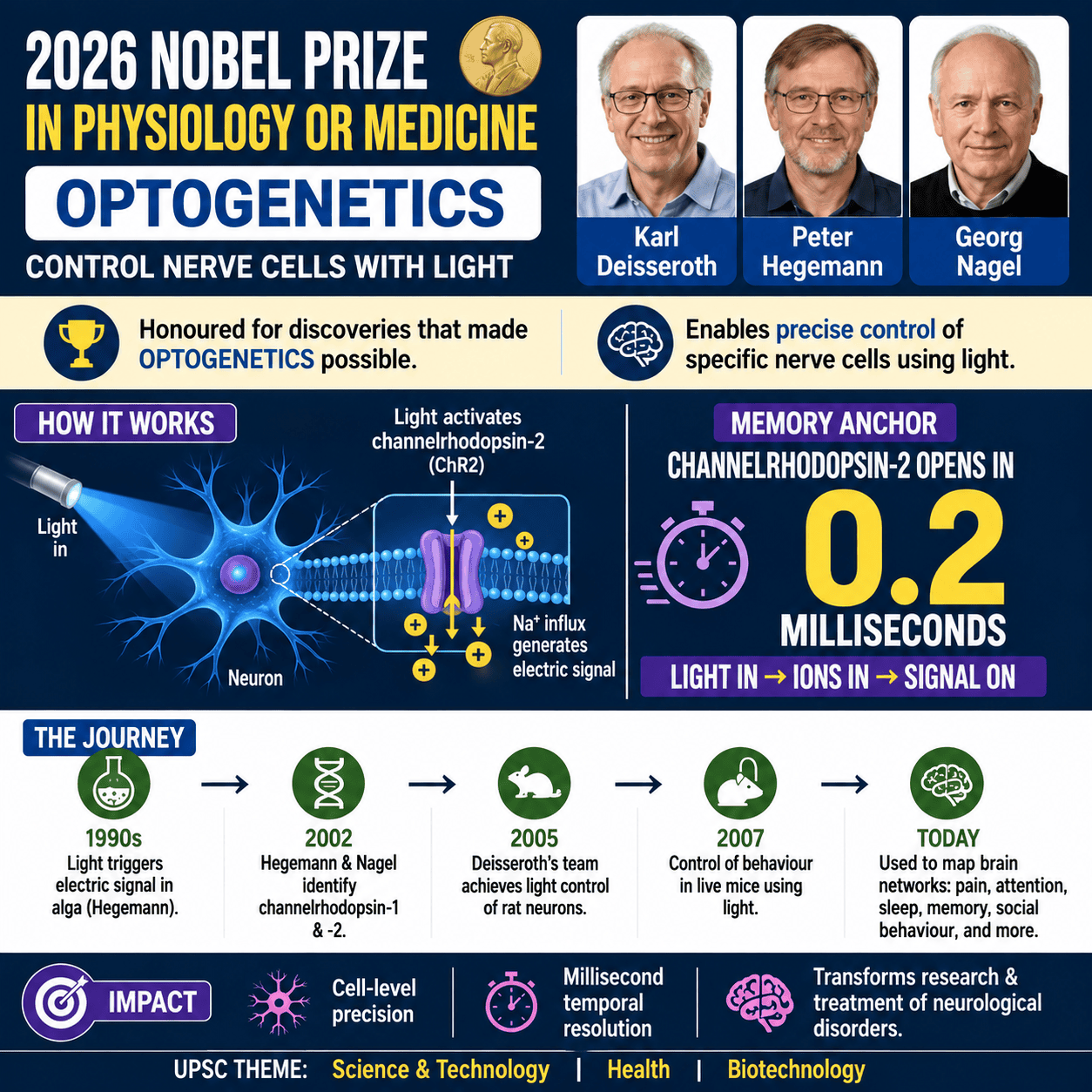
- A trio of scientists, Karl Deisseroth, Peter Hegemann, and Georg Nagel, were awarded the 2026 Nobel Prize in Physiology or Medicine.
- The award recognizes their discoveries leading to optogenetics, a technique that enables the control of specific nerve cells using light.
- Optogenetics allows scientists to switch on or off the activity of individual nerve cells in a living brain with high precision.
- The technique is crucial for studying neurological disorders like schizophrenia, depression, Alzheimer’s, and Parkinson’s diseases.
Nobel Prize for Medicine.jpg
Detailed Insights:
- In the 1990s, Peter Hegemann discovered that shining light on the microscopic alga Chlamydomonas rapidly triggered an electric signal.
- He hypothesized that a light-detecting molecule was linked to a protein allowing charged ions to enter cells.
- Georg Nagel confirmed this idea, and the team identified two light-sensitive channel proteins, channelrhodopsin-1 and channelrhodopsin-2.
- Channelrhodopsin-2 opens within 0.2 milliseconds when exposed to light, permitting positively charged ions to flow into a cell and generate an electric signal.
- Karl Deisseroth's team published their first major results in 2005 using rat neurons, and the technique was named optogenetics in 2006.
- In 2007, Deisseroth's group demonstrated control over behavior by stimulating specific neurons in live mice using fiber-optic cables.
- Optogenetics has since been used to identify brain networks involved in pain, attention, sleep, memories, and social behaviors.
- This method provides cell-level precision and millisecond temporal resolution, making it a transformative tool in neuroscience.
Scientific/Technical Concepts Involved:
- Optogenetics: A biological technique combining genetics and optics to control the activity of specific neurons or cells using light.
- Neurons: Fundamental units of the nervous system that transmit electrical and chemical signals throughout the body.
- Channelrhodopsin-2 (ChR2): A light-gated ion channel protein from algae that opens in response to blue light, allowing positive ions into neurons to trigger electrical signals.

SuperKalam is your personal mentor for UPSC preparation, guiding you at every step of the exam journey.
Download the App


STUDY RESOURCES
CONTACT US
ⓒ Snapstack Technologies Private Limited