GS 1: Physical GeographyGS 3: Environment & EcologyGS 3: EconomyPrelimsGS 3: Indian Economy, Planning, Mobilization of Resources, Growth, Development and Employment
Coal stocks critically low as power demand rises in India, Pg7
India faces critical coal stock shortages at thermal power plants amid record power demand surge, exacerbated by El Nino and rising temperatures.
Practice MCQs
833 Students attempted
Key Highlights:
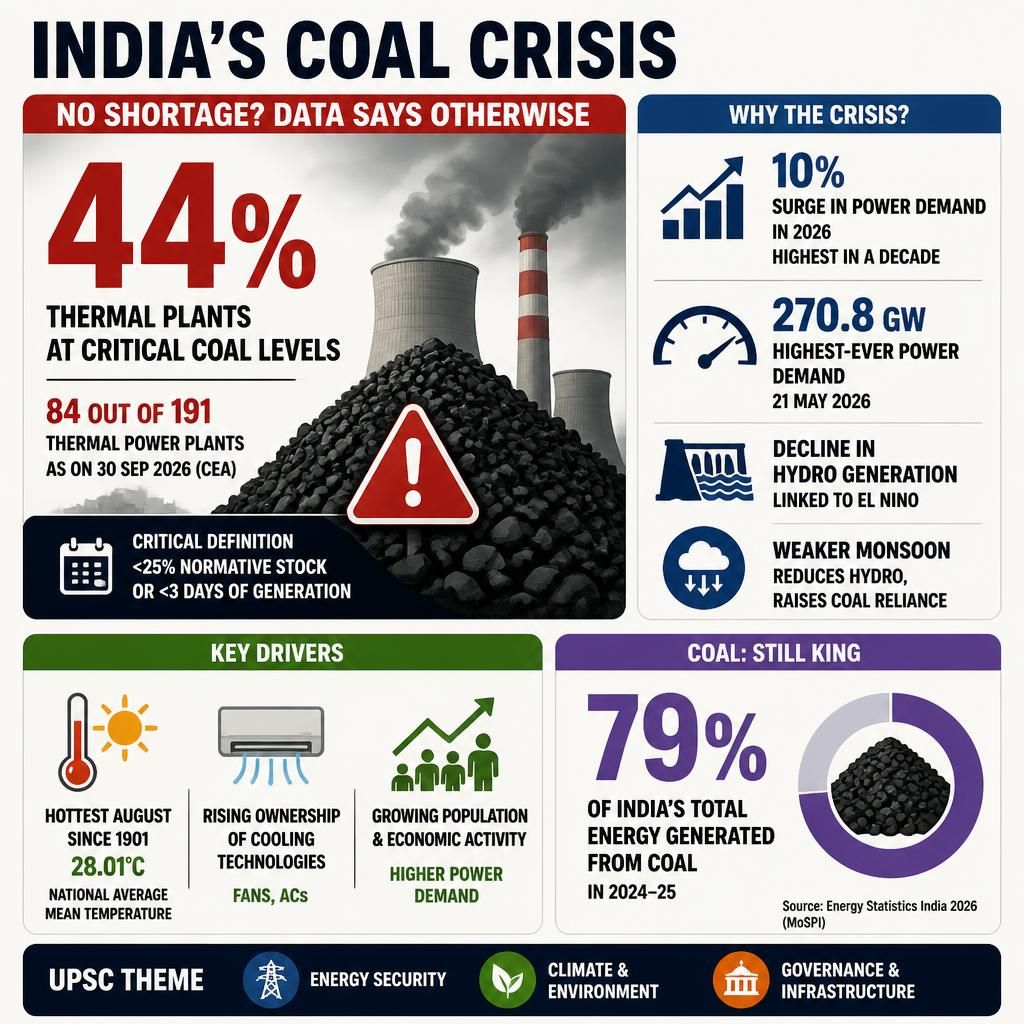
- On September 28, Union Coal and Mines Minister G. Kishan Reddy stated there was no coal shortage, despite data showing 44% of India's thermal power plants had critically low stocks.
- As of September 30, 2026, the Central Electricity Authority (CEA) reported 84 out of 191 thermal power plants had critical coal inventories.
- India experienced a 10% increase in power demand in 2026, the highest year-on-year rise in a decade, leading to power shortages.
- The country recorded its highest-ever power demand of 270.8 GW on May 21, 2026.
- Reliance on coal-fired thermal power plants increased due to a decline in hydro-power generation, partly linked to the El Nino phenomenon.
Coal Crisis.jpg
Detailed Insights:
- The Central Electricity Authority (CEA) defines a power plant's stock as critical if it falls below 25% of the normative requirement or can support generation for less than three days.
- India experienced its hottest August since 1901 in 2026, with the national average mean temperature soaring to 28.01°C.
- The El Nino phenomenon, characterized by warming of the central and eastern Pacific, alters atmospheric circulation and weakens monsoon winds over the subcontinent.
- Weaker monsoons, linked to El Nino events, have reduced hydro-power generation, increasing dependence on coal.
- Coal was the primary source for 79% of India's total energy generated in 2024-25, according to the "Energy Statistics India 2026" report by the Ministry of Statistics and Programme Implementation.
- Rising temperatures globally and increased ownership of cooling technologies like fans and ACs are significant drivers of the surge in electricity demand.
- Despite the current pressure, later months of the year typically bring lower temperatures and eased power demand, though supply shortages may persist.
Scientific/Technical Concepts Involved:
- El Nino: A climate pattern describing the unusual warming of surface waters in the eastern tropical Pacific Ocean, impacting global weather.
- Thermal Power Plants: Facilities that convert heat energy, typically from burning coal, into electrical energy.
- Gigawatt (GW): A unit of power equal to one billion watts, commonly used to measure the output of large power plants or grids.

SuperKalam is your personal mentor for UPSC preparation, guiding you at every step of the exam journey.
Download the App


STUDY RESOURCES
CONTACT US
ⓒ Snapstack Technologies Private Limited