GS 2: International RelationsGS 3: EconomyPrelimsGS 3: Indian Economy, Planning, Mobilization of Resources, Growth, Development and EmploymentGS 2: Bilateral, Regional and Global Groupings and Agreements
Why is BRICS exploring cross-border payments?, Pg14
BRICS nations push for alternative cross-border payment systems and CBDC links to cut costs and challenge dollar dominance in global trade.
Practice MCQs
826 Students attempted
Key Highlights:
- The 18th BRICS Summit, hosted by India in New Delhi on September 12-13, 2026, is set to prioritize mechanisms for cross-border payments, including links between digital payment systems and Central Bank Digital Currencies (CBDCs).
- BRICS nations aim to reduce reliance on the current system, which involves multiple intermediary banks and the U.S. dollar as a vehicle currency, leading to high transaction costs and exposure to external monetary policies.
- Current cross-border payments typically use the SWIFT messaging network and involve correspondent banks, often resulting in foreign exchange margins ranging from 2.5% to 20%.
- Proposed solutions include direct connections between national payment systems, shared hubs like Project Nexus, and platforms for interbank CBDC exchanges such as mBridge.
- India's proposal focuses on linking CBDCs for trade and tourism payments, framing the initiatives as cost-reduction measures rather than efforts to displace the dollar.
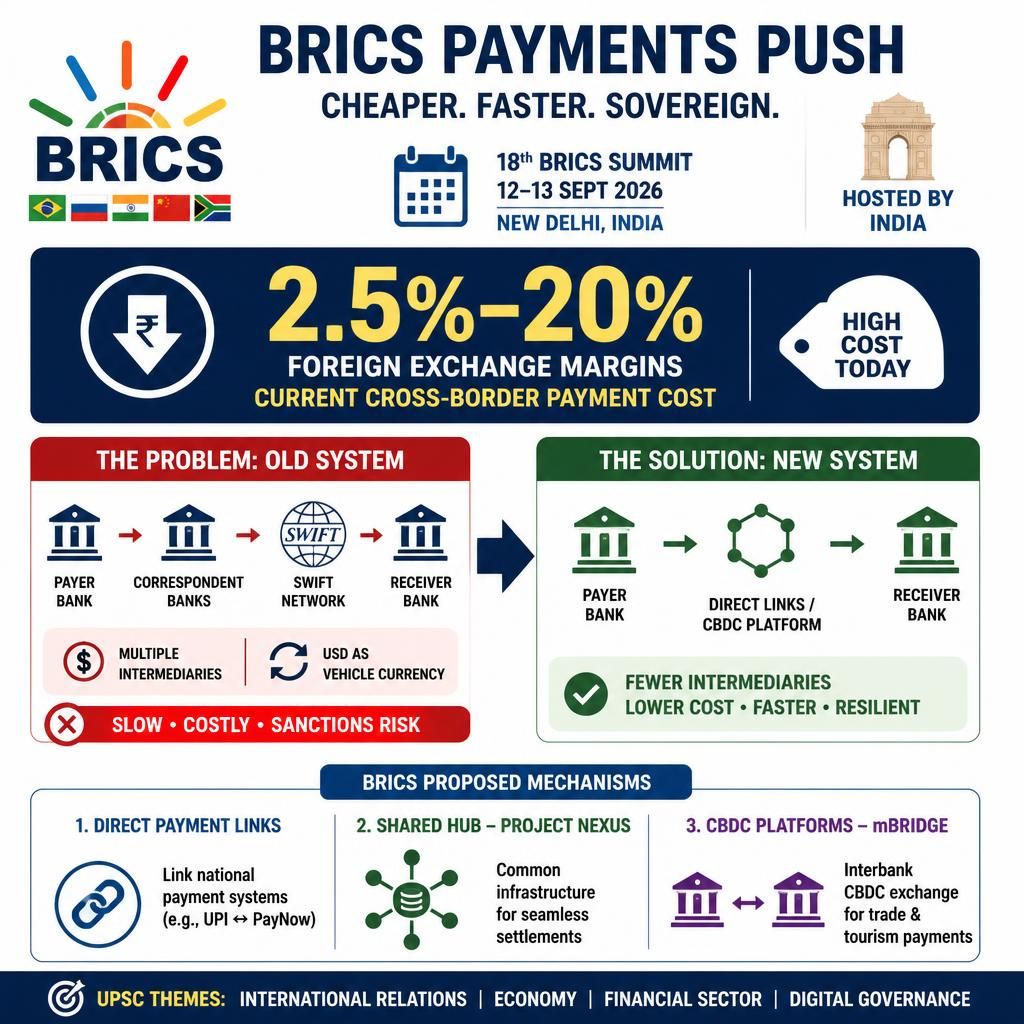
BRICS Payment Push.jpg
Detailed Insights:
- The existing cross-border payment system routes transactions through a chain of correspondent banks, often converting national currencies to the U.S. dollar and then to the recipient's currency.
- SWIFT (Society for Worldwide Interbank Financial Telecommunication) is a Belgium-based cooperative messaging network used by over 11,000 institutions globally to exchange payment instructions.
- A 2019 BRICS survey revealed significant foreign exchange margins, with some payments in Africa incurring costs as high as 20%.
- The Bank for International Settlements (BIS) reported a 20% decline in active correspondent banking relationships between 2011 and 2018, largely due to commercial reasons.
- BRICS countries, particularly Russia after being cut off from SWIFT in 2022, seek alternatives to mitigate risks from sanctions and reduce the monopolization of the financial system.
- Bilateral links, such as India's Unified Payments Interface (UPI) with Singapore's PayNow, demonstrate a model for direct national payment system connections.
- Project Nexus, a BIS Innovation Hub initiative, aims to connect multiple domestic instant payment systems globally through a single hub, with live implementation expected in 2027.
- mBridge, developed by the BIS with central banks from China, Thailand, Hong Kong, and the UAE, is an operational platform for interbank CBDC exchanges, with over 95% of its settlement volume in China's digital yuan.
- The Kazan Declaration of 2024 agreed to study the feasibility of an independent settlement system called BRICS Clear, though it was not mentioned in the subsequent Rio Declaration of 2025.
- Former U.S. President Donald Trump's threats of tariffs on BRICS countries if they moved away from the dollar may influence India's cautious stance on de-dollarization.
Key Concepts Involved:
- Cross-border payments: Financial transactions between individuals or entities located in different countries.
- SWIFT (Society for Worldwide Interbank Financial Telecommunication): A global messaging network facilitating secure communication between financial institutions for international payments.
- Central Bank Digital Currency (CBDC): A digital form of a country's fiat currency, issued and regulated by its central bank.
- Correspondent banking: A system where one bank provides services to another bank in a different country, enabling international transactions.
- De-dollarization: The process of reducing the reliance on the U.S. dollar as the primary currency for international trade and financial transactions.

SuperKalam is your personal mentor for UPSC preparation, guiding you at every step of the exam journey.
Download the App


STUDY RESOURCES
CONTACT US
ⓒ Snapstack Technologies Private Limited