GS 2: GovernanceGS 3: Science & TechnologyGS 3: Internal SecurityPrelimsGS 2: Government policies and interventions for development in various sectors
What is ‘One Nation, One Time’?, Pg14
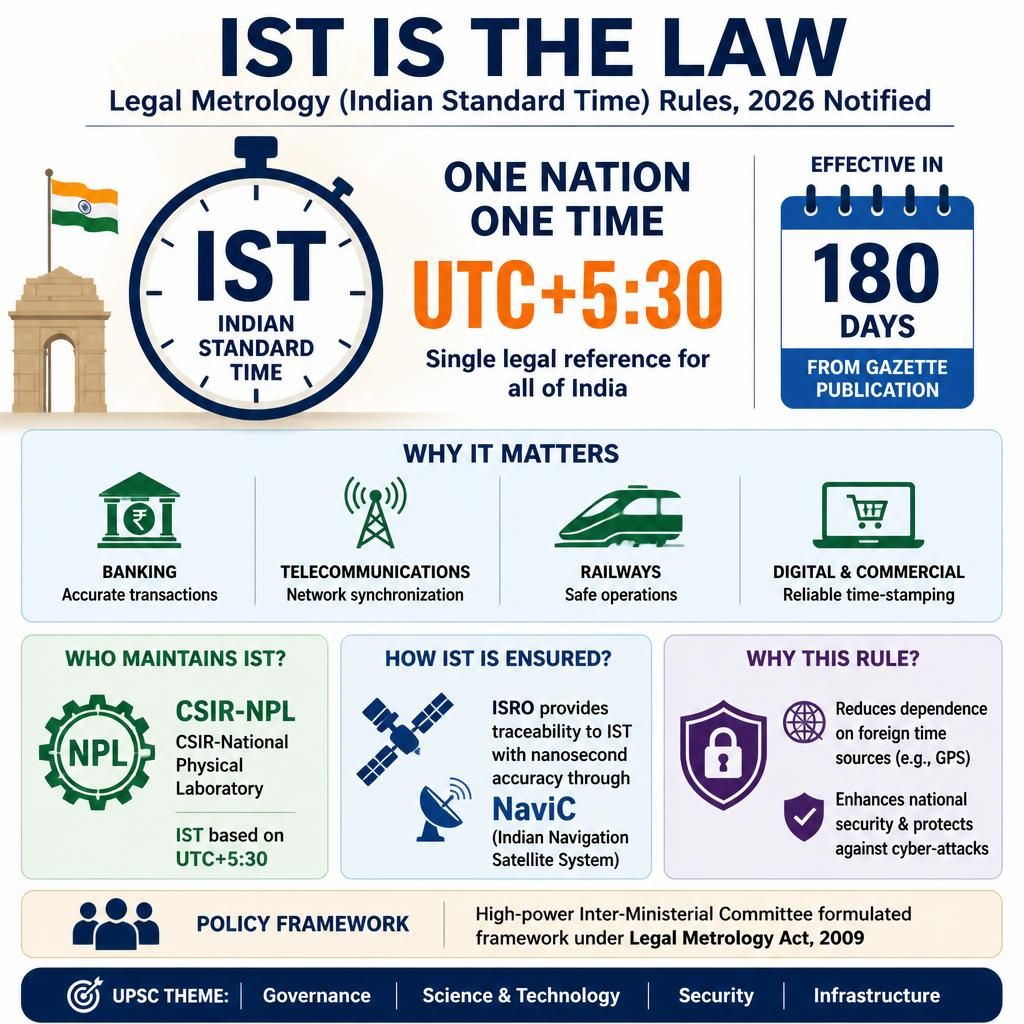
Centre notifies 'One Nation, One Time' rules, making Indian Standard Time mandatory for all official purposes, enhancing digital system coordination and national security.
Practice MCQs
826 Students attempted
Key Highlights:
- The Centre notified the Legal Metrology (Indian Standard Time) Rules, 2026, on August 27.
- These rules make Indian Standard Time (IST) the single reference for all legal, administrative, and commercial purposes nationwide.
- The rules will come into force 180 days from their publication in the Official Gazette.
- The initiative aims to ensure accurate and consistent time across critical digital and technology-based systems.
IST.jpg
Detailed Insights:
- The need for a common time reference has increased due to the widespread use of digital systems in banking, telecommunications, and railways.
- The Department of Consumer Affairs initiated the push for time synchronization in January 2025 with draft rules.
- Indian Standard Time (IST) is maintained by the CSIR-National Physical Laboratory (CSIR-NPL) and is based on Coordinated Universal Time (UTC) with a +5:30-hour offset.
- ISRO provides traceability to IST with nanosecond accuracy through satellite links to NavIC.
- The new rules reduce dependence on foreign satellite-based time sources like GPS, enhancing national security and protecting against cyber-attacks.
- A high-power inter-ministerial committee formulated the policy framework under the Legal Metrology Act, 2009.
- A White Rabbit Technology-based IST Dissemination Demonstration Network was commissioned in Bengaluru in July 2026 as part of this initiative.
Key Concepts Involved:
- Indian Standard Time (IST): India's official time, maintained by CSIR-NPL, based on UTC with a +5:30 offset.
- Coordinated Universal Time (UTC): The primary time standard by which the world regulates clocks and time.
- Legal Metrology Act, 2009: Legislation governing weights and measures, now extended to include time as a legal standard.
- NavIC: India's independent regional satellite navigation system, used for secure and reliable time dissemination.

SuperKalam is your personal mentor for UPSC preparation, guiding you at every step of the exam journey.
Download the App


STUDY RESOURCES
CONTACT US
ⓒ Snapstack Technologies Private Limited