GS 2: GovernanceGS 2: International RelationsGS 3: Environment & EcologyGS 3: EconomyPrelims
Glacial collapse unlikely to halt China’s plan to build mega dam, Pg1
China advances its 1.2 trillion Yuan Yarlung Zangbo mega dam project, raising India's concerns over downstream water flow and ecological impacts.
Practice MCQs
826 Students attempted
Key Highlights:
- China is proceeding with the construction of the Yarlung Zangbo Lower Reaches Hydropower Project on the Brahmaputra river in Tibet, despite recent glacial collapse concerns.
- The project is a key component of China's 15th Five-Year Plan for renewable energy development.
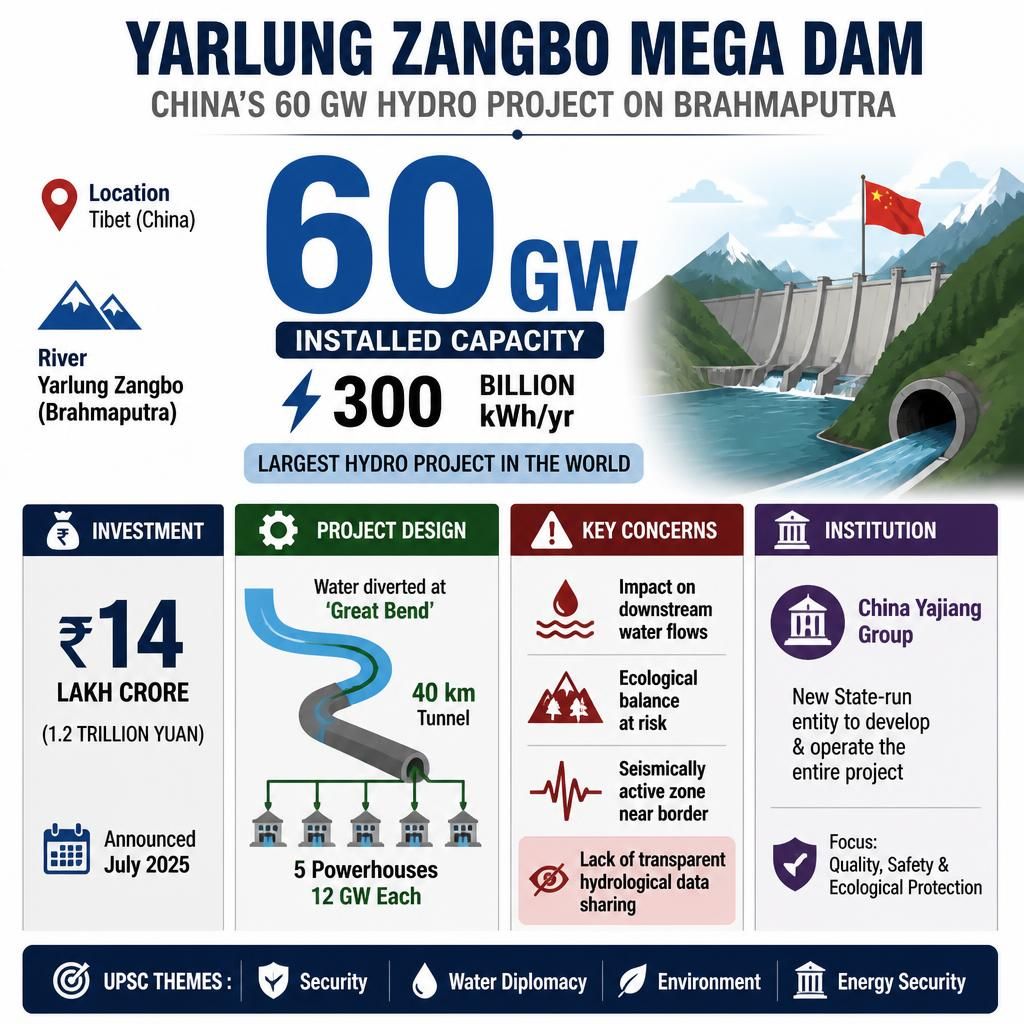
- Premier Li Qiang announced the project's commencement in July 2025, with an estimated investment of 1.2 trillion Yuan (approximately ₹14 lakh crore).
- India has raised concerns regarding the dam's potential impact on downstream water flows, ecological balance, and the lack of transparent hydrological data sharing.
- The proposed mega dam is projected to have an installed capacity of 60 GW, generating 300 billion kilowatt-hours annually, significantly exceeding the Three Gorges Dam.
Mega Dam.jpg
Detailed Insights:
- The dam is situated in a seismically active zone near the India-China border, raising environmental and safety concerns.
- China's Vice Premier Zhang Guoqing emphasized quality, safety, and ecological protection during his inspection of the project site in Nyingchi.
- The China Yajiang Group, a new State-run entity, has been established to oversee the entire project's development and operation.
- The project design involves diverting water at the "great bend" of the Yarlung Zangbo into a 40-km tunnel to power five 12-GW powerhouses.
- China already operates the Zangmu dam on the middle reaches of the Yarlung Zangbo, which contributes significantly to Tibet's electricity supply.
- India and China are scheduled to convene a meeting of the Expert-Level Mechanism on Trans-border Rivers to discuss water-related issues.
- China's Foreign Ministry maintains that the project will aid disaster prevention and mitigation without adverse effects on downstream regions.
Key Concepts Involved:
- Transboundary Rivers: Rivers that flow through or form a border between two or more countries, necessitating international cooperation for management.
- Run-of-the-river Dam: A hydroelectric project that utilizes the natural flow and elevation drop of a river to generate power, typically with limited water storage.
- Five-Year Plan: A comprehensive national economic and social development blueprint implemented by the Chinese government for a five-year period.
- Hydropower Project: An infrastructure development designed to generate electricity by converting the kinetic energy of flowing or falling water into electrical energy.

SuperKalam is your personal mentor for UPSC preparation, guiding you at every step of the exam journey.
Download the App


STUDY RESOURCES
CONTACT US
ⓒ Snapstack Technologies Private Limited