GS 1: Physical GeographyGS 2: International RelationsGS 3: EconomyPrelimsGS 2: Bilateral, Regional and Global Groupings and Agreements
New Hormuz route agreed, to be managed jointly with Oman: Iran, Pg14
Iran and Oman agree on new Strait of Hormuz shipping route, jointly managing the strategic global energy passage amidst US threats.
Practice MCQs
819 Students attempted
Key Highlights:
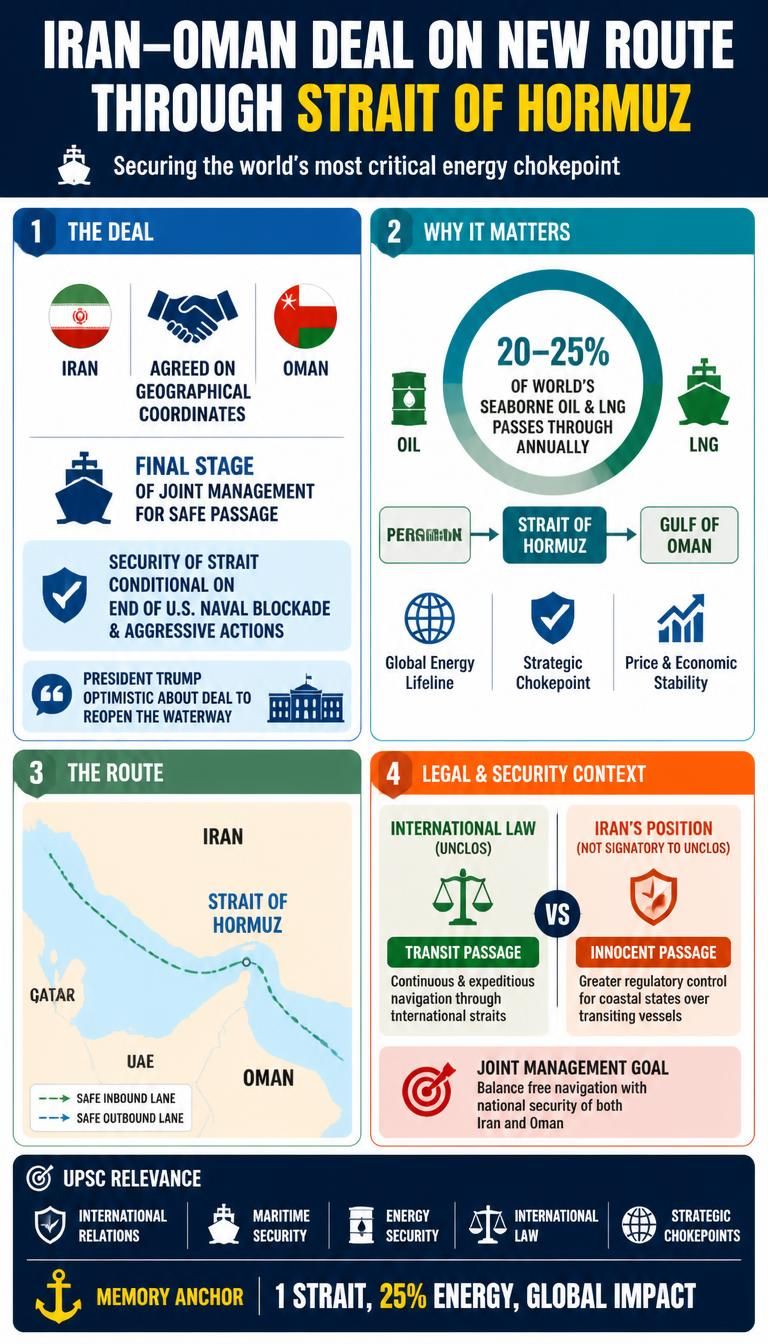
- Iran and Oman have reached an agreement on the geographical coordinates for a new shipping route through the Strait of Hormuz.
- Both nations are in the final stages of arranging joint management for the passage.
- Iran's Foreign Ministry indicated that the security of the strait is conditional on the cessation of the U.S. "naval blockade" and other "aggressive and threatening actions" against Iran.
- U.S. President Donald Trump (in the context of the article) expressed optimism about a potential deal to reopen the critical waterway.
Iran-Oman.jpg
Detailed Insights:
- The Strait of Hormuz is a crucial maritime chokepoint connecting the Persian Gulf to the Gulf of Oman, essential for global energy supply chains.
- Approximately 20-25% of the world's seaborne oil and liquefied natural gas (LNG) passes through this narrow strait annually.
- The proposed joint management by Iran and Oman aims to establish safe inbound and outbound shipping lanes, while addressing the national security concerns of both bordering states.
- International maritime law, particularly the United Nations Convention on the Law of the Sea (UNCLOS), generally provides for transit passage through such international straits, ensuring continuous and expeditious navigation.
- Iran, however, has not ratified UNCLOS and asserts that the strait falls under the regime of innocent passage, which grants coastal states greater regulatory control over transiting vessels.
- The implementation of the Iran-Oman agreement is stated to be contingent on the non-obstruction by "certain third parties," implicitly referring to the United States.
- The U.S. (as per the article's context) has maintained a naval presence and economic sanctions, which Iran perceives as destabilizing factors in the region.
Key Concepts Involved:
- Strait of Hormuz: A narrow, strategically vital waterway between the Persian Gulf and the Gulf of Oman, critical for global oil and gas shipments.
- United Nations Convention on the Law of the Sea (UNCLOS): An international treaty that establishes a comprehensive legal framework governing all ocean space, including navigation rights through international straits.
- Transit Passage: A right under UNCLOS allowing ships and aircraft to pass through international straits continuously and expeditiously, which cannot be suspended by coastal states.
- Innocent Passage: A right under international law permitting vessels to pass through a coastal state's territorial waters, provided the passage is not detrimental to the peace, good order, or security of that state.
Previous18/18

SuperKalam is your personal mentor for UPSC preparation, guiding you at every step of the exam journey.
Download the App


STUDY RESOURCES
CONTACT US
ⓒ Snapstack Technologies Private Limited