GS 2: GovernanceGS 2: PolityPrelimsGS 2: Indian Constitutional Evolution, Features, Amendments, Basic Structure DoctrineGS 2: Parliament and State Legislatures
Money Bill route pending before SC, Govt chooses it to raise strength of judges, Pg1
Government uses controversial Money Bill route to increase Supreme Court judge strength, sparking constitutional challenge pending before a larger bench.
Practice MCQs
819 Students attempted
Key Highlights:
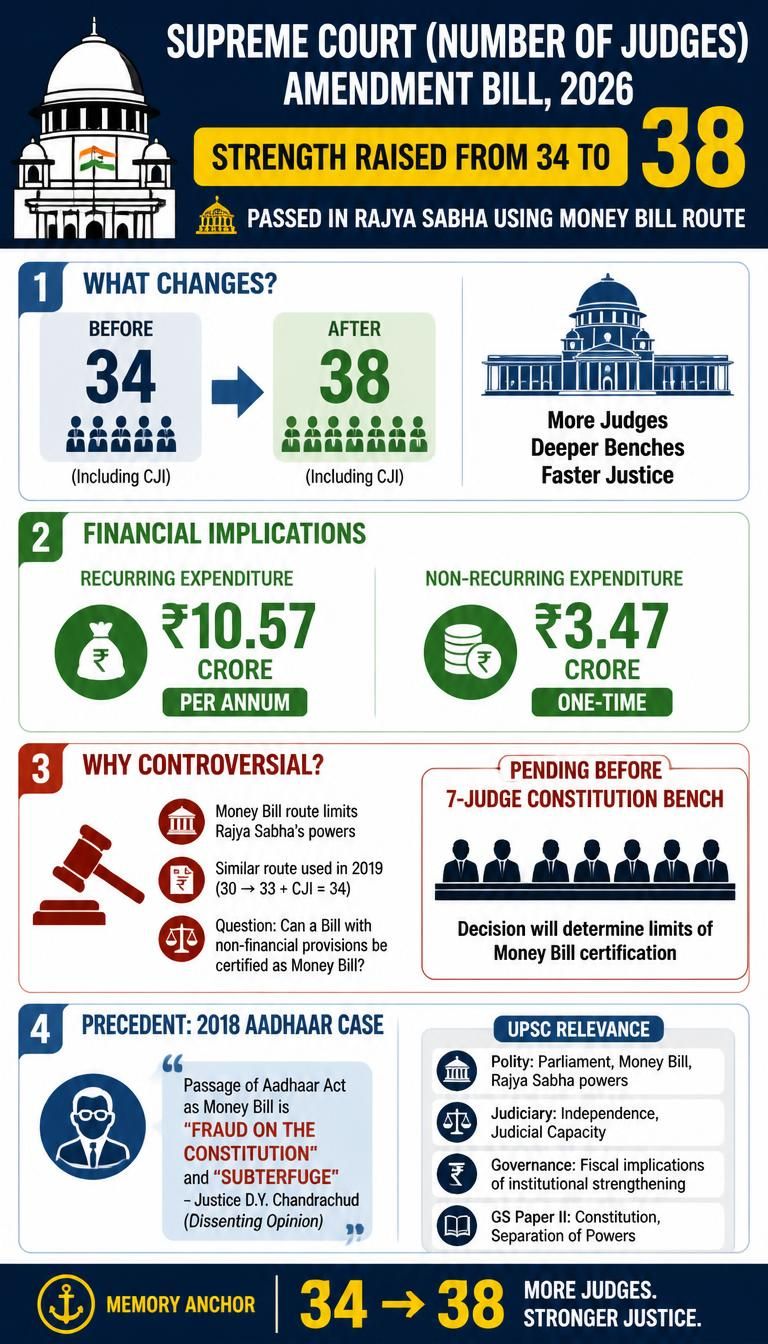
- The Rajya Sabha passed the Supreme Court (Number of Judges) Amendment Bill, 2026, which aims to increase the sanctioned strength of Supreme Court judges from 34 to 38, including the Chief Justice of India.
- The Bill was passed using the Money Bill route, a method also employed in 2019 when the Supreme Court's strength was previously raised to 34.
- The Statement of Objects and Reasons for the Bill cites an estimated recurring expenditure of approximately rupees 10.57 crore per annum and non-recurring expenditure of rupees 3.47 crore for the additional judges and associated costs.
- The constitutionality of using the Money Bill route for certain legislations is currently pending before a seven-judge Constitution bench of the Supreme Court.
SC judges.jpg
Detailed Insights:
- The use of the Money Bill route for the Supreme Court (Number of Judges) Amendment Bill, 2026 has drawn scrutiny, as it limits the powers of the Rajya Sabha in amending or rejecting the Bill.
- A similar amendment in 2019, the Supreme Court (Number of Judges) Amendment Bill, 2019, also utilized the Money Bill route to increase the strength from 30 to 33 judges, plus the Chief Justice of India, totaling 34.
- The Supreme Court's seven-judge Constitution bench is yet to rule on the broader question of whether a Bill can be certified as a Money Bill if it contains provisions beyond those exclusively financial.
- Justice D.Y. Chandrachud, in his dissenting opinion on the 2018 Aadhaar ruling, had criticized the passage of the Aadhaar Act as a Money Bill, terming it a "fraud on the Constitution" and "subterfuge".
- The validity of the Money Bill route has also been challenged in cases concerning amendments to the Prevention of Money Laundering Act (PMLA) and the 2017 amendments altering service conditions of Tribunals.
- The government often justifies the Money Bill classification by citing expenditure from the Consolidated Fund of India.
Key Concepts Involved:
- Money Bill: A Bill defined under Article 110 of the Indian Constitution that exclusively deals with financial matters such as taxation, government expenditure, and the Consolidated Fund of India.
- Article 110: A constitutional provision that defines what constitutes a Money Bill and states that the decision of the Speaker of the Lok Sabha on whether a Bill is a Money Bill is final.
- Consolidated Fund of India: The primary government account where all revenues are credited and from which all authorized government expenditures are made.
- Lok Sabha Speaker: The presiding officer of the Lok Sabha who holds the final authority to certify a Bill as a Money Bill.

SuperKalam is your personal mentor for UPSC preparation, guiding you at every step of the exam journey.
Download the App


STUDY RESOURCES
CONTACT US
ⓒ Snapstack Technologies Private Limited