GS 2: GovernanceGS 3: Science & TechnologyGS 2: Social JusticePrelimsGS 2: Government policies and interventions for development in various sectors
India’s cancer focus must shift to early detection, Pg7
India's cancer strategy needs a fundamental shift towards early detection and prevention, leveraging technology and policy to combat rising cases and catastrophic healthcare costs.
Practice MCQs
819 Students attempted
Key Highlights:
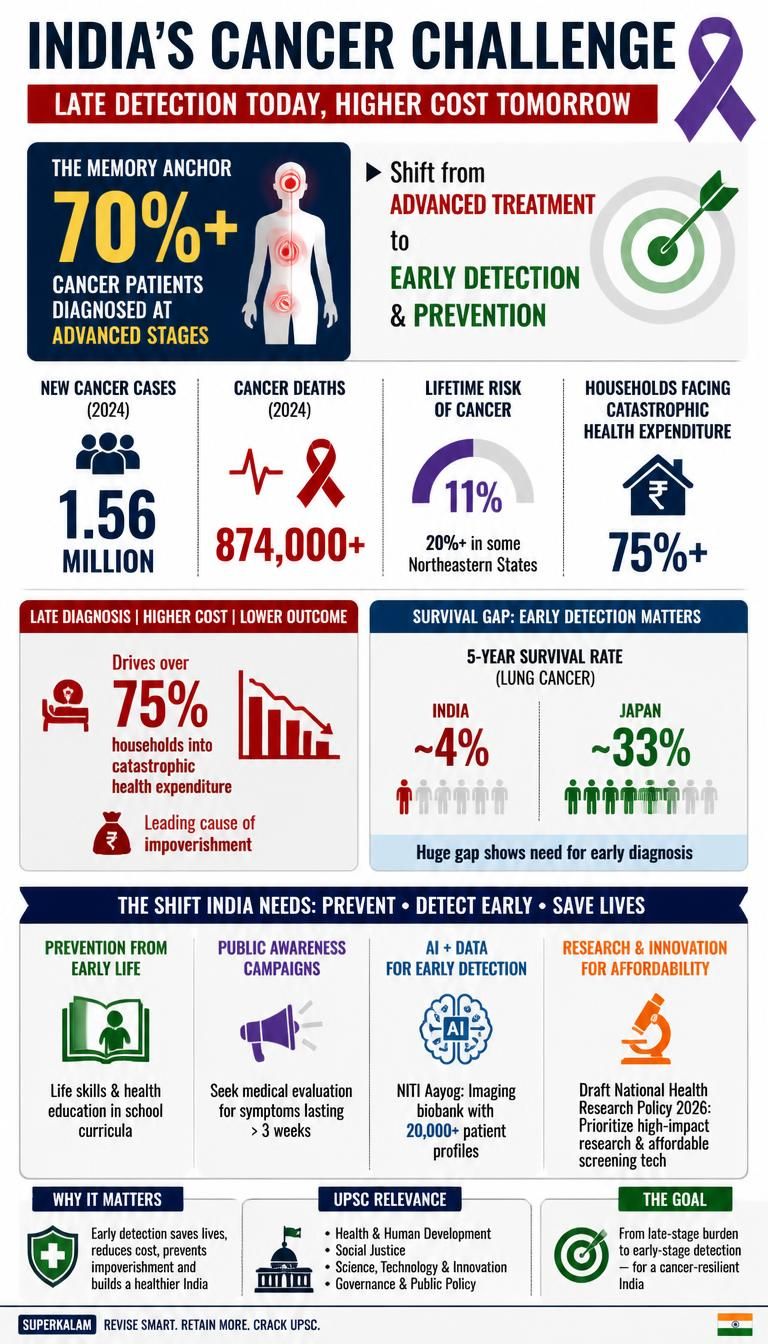
- Over 70% of cancer patients in India are diagnosed at advanced stages, leading to complex, expensive, and less effective treatment.
- India recorded an estimated 1.56 million new cancer cases and over 874,000 cancer deaths in 2024.
- The lifetime risk of developing cancer in India is approximately 11%, exceeding 20% in some northeastern states.
- A fundamental shift towards early detection and prevention, rather than just advanced treatment, is crucial to address the rising cancer burden.
- NITI Aayog is supporting the development of a large imaging biobank with over 20,000 cancer patient profiles to accelerate AI tool development.
- The Draft National Health Research Policy 2026 aims to prioritize research with measurable impact and encourage innovation in affordable screening technologies.
Cancer.jpg
Detailed Insights:
- Late cancer diagnosis contributes to catastrophic healthcare expenditure for over three-quarters of affected households, driving poverty.
- India's five-year survival rate for lung cancer is about 4%, significantly lower than Japan's nearly 33%, indicating a gap in early diagnosis.
- Prevention should be a lifelong public health priority, with health education on life skills integrated into school curricula from an early age.
- Public awareness campaigns are needed to educate people about seeking medical evaluation for persistent symptoms lasting over three weeks.
- Multi-Cancer Early Detection (MCED) tests, which detect biological signals from multiple malignancies through a single blood sample, show promising potential for early screening.
- India requires a layered screening model combining community health workers, digital risk assessment, AI, and mobile diagnostic services.
- The Draft National Health Research Policy 2026 signals a shift from publication-driven research to implementation science, focusing on real-world health outcomes.
- Coordinated partnerships between government agencies, medical colleges, technology companies, and community healthcare providers are essential for successful early detection strategies.
Key Concepts Involved:
- Multi-Cancer Early Detection (MCED) tests: Blood tests designed to detect signals from multiple types of cancer at early stages, often before symptoms appear.
- Implementation Science: A field of research that studies methods to promote the integration of research findings and evidence-based practices into routine health care.
- Imaging Biobank: A comprehensive repository of medical images, often combined with clinical data, used for research, AI development, and training healthcare professionals.

SuperKalam is your personal mentor for UPSC preparation, guiding you at every step of the exam journey.
Download the App


STUDY RESOURCES
CONTACT US
ⓒ Snapstack Technologies Private Limited