GS 2: International RelationsGS 3: Environment & EcologyPrelimsGS 3: Infrastructure: Energy, Ports, Roads, Airports, Railways etc.GS 3: Conservation, Pollution and Degradation
Look Beyond Old Climate Fault Lines, Pg12
India resists global '35 by 2035' electrification target at COP31, prioritizing national sovereignty and poverty eradication while seeking Global South climate leadership.
Practice MCQs
833 Students attempted
Key Highlights:
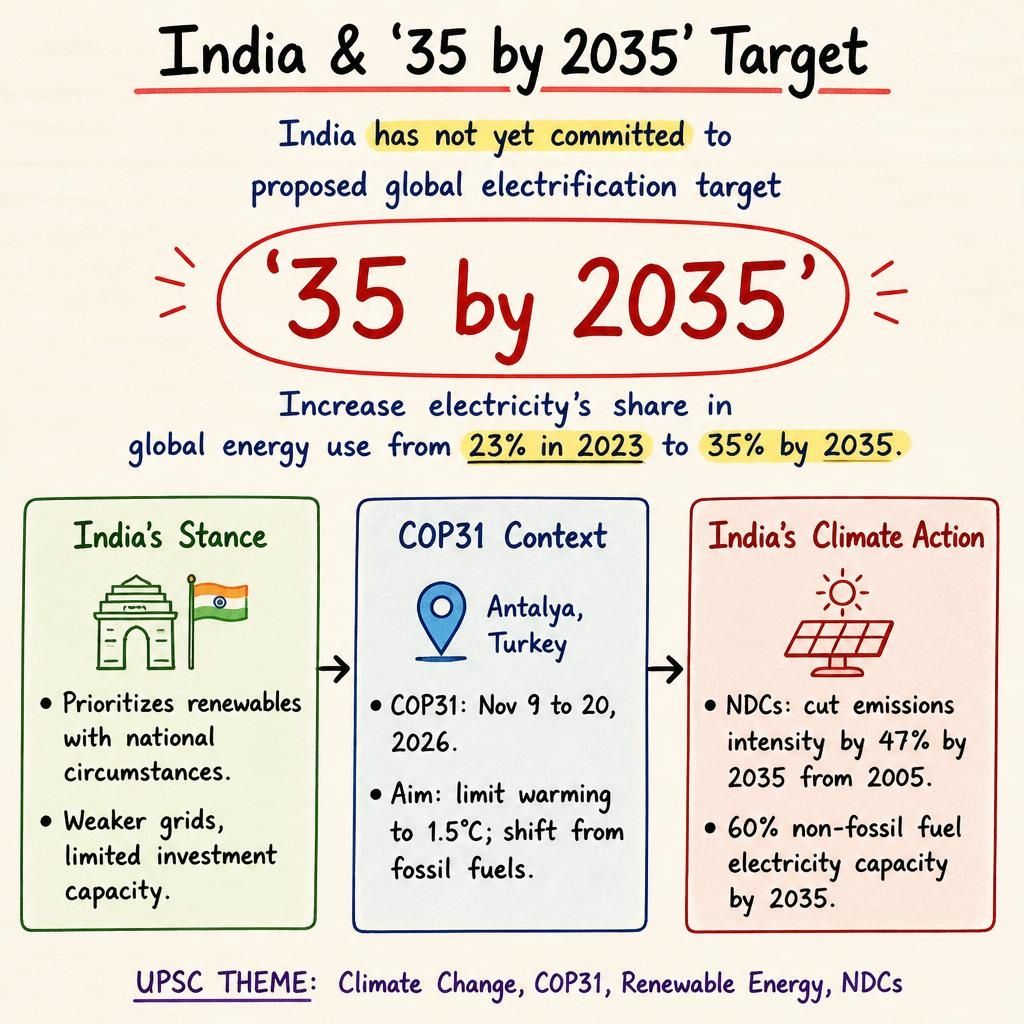
- India's Environment Minister stated that India has not yet committed to the proposed global "35 by 2035" electrification target ahead of COP31 in Antalya, Turkey.
- The "35 by 2035" target, proposed by COP31 co-presidencies Turkey and Australia, aims to increase electricity's share in global energy use from 23% in 2023 to 35% by 2035.
- India prioritizes renewables and emphasizes national circumstances, citing weaker grids and limited investment capacity in developing countries.
- India has made steady progress on its Paris Agreement commitments, but faces criticism for not setting sufficiently ambitious targets.
- India aims to leverage its leadership in institutions like the International Solar Alliance (ISA) and the Coalition for Disaster-Resilient Infrastructure (CDRI) for climate action.
35 by 2035 Target.jpg
Detailed Insights:
- COP31 is scheduled to take place in Antalya, Turkey, from November 9 to 20, 2026, focusing on accelerating climate action implementation.
- The proposed electrification target is considered vital for limiting global warming to 1.5°C by transitioning away from fossil fuels across various sectors.
- India's stance reflects the challenges faced by developing nations, including financially stressed utilities and the need for poverty eradication programs.
- Critiques against India's climate ambition often overlook the Global North's historical emissions and its failure to meet financial and technology transfer commitments.
- India's updated Nationally Determined Contributions (NDCs) include reducing emissions intensity by 47% by 2035 from 2005 levels and achieving 60% non-fossil fuel electricity capacity by 2035.
- India's climate action is also driven by its developmental and strategic interests, positioning it as a leader of the Global South.
Key Concepts Involved:
- COP (Conference of the Parties): The supreme decision-making body of the United Nations Framework Convention on Climate Change (UNFCCC), meeting annually to assess climate change progress.
- Paris Agreement: A legally binding international treaty on climate change adopted in 2015, aiming to limit global warming to well below 2, preferably to 1.5 degrees Celsius.
- International Solar Alliance (ISA): An India-led intergovernmental organization promoting solar energy deployment, launched in 2015 by India and France.
- Coalition for Disaster-Resilient Infrastructure (CDRI): An India-led global partnership launched in 2019 to promote the resilience of infrastructure systems against climate and disaster risks.
- Global North/Global South: Terms used to describe the socio-economic and political division between developed (North) and developing (South) countries, often relevant in climate justice discussions.

SuperKalam is your personal mentor for UPSC preparation, guiding you at every step of the exam journey.
Download the App


STUDY RESOURCES
CONTACT US
ⓒ Snapstack Technologies Private Limited