GS 2: Social JusticeGS 2: GovernanceGS 3: Science & TechnologyPrelimsGS2: Government policies and interventions for development in various sectors
Why India doesn’t screen for its deadliest cancer, Pg13
India lacks a national lung cancer screening program despite it being the deadliest cancer, leading to late diagnoses and high mortality rates.
Practice MCQs
826 Students attempted
Key Highlights:
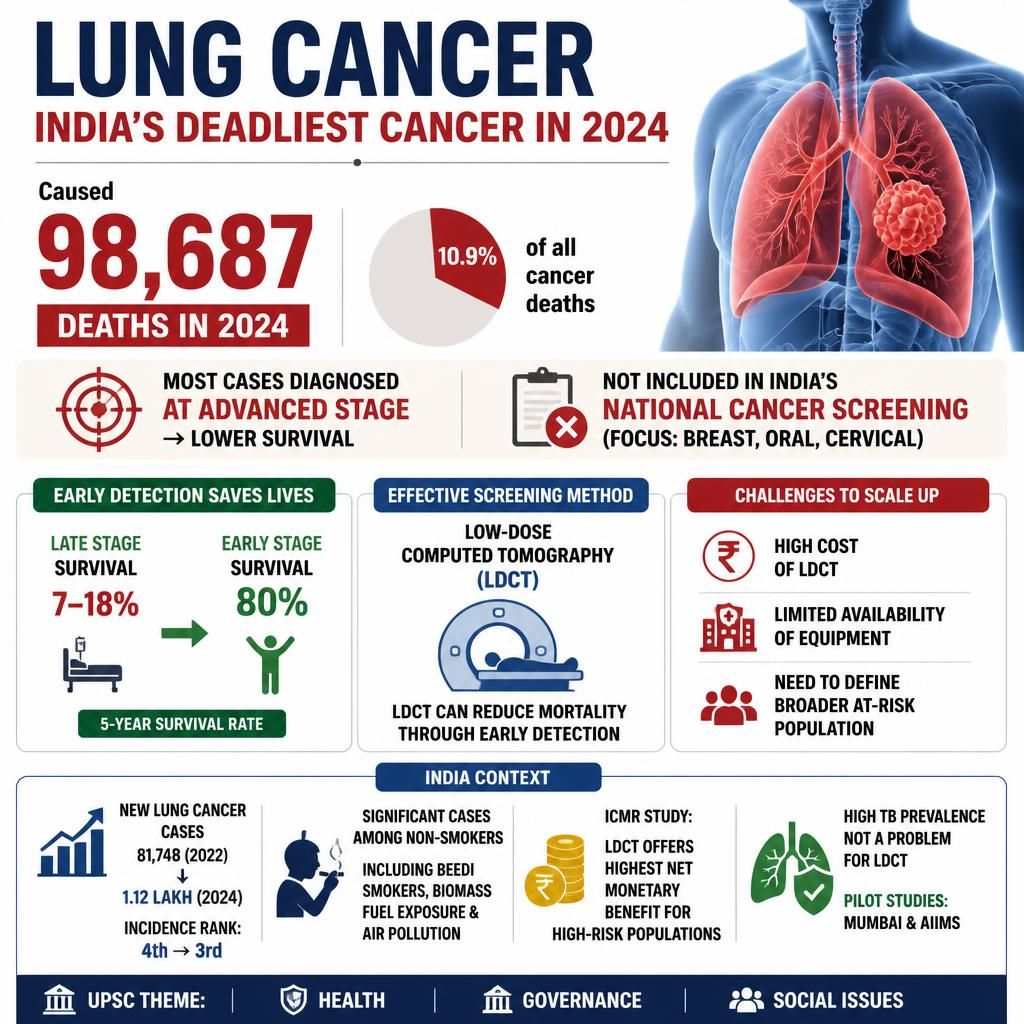
- Lung cancer became India's deadliest cancer in 2024, causing 10.9% of all cancer deaths, totaling 98,687 fatalities.
- Most lung cancer cases in India are diagnosed in advanced stages, leading to significantly lower survival rates.
- India's national cancer screening programs currently do not include lung cancer, focusing instead on breast, oral, and cervical cancers.
- Low-Dose Computed Tomography (LDCT) is identified as an effective screening method that can reduce mortality through early detection.
- Challenges to implementing widespread lung cancer screening include the high cost of LDCT, limited availability of equipment, and the need to define a broader at-risk population beyond traditional smokers.
Lung Cancer.jpg
Detailed Insights:
- New lung cancer cases increased from 81,748 in 2022 to 1.12 lakh in 2024, moving it from fourth to third in incidence.
- Data from the Global Cancer Observatory, maintained by the International Agency for Research on Cancer (IARC), highlights this rising mortality.
- Early detection can boost the five-year survival rate for lung cancer from 7-18% (late stage) to 80% (early stage).
- An Indian Council of Medical Research (ICMR) study suggested that despite higher initial costs, LDCT offers the highest net monetary benefit for screening high-risk populations.
- Unlike Western populations, a significant proportion of lung cancer in India occurs among non-smokers, including beedi smokers and those exposed to biomass fuel and air pollution.
- Pilot studies from Mumbai and by AIIMS doctors indicate that India's high prevalence of Tuberculosis (TB) does not pose a problem for LDCT screening.
- The Indian Lung Screening Trial is generating local evidence for LDCT screening, while AIRCARE (Air Pollution and Cancer Research Ecosystem) studies environmental contributions to lung cancer risk.
Key Concepts Involved:
- Low-Dose Computed Tomography (LDCT): A specialized CT scan using minimal radiation to detect lung abnormalities, crucial for early cancer screening.
- Global Cancer Observatory: An online platform by the World Health Organization (WHO) providing global cancer statistics and estimates.
- International Agency for Research on Cancer (IARC): The specialized cancer agency of the WHO, conducting and coordinating research on cancer causes and prevention.
- Indian Council of Medical Research (ICMR): India's apex body for the formulation, coordination, and promotion of biomedical research.

SuperKalam is your personal mentor for UPSC preparation, guiding you at every step of the exam journey.
Download the App


STUDY RESOURCES
CONTACT US
ⓒ Snapstack Technologies Private Limited