GS 3: EconomyPrelimsGS2: Statutory, Regulatory and Quasi Judicial BodiesGS2: Effect of Policies and Politics of Developed and Developing Countries on India's InterestsGS3: Indian Economy, Planning, Mobilization of Resources, Growth, Development and Employment
RBI may hike rates: Why inflation, crude & global rates are forcing its hand, Pg15
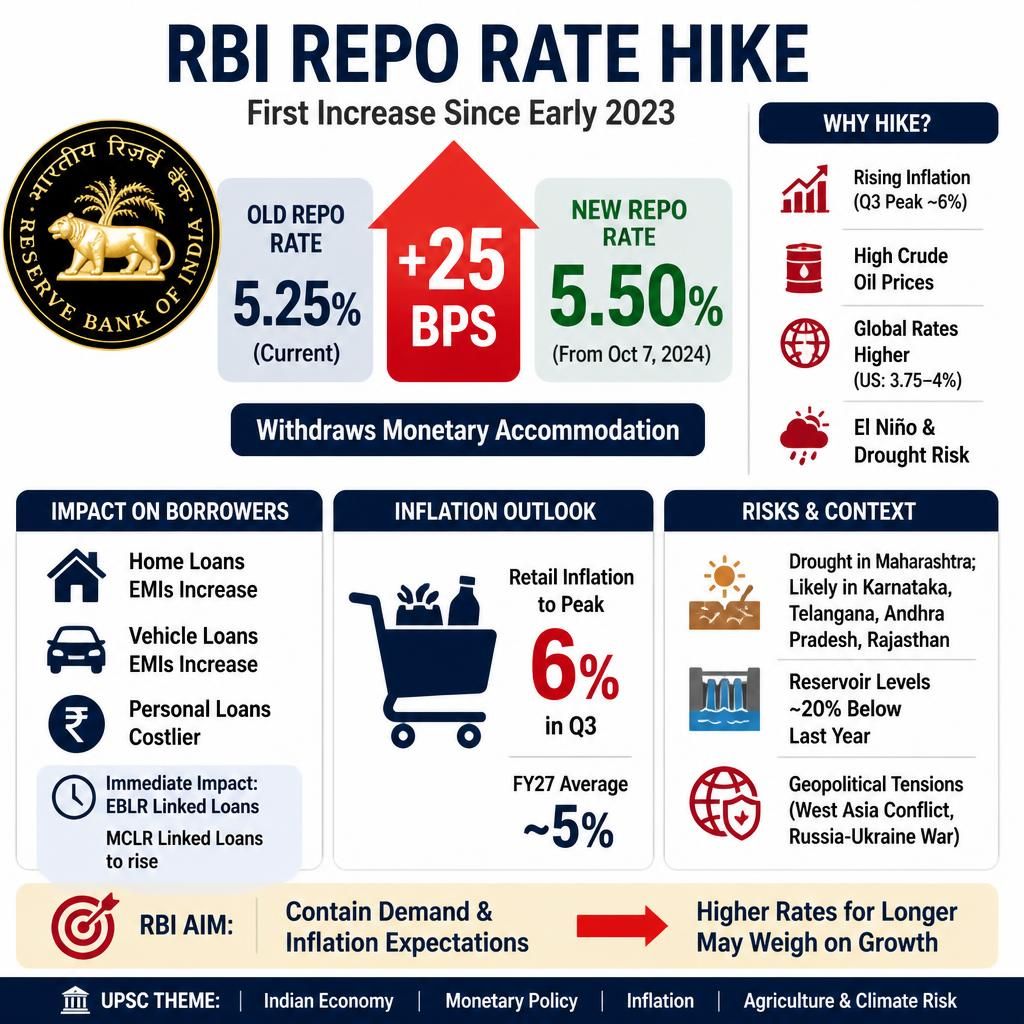
RBI poised to hike repo rate by 25 bps to 5.50% amid surging domestic inflation, global crude prices, and US Fed tightening, impacting borrowing costs.
Practice MCQs
826 Students attempted
Key Highlights:
- The Reserve Bank of India (RBI) is expected to begin withdrawing monetary accommodation by hiking the policy repo rate.
- The Monetary Policy Committee (MPC) is likely to raise the repo rate by 25 basis points (bps) to 5.50% at its October 7 meeting.
- This move is driven by rising domestic inflation, higher global interest rates, elevated crude oil prices, and El Niño related disruptions.
- Retail inflation is projected to peak at 6% in the third quarter and average around 5% in FY27.
Repo Rate Hike.jpg
Detailed Insights:
- The anticipated rate hike would be the first since early 2023, following nearly two years of accommodative monetary policy.
- Increased repo rate will lead to higher borrowing costs, impacting interest rates on personal, home, and vehicle loans.
- The US Federal Reserve recently raised its policy rate to 3.75-4%, influencing global financial conditions.
- Domestic retail inflation is becoming broad-based, fueled by elevated energy and food prices.
- Drought conditions have been declared in Maharashtra, with potential for other states like Karnataka, Telangana, Andhra Pradesh, and Rajasthan.
- Lower reservoir levels, about 20% below last year, pose a risk to the upcoming rabi crop.
- Geopolitical tensions, including the West Asia conflict and Russia-Ukraine war, contribute to economic uncertainty and higher crude oil prices.
- Loans linked to External Benchmark Linked Lending Rate (EBLR) will see immediate impact, while Marginal Cost of Funds Based Lending Rate (MCLR) linked loans will also likely rise.
- The RBI aims to contain demand and inflation expectations, but sustained high borrowing costs could affect consumption and investment.
Key Concepts Involved:
- Repo Rate: The rate at which the RBI lends money to commercial banks.
- Monetary Policy Committee (MPC): A body responsible for fixing the benchmark interest rate in India.
- Inflation: The rate at which the general level of prices for goods and services is rising, and subsequently, purchasing power is falling.
- Basis Points (bps): A common unit of measure for interest rates and other financial percentages, equal to one-hundredth of a percentage point.
- El Niño: A climate pattern describing unusual warming of surface waters in the eastern tropical Pacific Ocean, often leading to droughts in India.
- External Benchmark Linked Lending Rate (EBLR): Lending rates directly linked to an external benchmark like the repo rate.
- Marginal Cost of Funds Based Lending Rate (MCLR): The minimum interest rate that a bank can charge for a particular loan, based on its marginal cost of funds.
Previous11/11

SuperKalam is your personal mentor for UPSC preparation, guiding you at every step of the exam journey.
Download the App


STUDY RESOURCES
CONTACT US
ⓒ Snapstack Technologies Private Limited