GS 3: EconomyGS 2: GovernancePrelimsGS2: Effect of Policies and Politics of Developed and Developing Countries on India's InterestsGS3: Indian Economy, Planning, Mobilization of Resources, Growth, Development and Employment
Global capital is no longer cheap, that's the challenge, Pg10
Global capital costs surge as US, French, Japanese bond yields hit multi-decade highs, driven by fiscal deficits, inflation, and AI infrastructure demand, challenging India.
Practice MCQs
826 Students attempted
Key Highlights:
- Global government bond yields, including those for the US, France, and Japan, have surged to multi-decade highs, indicating a significant increase in borrowing costs.
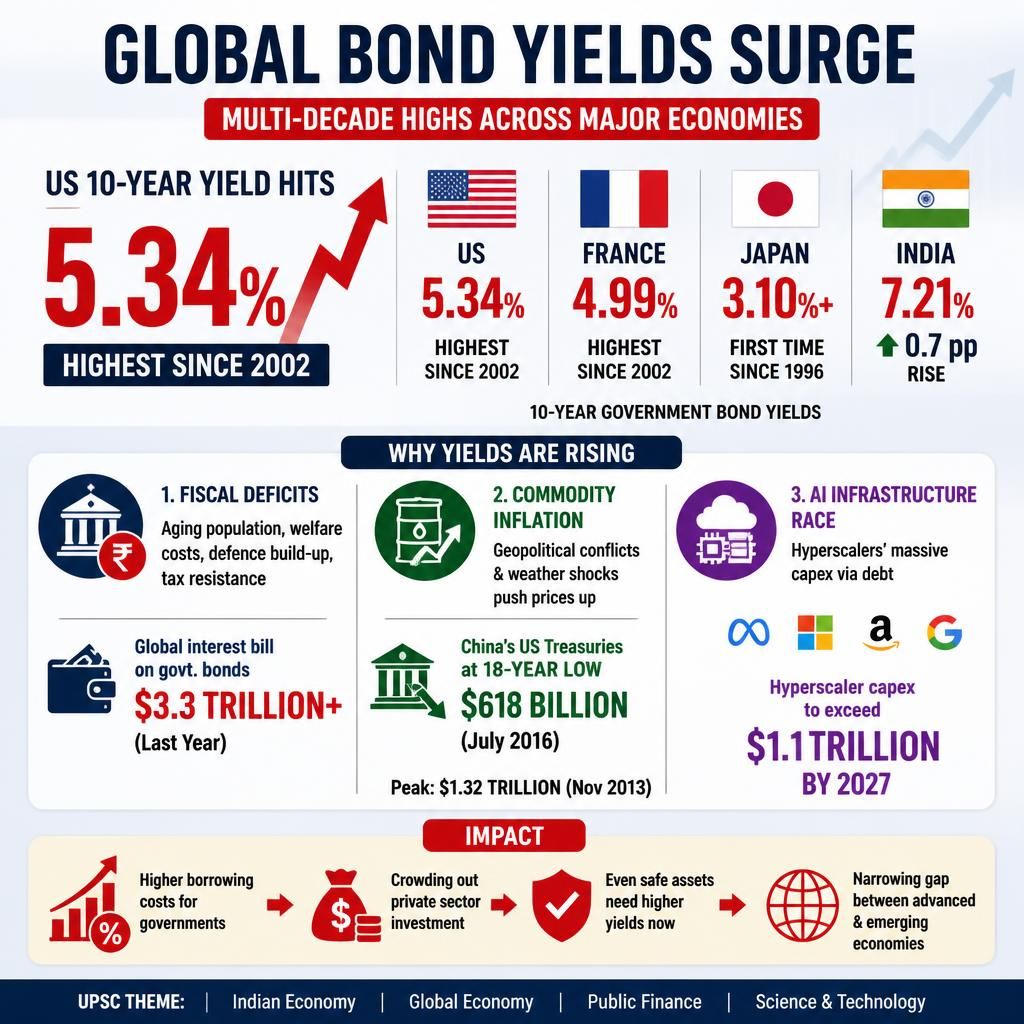
- The 10-year US bond yield reached 5.34%, its highest since 2002, while France's hit 4.99% (highest since 2002) and Japan's crossed 3.1% (first time since 1996).
- India's 10-year government security yield rose by 0.7 percentage points to 7.21%, a smaller increase compared to developed economies.
- Three primary factors are driving this trend: persistent fiscal deficits in developed nations, commodity inflation, and the global race for Artificial Intelligence (AI) infrastructure.
- The US national debt has surpassed $40 trillion, with its defense budget request for FY2026 at $961 billion and a proposed $1.5 trillion for FY2027.
- Major tech companies (hyperscalers) are projected to spend over $1.1 trillion on capital expenditure by 2027, largely funded by debt, intensifying competition for investor capital.
Bond Yield Surge.jpg
Detailed Insights:
- Investors are demanding higher returns on government debt instruments, reflecting a reduced differentiation between advanced and emerging economies.
- Developed countries face mounting fiscal risks due to aging populations, expanded social welfare, military build-ups, and resistance to tax increases.
- The Institute of International Finance estimated that advanced economies paid over $3.3 trillion in interest on globally traded government bonds last year.
- China's holdings of US Treasuries fell to an 18-year low of $618 billion in July 2026, down from a peak of $1.32 trillion in November 2013, indicating reduced confidence.
- Commodity inflation, exacerbated by geopolitical conflicts and weather-induced supply shocks, has prompted central banks to raise interest rates.
- The massive capital expenditure by hyperscalers like Meta, Microsoft, Amazon, and Google for AI infrastructure is creating significant demand for debt.
- This competition from tech giants forces governments to offer higher yields to attract investors, even for traditionally safe assets like long-term US Treasuries.
- For India, the implications include the end of cheap global capital and an increased emphasis on fiscal discipline to avoid crowding out private sector borrowings.
Key Concepts Involved:
- Government Bond Yields: The return an investor receives on a government bond, reflecting interest payments relative to its price and influenced by market conditions.
- Fiscal Deficit: The difference between a government's total expenditure and its total revenue (excluding borrowings) in a given fiscal year.
- Crowding Out: An economic phenomenon where increased government borrowing and spending reduce private investment by increasing interest rates and competing for available capital.
- Sovereign Debt: The total amount of money that a country's government has borrowed from both domestic and foreign creditors.

SuperKalam is your personal mentor for UPSC preparation, guiding you at every step of the exam journey.
Download the App


STUDY RESOURCES
CONTACT US
ⓒ Snapstack Technologies Private Limited