GS 2: International RelationsGS 3: Disaster ManagementGS 3: Environment & EcologyPrelimsGS 3: Disaster and Disaster Management
On Nepal Minister seeking damages, India says climate change a common challenge, Pg9
Nepal seeks climate compensation from major emitters after flash floods; India emphasizes common but differentiated responsibilities and developed nations' lead role.
Practice MCQs
819 Students attempted
Key Highlights:
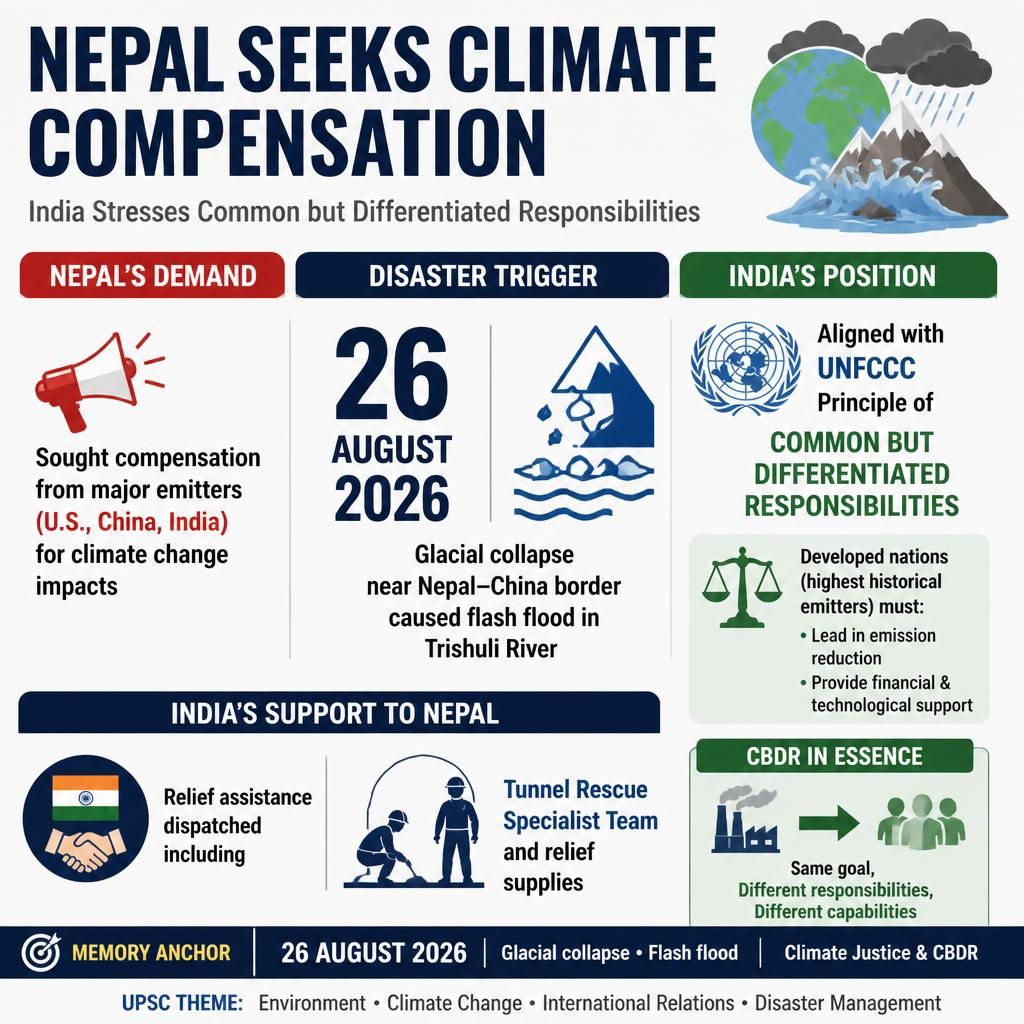
- Nepal's Foreign Minister sought compensation from major emitters, including the U.S., China, and India, for climate change impacts following a flash flood on August 26, 2026.
- India's Ministry of External Affairs spokesperson stated that climate change is a common challenge, emphasizing the principle of Common but Differentiated Responsibilities.
- India asserted that developed nations, historically the highest emitters, must lead in emission reduction and provide financial and technological support to developing countries.
- India has dispatched relief assistance, including a team of tunnel rescue specialists, to Nepal following the disaster.
Climate Compensation.jpg
Detailed Insights:
- Nepal's Foreign Minister initially framed the crisis as a matter of "justice and compensation" rather than "aid" ahead of the UN General Assembly session.
- The flash flood on August 26, 2026, was triggered by a glacial collapse near the Nepal-China border, causing significant devastation along the Trishuli River.
- India's position aligns with the United Nations Framework Convention on Climate Change (UNFCCC), advocating for developed countries to take the lead due to their historical emissions and greater capacity.
- The Common but Differentiated Responsibilities principle acknowledges that while all countries share responsibility for climate action, their obligations vary based on their contributions to climate change and their respective capabilities.
- Nepal's Foreign Minister later clarified his statements, denying explicitly seeking compensation and expressing gratitude for India's ongoing assistance.
Key Concepts Involved:
- Common but Differentiated Responsibilities (CBDR): A principle in international environmental law recognizing that all states have a shared responsibility to address global environmental degradation, but their responsibilities differ based on their historical contributions to the problem and their economic and technical capacities.
- Loss and Damage: Refers to the unavoidable negative impacts of climate change that cannot be addressed through mitigation or adaptation efforts, often requiring financial mechanisms to support vulnerable nations.
- Greenhouse Gases (GHGs): Atmospheric gases, such as carbon dioxide, methane, and nitrous oxide, that absorb and emit infrared radiation, trapping heat in the Earth's atmosphere and contributing to global warming.

SuperKalam is your personal mentor for UPSC preparation, guiding you at every step of the exam journey.
Download the App


STUDY RESOURCES
CONTACT US
ⓒ Snapstack Technologies Private Limited