GS 2: GovernanceGS 3: EconomyPrelimsGS 3: Inclusive GrowthGS 3: Indian Economy, Planning, Mobilization of Resources, Growth, Development and Employment
Jobs to inflation: The likely factors behind mistrust in GDP data, Pg11
Public mistrust in India's robust 7.8% GDP growth deepens amidst stagnant employment, declining wages, and soaring retail inflation, challenging official economic narratives.
Practice MCQs
819 Students attempted
Key Highlights:
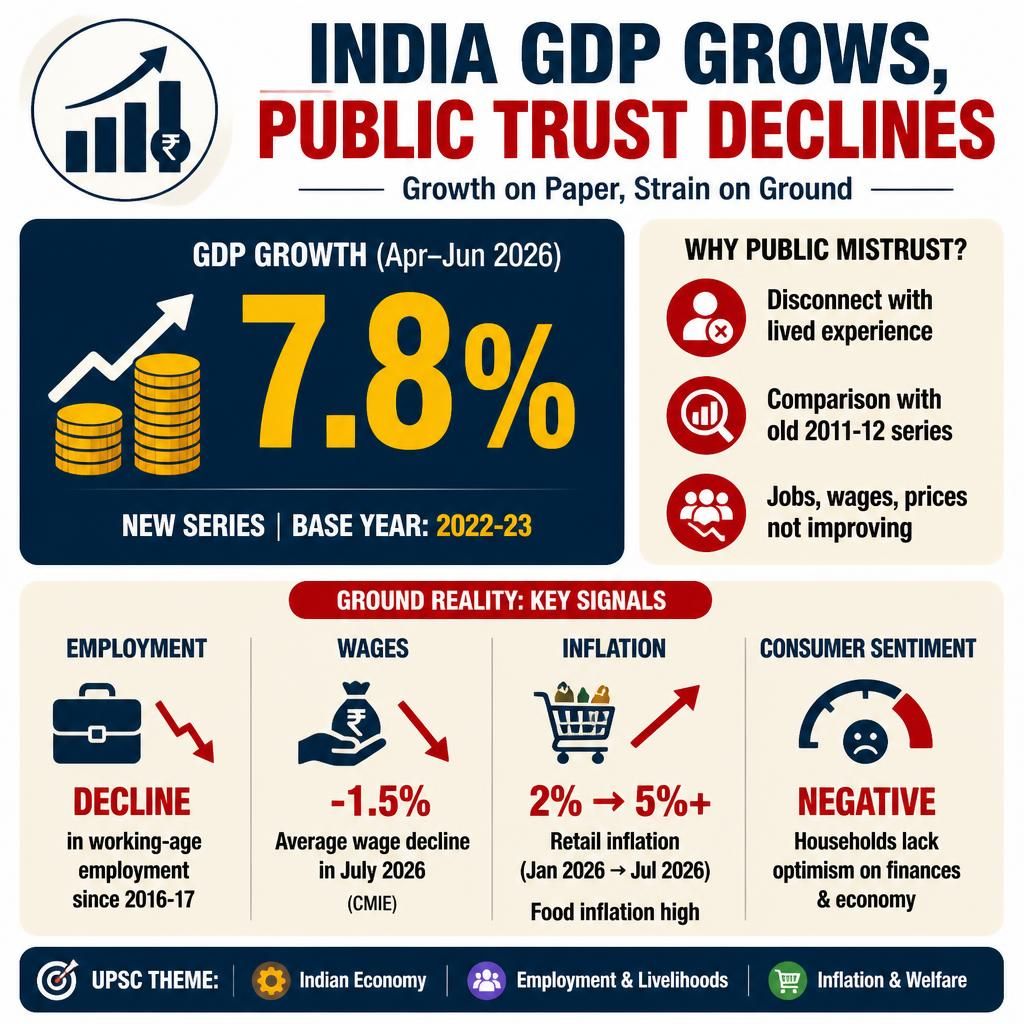
- India's Gross Domestic Product (GDP) grew by 7.8% in the April to June quarter of 2026.
- Despite this robust growth figure, a significant section of the public expresses mistrust in the official data.
- The Ministry of Statistics and Programme Implementation (MoSPI) introduced a new GDP series in February 2026, with 2022-23 as the base year.
- Public skepticism is attributed to a disconnect between official statistics and lived economic experiences, including stagnant employment and rising inflation.
India's GDP.jpg
Detailed Insights:
- The public's mistrust is partly fueled by comparisons of the new GDP series with the previously used 2011-12 base year series, which was criticized for overstating economic output.
- Employment for the working-age population (15 years and above) has declined since 2016-17, and the labor force has shrunk, indicating fewer people actively seeking jobs.
- Wage rates have been decreasing, with a Centre for Monitoring Indian Economy (CMIE) report noting a 1.5% average wage decline in July 2026.
- Retail inflation, particularly food inflation, saw a sharp increase from approximately 2% in January to over 5% in July.
- Overall consumer sentiment remains negative, reflecting a lack of optimism among households regarding their financial situation and the economy.
- Delayed monsoon in 2026 significantly hampered the Kharif sowing schedule, impacting agricultural prospects and contributing to economic stress.
Key Concepts Involved:
- Gross Domestic Product (GDP): The total monetary value of all finished goods and services produced within a country's borders in a specific time period.
- Retail Inflation: The rate at which the prices of goods and services commonly purchased by households increase over time, measured by the Consumer Price Index (CPI).
- Labour Force Participation Rate (LFPR): The percentage of the working-age population (15 years and above) that is either employed or actively seeking employment.
- Consumer Sentiment: A measure of consumers' optimism about the overall state of the economy and their personal financial situation.
- Kharif Crops: Agricultural crops sown at the beginning of the southwest monsoon season (June-July) and harvested at the end of the monsoon (September-October).
- Ministry of Statistics and Programme Implementation (MoSPI): The nodal agency responsible for the development of the statistical system in India, including the release of GDP data.
- Centre for Monitoring Indian Economy (CMIE): An independent economic think-tank and business information company that provides data and analysis on the Indian economy.

SuperKalam is your personal mentor for UPSC preparation, guiding you at every step of the exam journey.
Download the App


STUDY RESOURCES
CONTACT US
ⓒ Snapstack Technologies Private Limited