GS 2: GovernanceGS 2: PolityPrelimsGS 2: Indian Constitutional Evolution, Features, Amendments, Basic Structure DoctrineGS 2: Separation of Powers and Dispute Redressal Mechanisms
CJP cases scrapped: Supreme Court's much-debated powers under Article 142, Pg11
Supreme Court's use of expansive Article 142 powers to quash FIRs in CJP protest cases sparks renewed debate on judicial discretion and limits.
Practice MCQs
819 Students attempted
Key Highlights:
- The Supreme Court recently utilized its special powers under Article 142 of the Constitution to quash First Information Reports (FIRs) against protestors associated with the Cocherian Janta Party (CJP).
- This order was issued following an assurance from the government to the CJP members.
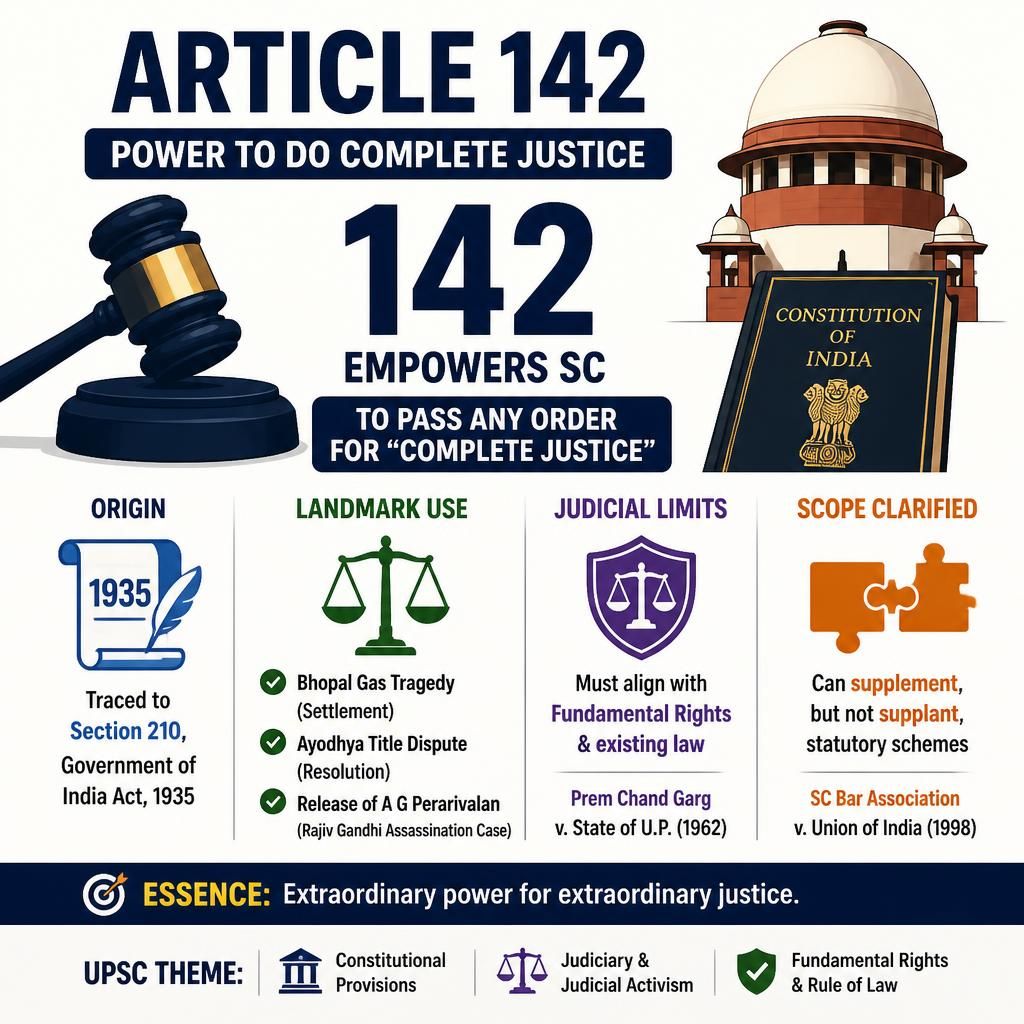
- Article 142 empowers the Supreme Court to pass any decree or order necessary for "doing complete justice" in a matter.
- The provision's origins can be traced back to Section 210 of the Government of India Act, 1935.
Article 142.jpg
Detailed Insights:
- Article 142 does not explicitly define "complete justice" or specify the conditions for its use, granting the Supreme Court broad discretion.
- In the Draft Constitution, this provision was known as Article 118 and was adopted without significant debate.
- The Supreme Court has invoked Article 142 in several landmark cases, including the settlement of the Bhopal gas tragedy and the resolution of the Ayodhya title dispute.
- It has also been used to order the release of convicts, such as A G Perarivalan in the Rajiv Gandhi assassination case.
- The Court, in Prem Chand Garg versus State of Uttar Pradesh (1962), held that orders under Article 142 must align with fundamental rights and existing law.
- In Supreme Court Bar Association versus Union of India (1998), it clarified that Article 142 can supplement, but not supplant, statutory schemes.
- The recent CJP order has drawn criticism for quashing numerous FIRs collectively, potentially circumventing the individual scrutiny required under the Bharatiya Nagrik Suraksha Sanhita.
- Vice-President Jagdeep Dhankhar and former Attorney General K K Venugopal have previously criticized the expansive use of Article 142, with Venugopal describing it as a "Kāmadhenu" and suggesting its use be restricted to Constitution benches.
Key Concepts Involved:
- Article 142 of the Indian Constitution: Grants the Supreme Court extraordinary power to pass orders necessary for "complete justice" in any case before it.
- First Information Report (FIR): A document prepared by the police when they receive information about the commission of a cognizable offense.
- Bharatiya Nagrik Suraksha Sanhita: A new criminal procedure code enacted in India, replacing the Code of Criminal Procedure, 1973.

SuperKalam is your personal mentor for UPSC preparation, guiding you at every step of the exam journey.
Download the App


STUDY RESOURCES
CONTACT US
ⓒ Snapstack Technologies Private Limited