GS 2: GovernanceGS 2: Social JusticeGS 3: EconomyPrelimsGS 3: Indian Economy, Planning, Mobilization of Resources, Growth, Development and Employment
Why must people be poor in a state rich with minerals?, Pg11
Despite immense mineral wealth, Jharkhand's mining communities remain impoverished due to poor governance, delayed auctions, and DMFT's unfulfilled promise of welfare.
Practice MCQs
811 Students attempted
Key Highlights:
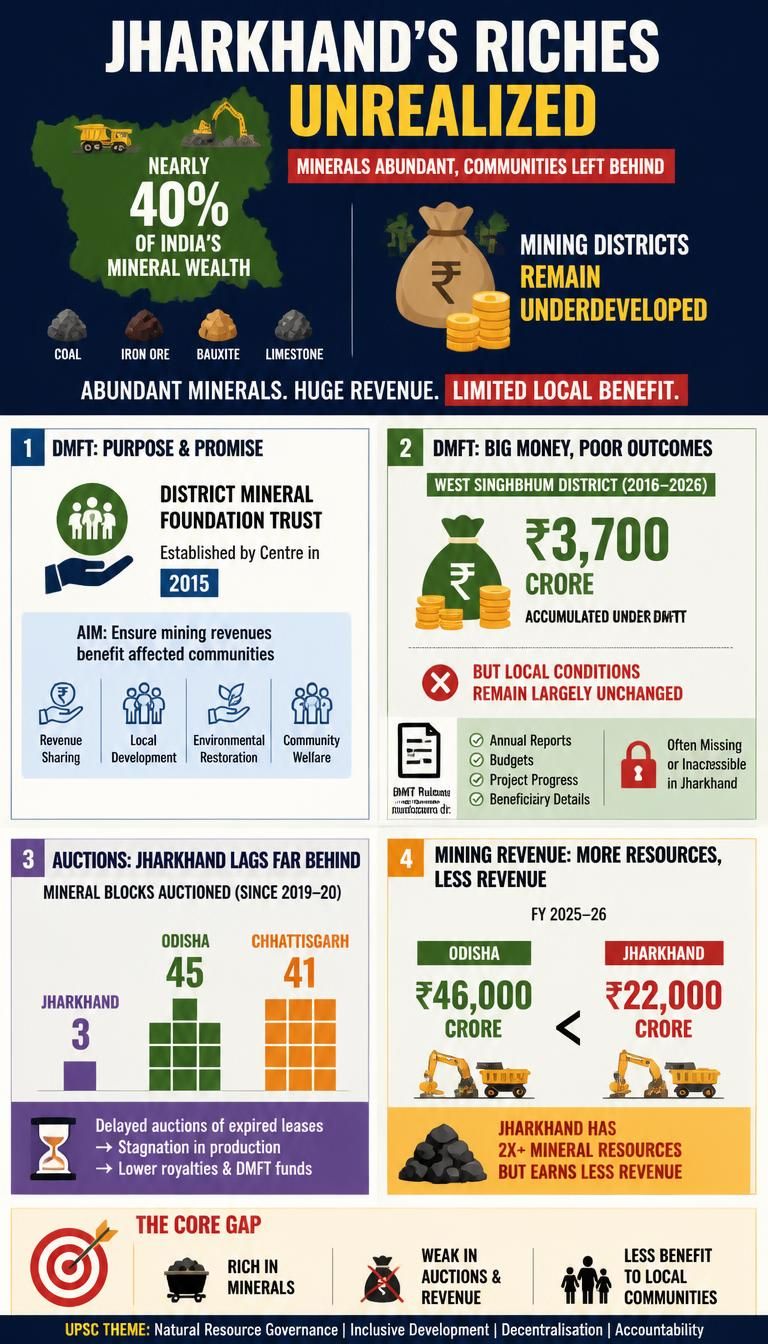
- Jharkhand possesses nearly 40% of India’s total mineral wealth, including coal, iron ore, bauxite, and limestone, yet its mining districts remain underdeveloped.
- The District Mineral Foundation Trust (DMFT) was established by the Centre in 2015 to ensure a portion of mining revenues benefits communities affected by mining.
- West Singhbhum district in Jharkhand accumulated nearly Rs 3,700 crore under its DMFT between 2016 and 2026, but the funds have not translated into improved local conditions.
- Jharkhand has auctioned only three mineral blocks since 2019-20, compared to Odisha's 45 and Chhattisgarh's 41, despite being mineral-rich.
- In 2025-26, Odisha generated approximately Rs 46,000 crore in mining revenue, while Jharkhand generated about Rs 22,000 crore, despite having more than double Odisha's mineral resources.
DMFT.jpg
Detailed Insights:
- The establishment of DMFT aimed to address the imbalance where mining-affected communities bear significant social and environmental costs but receive minimal benefits.
- DMFT Rules require public disclosure of annual reports, budgets, project progress, and beneficiary details, which are often missing or inaccessible in Jharkhand.
- Delayed auctions of expired mining leases in Jharkhand have led to stagnation in mineral production and reduced royalty collections.
- This stagnation directly impacts DMFT contributions, thereby limiting resources available for development in mining-affected villages.
- The contrast with Odisha highlights governance issues, as Odisha's timely auctions and efficient management have led to increased production and revenue.
- The lack of effective management of existing resources in Jharkhand raises concerns about the state's ability to handle new industrial plans or investments.
- The failure of DMFT in Jharkhand is primarily administrative, not financial, indicating a breakdown in implementation and accountability.
Key Concepts Involved:
- District Mineral Foundation Trust (DMFT): A non-profit trust established in mining districts to work for the welfare and benefit of persons and areas affected by mining operations.
- Mining Lease: A legal agreement granting a party the exclusive right to explore for, extract, and remove minerals from a specific area for a defined period, in exchange for rent or royalties.
- Royalty: A statutory payment made by a mining lease holder to the government (the sovereign owner of mineral resources) for the right to extract minerals, typically based on the quantity or value of minerals produced.

SuperKalam is your personal mentor for UPSC preparation, guiding you at every step of the exam journey.
Download the App


STUDY RESOURCES
CONTACT US
ⓒ Snapstack Technologies Private Limited