GS 2: GovernanceGS 2: PolityGS 3: Internal SecurityGS 3: EconomyPrelims
SC directs Centre to frame SOPs to curb ‘digital arrest’ scams, Pg1
Supreme Court directs Centre, RBI, States to frame SOPs and operationalize mechanisms to curb 'digital arrest' scams and restore victims' monetary losses.
Practice MCQs
811 Students attempted
Key Highlights:
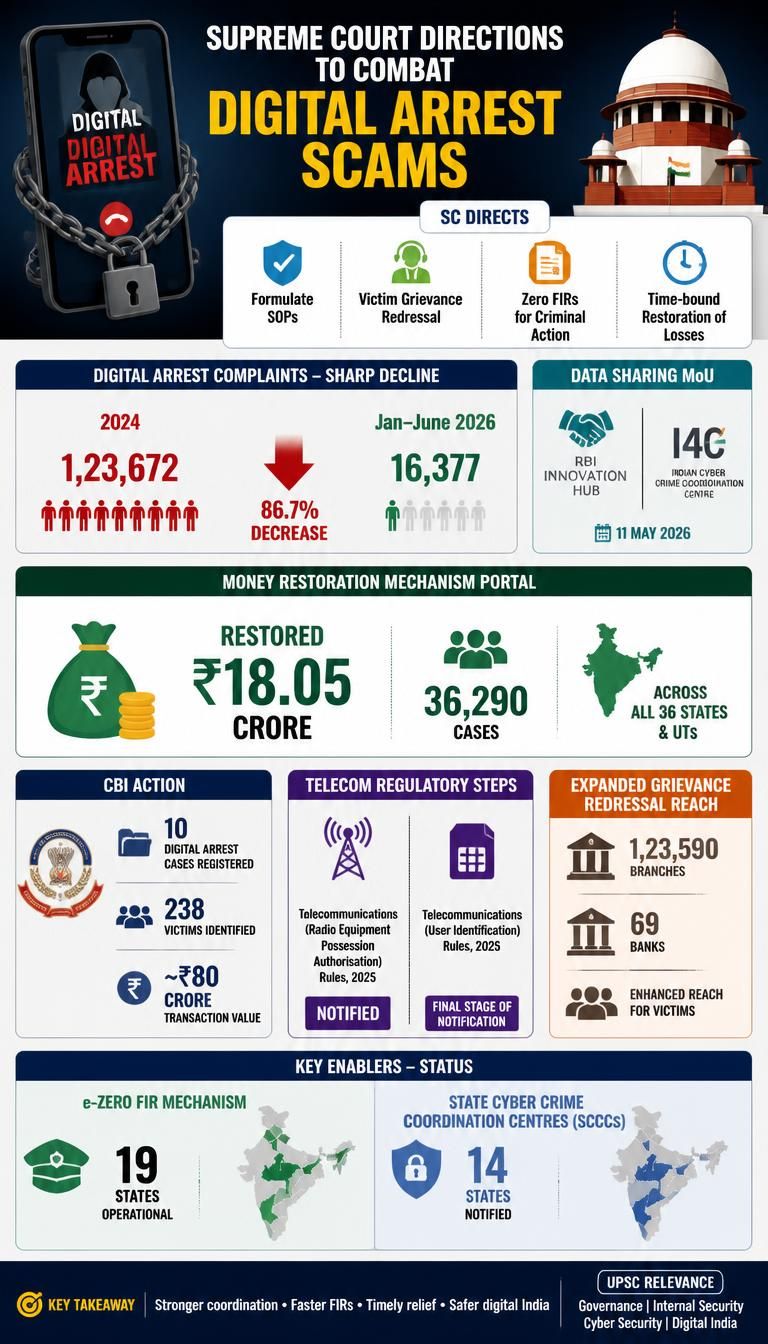
- The Supreme Court has directed the Centre, States, the Reserve Bank of India (RBI), and telecom authorities to formulate Standard Operating Procedures (SOPs) to combat "digital arrest" scams.
- The directives include establishing mechanisms for victim grievance redressal, initiating criminal action through zero FIRs, and ensuring time-bound restoration of monetary losses.
- Complaints regarding digital arrests on the National Cyber Crime Reporting Portal significantly decreased from 1,23,672 in 2024 to 16,377 by June 2026.
- A data-sharing Memorandum of Understanding (MoU) was executed between the Reserve Bank Innovation Hub and the Indian Cyber Crime Coordination Centre (I4C) on May 11, 2026.
- The Money Restoration Mechanism Portal has successfully restored ₹18.05 crore in 36,290 cases across all 36 States and Union Territories.
- The Central Bureau of Investigation (CBI) has registered 10 digital arrest cases, identifying 238 victims and transactions totaling approximately ₹80 crore.
- The Telecommunications (Radio Equipment Possession Authorisation) Rules, 2025, have been notified, while the Telecommunications (User Identification) Rules, 2025, are in the final stages of notification.
Digital Arrest.jpg
Detailed Insights:
- The Supreme Court emphasized the need for continued vigilance despite the encouraging reduction in reported digital arrest cases.
- The Indian Cyber Crime Coordination Centre (I4C), operating under the Ministry of Home Affairs, provided a status report on the measures taken against these scams.
- The grievance redressal mechanism portal now encompasses 1,23,590 branches of 69 banks, enhancing the reach for victims.
- The e-Zero FIR mechanism is operational in 19 States, but only 14 States have officially notified their State Cyber Crime Coordination Centres.
- The RBI is mandated to prepare and circulate an SOP within four weeks for banks to place temporary debit holds on mule accounts linked to cyber-enabled fraud.
- States and Union Territories are directed to develop modules for grievance redressal and money restoration, aligning with the Ministry of Home Affairs' SOPs for the National Cyber Crime Reporting Portal and Cyber RMS.
- States have been given a four-week deadline to notify their Cyber Crime Coordination Centres and implement e-Zero FIRs.
- CBI investigations have identified 67 first-layer bank accounts involved in these scams and conducted searches at 93 locations across 16 States.
Key Concepts Involved:
- Digital Arrest Scams: Fraudulent schemes where criminals impersonate law enforcement or government officials to extort money by threatening arrest or legal action.
- Zero FIR: An FIR that can be registered at any police station, irrespective of territorial jurisdiction, and then transferred to the appropriate police station.
- Mule Accounts: Bank accounts used by cybercriminals to receive, transfer, and launder illegally obtained money, often belonging to unsuspecting individuals.
- Indian Cyber Crime Coordination Centre (I4C): A centralized institutional mechanism under the Ministry of Home Affairs to combat cybercrime across India.

SuperKalam is your personal mentor for UPSC preparation, guiding you at every step of the exam journey.
Download the App


STUDY RESOURCES
CONTACT US
ⓒ Snapstack Technologies Private Limited