GS 2: GovernanceGS 2: PolityGS 1: Indian SocietyGS 3: Internal SecurityPrelims
Jammu And Kashmir — The Elusive Quest For Statehood, Pg6
Seven years post Article 370 revocation, J&K grapples with continued direct rule, economic decline, and security challenges, intensifying calls for statehood restoration and democratic accountability.
Practice MCQs
811 Students attempted
Key Highlights:
- August 5 marks seven years since Article 370, granting special status to Jammu and Kashmir, was revoked.
- August 9 will mark seven years since Jammu and Kashmir lost its Statehood following the Jammu and Kashmir Reorganisation Act, 2019.
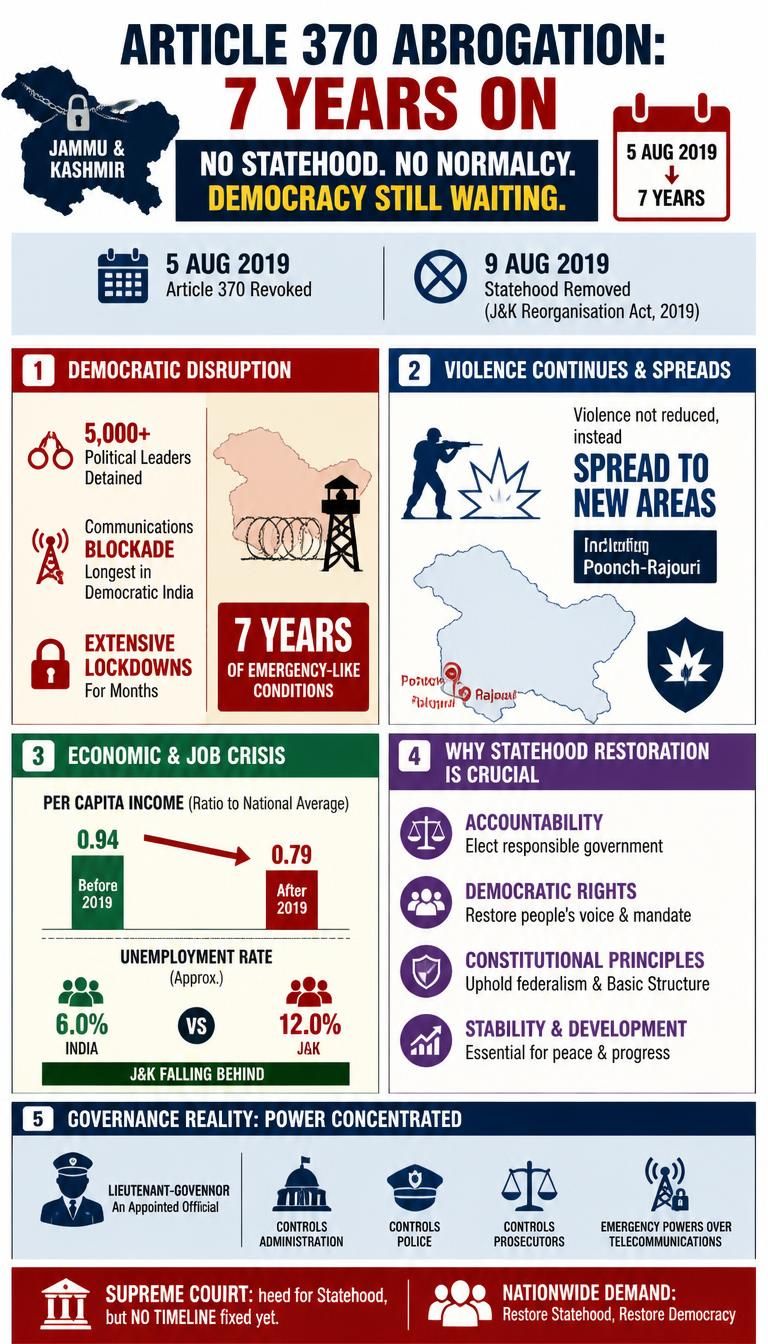
- The 2019 actions were accompanied by extensive lockdowns, detention of over 5,000 political leaders, and a communications blockade.
- Contrary to government claims, violence has continued and spread to new areas like Poonch-Rajouri.
- Jammu and Kashmir's per capita income ratio to the national average has fallen, and unemployment remains nearly double the national average.
- A renewed campaign by political parties is underway for the restoration of Statehood to ensure accountability.
Ar 370.jpg
Detailed Insights:
- The revocation of Article 370 was executed by executive fiat through the Governor, and Statehood was removed by legislative fiat without consulting the people of J&K.
- This marked the first time an Indian State lost its Statehood since Delhi in 1956, raising concerns about constitutional principles.
- The actions are viewed by some as a violation of India’s constitutional principles and potentially the Basic Structure Doctrine.
- The Supreme Court of India has not yet set a timeline for the restoration of Statehood, despite acknowledging the need for it.
- Emergency-like conditions, including direct rule and security measures, have persisted in J&K for seven years, exceeding typical constitutional limits for such impositions.
- The Lieutenant-Governor, an appointed official, currently controls the administration, police, and prosecutors, and holds emergency powers over telecommunications.
- J&K has experienced "ugly firsts" such as the widespread use of pellet guns in 2016 and communal delimitation in 2022.
- The 2024 elections saw a majority for the pluralist National Conference-Congress alliance, indicating a desire for democratic representation.
Key Concepts Involved:
- Article 370: A constitutional provision that granted special autonomous status to the erstwhile state of Jammu and Kashmir.
- Statehood: The status of being a constituent unit of the Indian Union with its own elected government and legislative powers.
- Jammu and Kashmir Reorganisation Act, 2019: The parliamentary act that bifurcated the state of J&K into two Union Territories: Jammu and Kashmir, and Ladakh.
- Lieutenant-Governor: The administrative head of a Union Territory, appointed by the President of India, who acts as a representative of the central government.
- Jammu and Kashmir Public Safety Act (PSA): A preventive detention law allowing for administrative detention without trial for up to two years in certain cases.
- Unlawful Activities (Prevention) Act (UAPA): An anti-terrorism law that allows for extended detention of suspects and makes bail difficult.
- Basic Structure Doctrine: A judicial principle established by the Supreme Court of India that certain fundamental features of the Indian Constitution cannot be altered by Parliament.

SuperKalam is your personal mentor for UPSC preparation, guiding you at every step of the exam journey.
Download the App


STUDY RESOURCES
CONTACT US
ⓒ Snapstack Technologies Private Limited