GS 3: EconomyPrelimsGS 3: Effects of Liberalization on the EconomyGS 3: Indian Economy, Planning, Mobilization of Resources, Growth, Development and EmploymentGS 2: Effect of Policies and Politics of Developed and Developing Countries on India's Interests
Inflows of $49 billion in 2 months, but no 2013-like boost for rupee, Pg13
Despite $49 billion foreign inflows in two months, the rupee shows minimal strengthening, unlike 2013, due to RBI intervention and hedging.
Practice MCQs
811 Students attempted
Key Highlights:
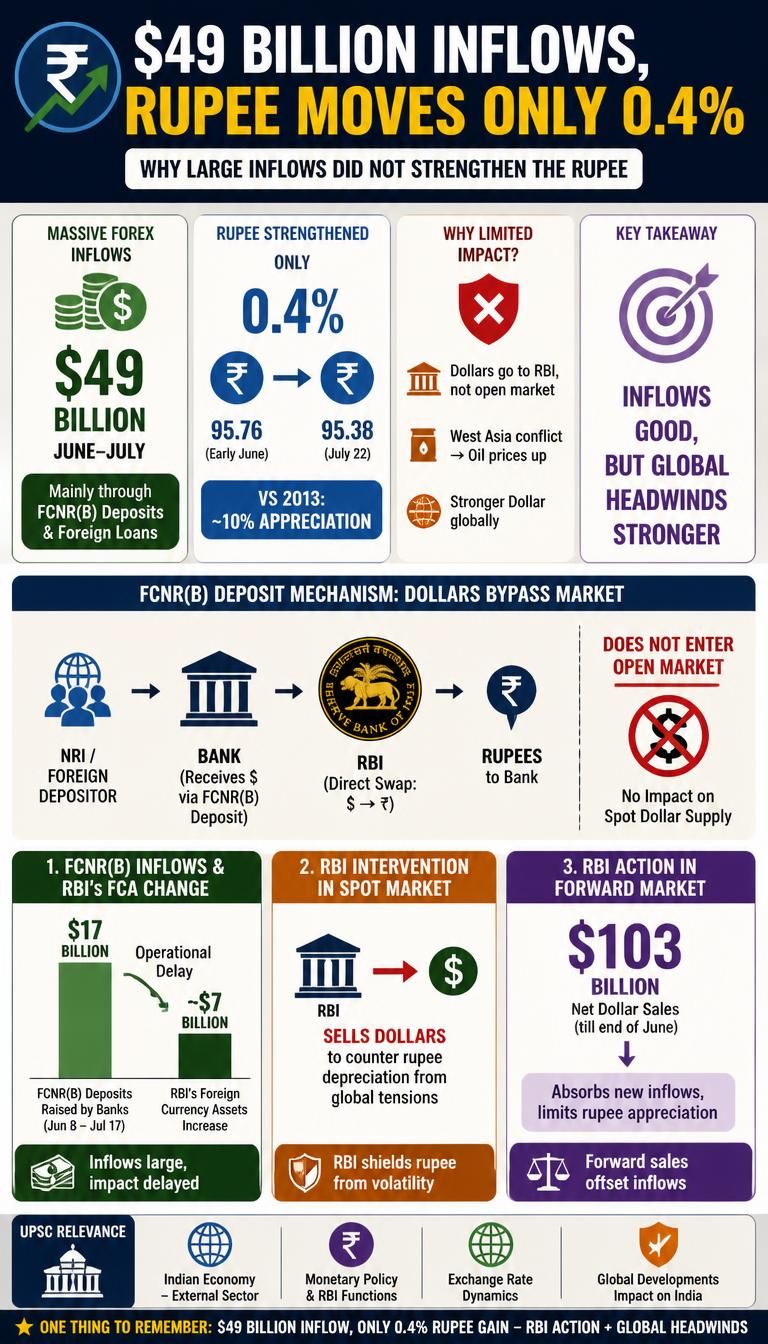
- India received $49 billion in foreign currency inflows during June and July, primarily through Foreign Currency Non-Resident (Bank) deposits (FCNR(B) deposits) and foreign loans.
- Despite these significant inflows, the Indian Rupee strengthened by only 0.4% against the US Dollar, closing at 95.38 per dollar on Tuesday.
- This contrasts sharply with 2013, when a similar FCNR(B) swap window led to a nearly 10% appreciation of the rupee.
- The limited impact is partly due to the mechanism of FCNR(B) deposits, where dollars go directly to the Reserve Bank of India (RBI) rather than the open market.
- External factors like the re-escalation of the West Asia conflict, rising oil prices, and a stronger dollar also countered the rupee's potential appreciation.
Foreign Inflows.jpg
Detailed Insights:
- The FCNR(B) swap window allows banks to receive dollar deposits and exchange them directly with the RBI for rupees, preventing these dollars from entering the open market.
- Between June 8 and July 17, Indian banks raised $17 billion in FCNR(B) deposits, but the RBI's Foreign Currency Assets (FCA) rose by only about $7 billion due to operational delays.
- The RBI actively intervened in the spot market by selling dollars to counter rupee depreciation caused by global tensions.
- The central bank also engaged in the forward market, selling $103 billion on a net basis by the end of June, which would absorb some of the new inflows.
- Banks are hedging their interest payment-related exchange rate risks for FCNR(B) deposits, increasing future demand for dollars and putting pressure on the rupee.
- Non-Resident Indians (NRIs) are expected to pour in as much as $75 billion through FCNR(B) deposits by September 30, when the current window ends.
- The rupee's trajectory is expected to remain stable around 96 per dollar by 2026-27, influenced by a balance of improved near-term external outlook and structural headwinds.
Key Concepts Involved:
- Foreign Currency Non-Resident (Bank) Deposits (FCNR(B) Deposits): Term deposit accounts maintained by Non-Resident Indians (NRIs) in foreign currency with banks in India.
- Reserve Bank of India (RBI): India's central bank, responsible for monetary policy, currency issuance, and foreign exchange management.
- Foreign Currency Assets (FCA): The foreign currency component of a country's foreign exchange reserves, held by the central bank.
- Spot Market Intervention: A central bank's action of buying or selling foreign currency in the immediate delivery market to influence the exchange rate.
- Forward Market Intervention: A central bank's strategy of entering into contracts to buy or sell foreign currency at a future date to influence future exchange rate expectations.

SuperKalam is your personal mentor for UPSC preparation, guiding you at every step of the exam journey.
Download the App


STUDY RESOURCES
CONTACT US
ⓒ Snapstack Technologies Private Limited