GS 2: GovernanceGS 3: Environment & EcologyGS 3: EconomyPrelimsGS 3: Indian Economy, Planning, Mobilization of Resources, Growth, Development and Employment
Cut, hike, hold: How RBI decides monetary policy, Pg16
RBI's Monetary Policy Committee evaluates inflation, crude oil, monsoon, and global factors to determine interest rate adjustments for economic stability.
Practice MCQs
811 Students attempted
Key Highlights:
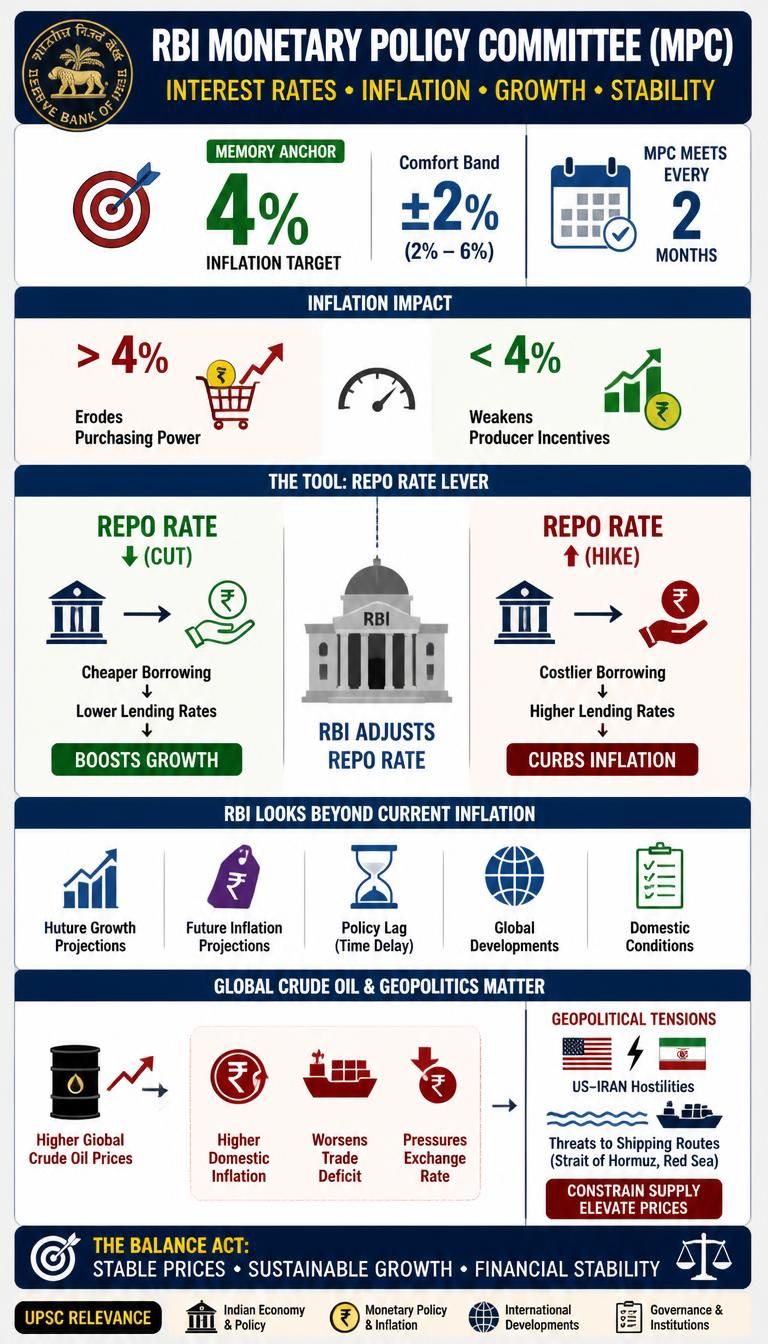
- The Monetary Policy Committee (MPC) of the Reserve Bank of India (RBI) meets every two months to review the economy and decide on interest rates.
- The RBI is mandated to maintain stable prices, targeting retail inflation at 4% with a comfort band of two percentage points on either side.
- The primary tool for achieving this inflation target is by adjusting the repo rate.
- Most economists anticipate the RBI to maintain a status quo on interest rates in its upcoming policy statement.
RBI MPC.jpg
Detailed Insights:
- A retail inflation rate persistently above 4% erodes consumer purchasing power, while below 4% weakens producer profit incentives.
- Reducing the repo rate makes borrowing cheaper for commercial banks, which in turn lowers lending rates and stimulates economic growth.
- Conversely, raising the repo rate increases borrowing costs, dampening demand to control high inflation.
- The RBI considers various factors beyond current inflation, including future growth and inflation projections, due to the time lag in policy effects.
- Global crude oil prices are a significant factor, as higher prices increase domestic inflation, worsen India's trade deficit, and impact the exchange rate.
- Geopolitical tensions, such as US-Iran hostilities and threats to shipping routes like the Strait of Hormuz and Red Sea, can constrain energy supply and elevate prices.
- Domestic agricultural prospects, influenced by Monsoon performance and El Niño conditions, are crucial for food inflation.
- The RBI assesses the quality and broad-based nature of economic growth momentum using various high-frequency indicators.
- Actions by other central banks globally influence the RBI's decisions to maintain India's attractiveness for international bond market investments.
Key Concepts Involved:
- Monetary Policy Committee (MPC): A statutory body of the RBI responsible for fixing the benchmark interest rate in India.
- Repo Rate: The interest rate at which the RBI lends money to commercial banks for their short-term needs.
- Retail Inflation: The rate of increase in prices of goods and services purchased by consumers, measured by the Consumer Price Index (CPI).
- El Niño: A climate pattern characterized by the unusual warming of surface waters in the eastern tropical Pacific Ocean, affecting global weather patterns.

SuperKalam is your personal mentor for UPSC preparation, guiding you at every step of the exam journey.
Download the App


STUDY RESOURCES
CONTACT US
ⓒ Snapstack Technologies Private Limited