GS 2: PolityGS 3: Environment & EcologyPrelimsGS 3: Conservation, Pollution and DegradationGS 2: Government policies and interventions for development in various sectors
10-km mining buffer applies to all wetland reserves: SC, Pg12
Supreme Court mandates 10-km mining buffer zone for all wetland conservation reserves nationwide, citing environmental parity and protection.
Practice MCQs
811 Students attempted
Key Highlights:
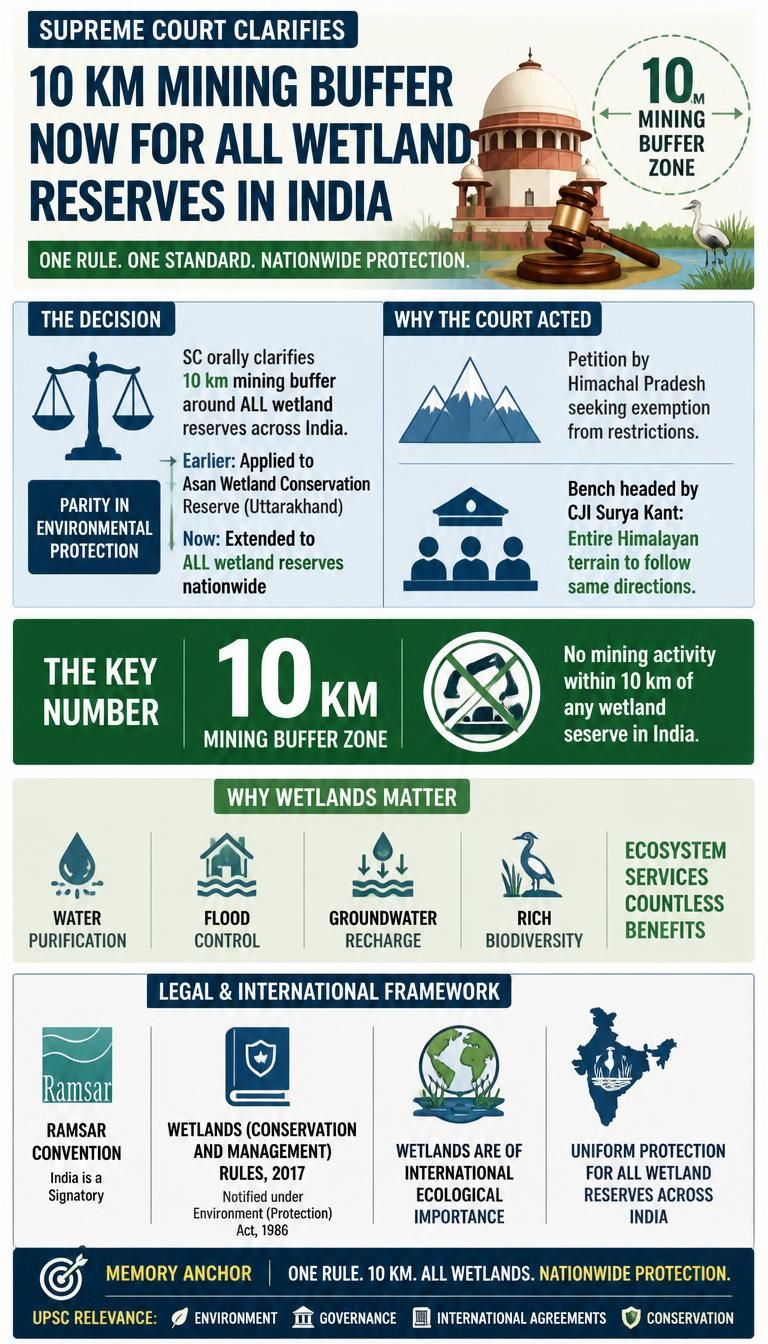
- The Supreme Court orally clarified that a 10-km mining buffer zone, initially applied to the Asan wetland conservation reserve in Uttarakhand, will now extend to all wetland reserves across India.
- This decision was made to ensure parity in environmental protection for wetlands nationwide.
- The ruling came during a hearing on a petition filed by Himachal Pradesh, which sought exemption from such restrictions.
- The Bench, headed by Chief Justice of India Surya Kant, emphasized that the entire Himalayan terrain should be governed by the same set of directions.
Wetland.jpg
Detailed Insights:
- The Asan wetland conservation reserve is a designated Ramsar site, highlighting its international ecological importance.
- The Supreme Court's decision aims to provide uniform protection to these crucial ecosystems, preventing localized degradation.
- Wetlands are vital for numerous ecosystem services, including water purification, flood control, groundwater recharge, and supporting rich biodiversity.
- India is a signatory to the Ramsar Convention, an intergovernmental treaty for the conservation and wise use of wetlands.
- The Wetlands (Conservation and Management) Rules, 2017, notified under the Environment (Protection) Act, 1986, provide a regulatory framework for wetland conservation in India.
- These rules prohibit activities like land reclamation, setting up new industries, and dumping of solid or hazardous waste within notified wetland boundaries.
- The ruling underscores the judiciary's role in enforcing environmental regulations and ensuring consistent application of protective measures across states.
Key Concepts Involved:
- Ramsar Sites: Wetlands designated as internationally important under the Ramsar Convention for their ecological significance.
- Wetland Conservation Reserves: Areas specifically identified and managed for the protection and sustainable use of wetland ecosystems.
- Mining Buffer Zone: A specified area around a protected site where mining activities are restricted or prohibited to mitigate environmental impact.
- Judicial Parity: The principle of treating similar cases or situations alike to ensure fairness and consistency in legal judgments.

SuperKalam is your personal mentor for UPSC preparation, guiding you at every step of the exam journey.
Download the App


STUDY RESOURCES
CONTACT US
ⓒ Snapstack Technologies Private Limited