GS 2: GovernanceGS 2: PolityGS 1: Indian SocietyGS 3: EconomyPrelims
Need for a unified urbanisation plan, Pg8
Experts call for unified National Urbanisation Policy to overhaul India's outdated urban definitions, address uneven growth, and bridge critical governance gaps.
Practice MCQs
826 Students attempted
Key Highlights:
- India's 2027 Census will classify urban settlements based on traditional criteria, despite evolving economic realities.
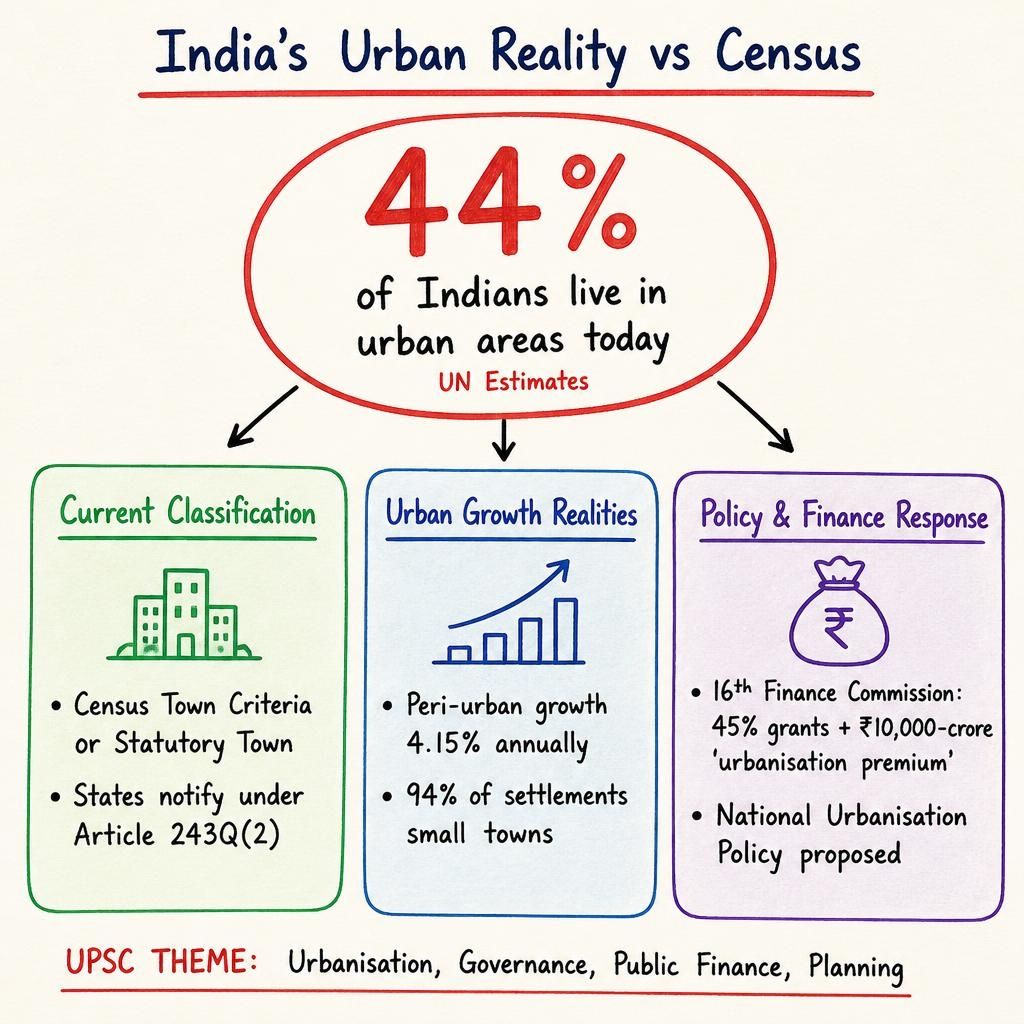
- The United Nations estimates 44% of Indians live in urban areas today, projecting this to exceed 720 million by 2050.
- The Economic Survey 2026 indicated India was functionally 63% urban in 2015, significantly higher than official definitions.
- The 16th Finance Commission increased local grants for urban local bodies to 45% and introduced a ₹10,000-crore 'urbanisation premium'.
- A National Urbanisation Policy is proposed to create a coherent framework for recognizing transitioning settlements and aligning fiscal incentives.
India's Urbanisation.jpg
Detailed Insights:
- Current urban classification relies on Census Town Criteria (population ≥ 5,000, density ≥ 400/sq km, ≥75% male non-agricultural workers) or notification as a Statutory Town.
- Urban growth is highly uneven, with 94% of urban settlements being small towns, while 60% of the urban population resides in Class I cities.
- Peri-urban areas are experiencing the fastest growth at approximately 4.15% annually, outpacing growth within administrative city limits.
- The Union Budget 2026 allocated ₹5,000 crore to City Economic Regions, shifting focus from individual cities to broader economic geographies.
- Classification significantly impacts access to master plans, municipal finance, Finance Commission grants, and scheme eligibility.
- Article 243Q(2) grants States discretion in notifying urban areas, often without standardized criteria or public reasoning.
- Many statutory and census towns lack master plans, and planning legislation in several states remains unupdated since the 74th Constitutional Amendment of 1992.
- A National Urbanisation Policy aims to standardize definitions, modernize spatial planning, reorient finance, and establish a National Urbanisation Council.
- The policy advocates for regular review of settlement status using geospatial data, rather than solely during the Census.
- It emphasizes extending regional planning beyond million-plus cities and making peri-urban zoning mandatory.
- India's municipal revenue is low at about 1% of GDP, highlighting the need for stronger own-source revenue and formula-based transfers.
- Existing constitutional provisions for Metropolitan and District Planning Committees (Articles 243ZE and 243ZD) can be leveraged for improved coordination.
- Reforms should be based on functional units like airsheds or river basins, rather than strictly administrative boundaries, for effective problem-solving.
Key Concepts Involved:
- Census Town: A settlement meeting specific demographic and economic criteria but not formally notified as urban by the state.
- Statutory Town: An urban area formally notified by a State government under relevant municipal laws.
- Peri-urban Areas: Transitional zones surrounding cities, characterized by mixed rural and urban features and rapid development.
- 74th Constitutional Amendment Act: Constitutionalized Urban Local Bodies, providing a framework for municipal governance, planning, and decentralization.

SuperKalam is your personal mentor for UPSC preparation, guiding you at every step of the exam journey.
Download the App


STUDY RESOURCES
CONTACT US
ⓒ Snapstack Technologies Private Limited