GS 2: International RelationsGS 3: Environment & EcologyPrelimsGS 3: Conservation, Pollution and DegradationGS 2: Bilateral, Regional and Global Groupings and Agreements
India to Push for Predictable Climate Finance, Equitable Transition at Key UN Summit, Pg12
India will demand predictable climate finance and technology transfer at COP31, opposing fossil fuel phase-out and new mitigation targets for developing nations.
Practice MCQs
826 Students attempted
Key Highlights:
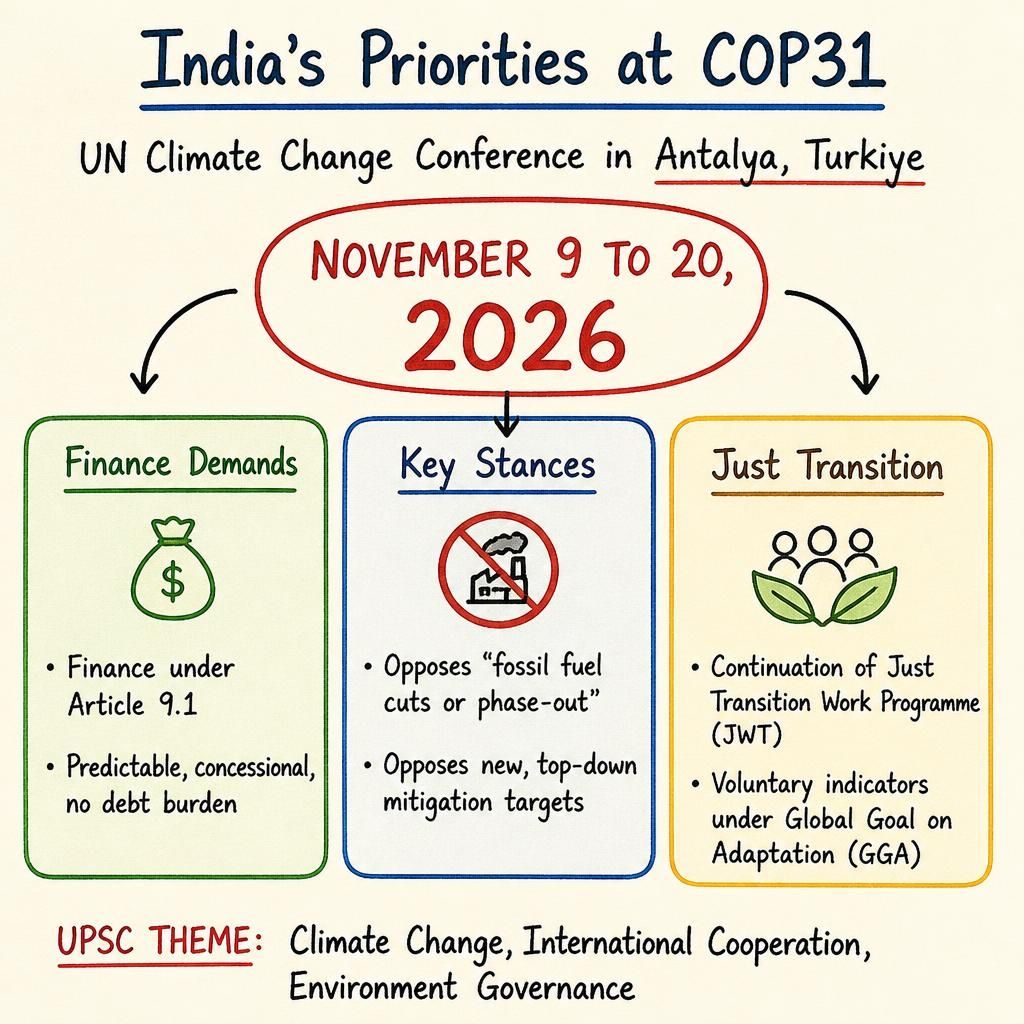
- India will advocate for predictable climate finance, technology transfer, and nationally determined approaches at the UN Climate Change Conference (COP31) in Antalya, Turkiye, from November 9 to 20, 2026.
- Union Environment Minister Bhupender Yadav outlined India's priorities, emphasizing that developed nations must fulfill their financial obligations to developing countries.
- India opposes language suggesting "fossil fuel cuts or phase-out," highlighting its ongoing efforts to increase renewable energy, forest cover, and energy efficiency.
- India seeks the continuation of the Just Transition Work Programme (JWT) and will oppose new, top-down mitigation targets for developing countries.
- India demands that climate finance provided under Article 9.1 of the Paris Agreement be predictable, largely public, concessional, and not add to the debt burden of developing countries.
India at COP 31.jpg
Detailed Insights:
- COP31 is a crucial global summit for climate action, where countries will negotiate strategies to accelerate climate action and strengthen cooperation.
- India's emphasis on nationally determined approaches underscores its commitment to climate action tailored to its specific developmental context and priorities.
- The demand for predictable and concessional climate finance aims to ensure developing countries can implement climate actions without increasing their financial liabilities.
- India's stance on fossil fuels reflects its energy security needs while actively pursuing a transition to cleaner energy sources.
- The Just Transition Work Programme (JWT) aims to ensure that the shift to a green economy is equitable and inclusive, protecting workers and communities during the transition.
- India advocates for voluntary indicators under the Global Goal on Adaptation (GGA) to maintain flexibility and prevent financial conditionalities for adaptation efforts.
Key Concepts Involved:
- COP31: The 31st Conference of the Parties to the UN Framework Convention on Climate Change (UNFCCC), a global summit for climate action.
- Climate Finance: Financial resources provided by developed countries to developing countries to help them address climate change mitigation and adaptation.
- Paris Agreement (Article 9.1): A global accord aiming to limit global warming, with Article 9.1 specifically addressing financial support from developed to developing nations.
- Just Transition Work Programme (JWT): An initiative under the UNFCCC to ensure social and economic justice during the transition to a low-carbon economy.
- Global Goal on Adaptation (GGA): A collective objective under the Paris Agreement to enhance adaptive capacity, strengthen resilience, and reduce vulnerability to climate change.
Previous11/11

SuperKalam is your personal mentor for UPSC preparation, guiding you at every step of the exam journey.
Download the App


STUDY RESOURCES
CONTACT US
ⓒ Snapstack Technologies Private Limited