GS 1: Post-Independence IndiaGS 2: GovernanceGS 2: PolityPrelimsGS 2: Role of Civil Services in a Democracy
Why did the J&K Statehood resolution cause a row?, Pg14
J&K Assembly passes resolution demanding immediate statehood, igniting political controversy with BJP and bureaucratic pushback over autonomy references.
Practice MCQs
819 Students attempted
Key Highlights:
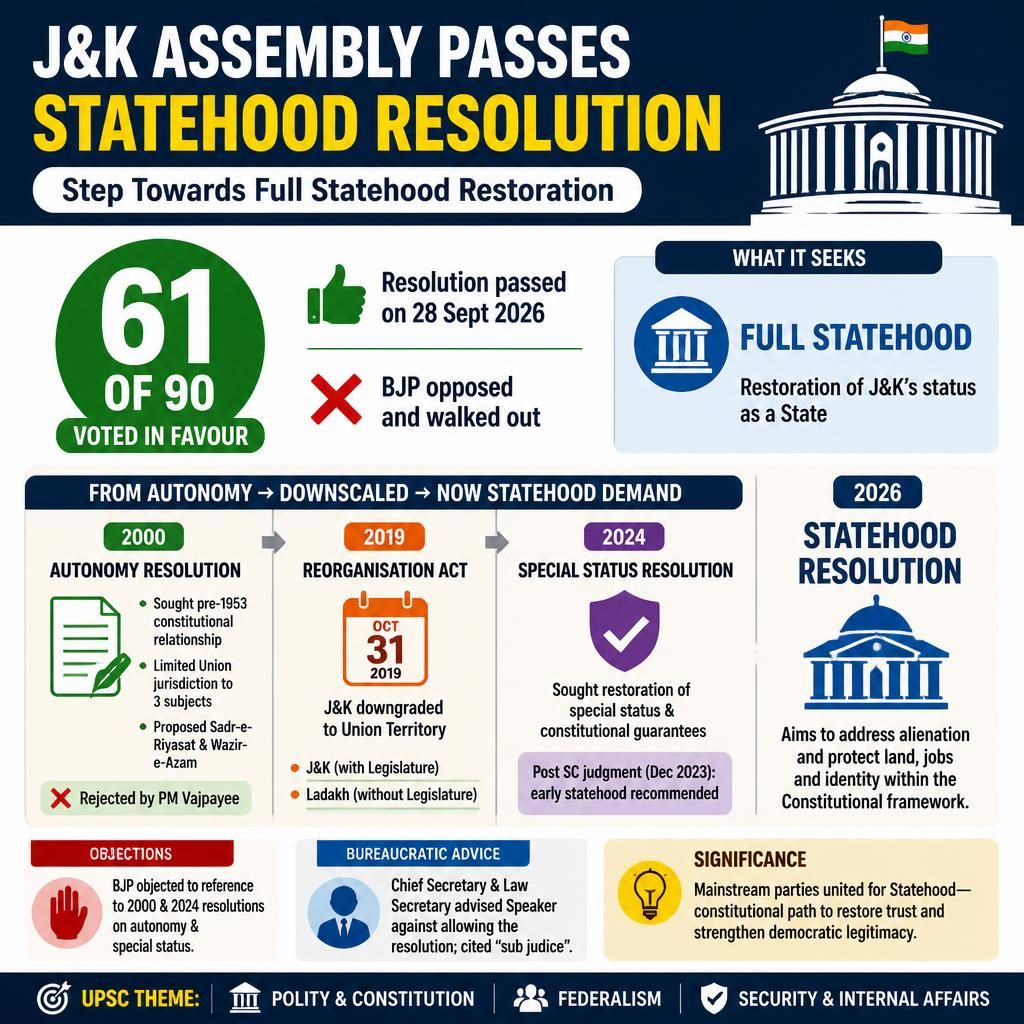
- On September 28, 2026, the Jammu and Kashmir (J&K) Assembly passed a resolution calling for the immediate restoration of full Statehood to J&K.
- J&K Chief Minister Omar Abdullah introduced the resolution, citing the Centre's delay in granting Statehood after the region was downgraded to a Union Territory in 2019.
- The resolution passed with support from 61 out of 90 members, including the National Conference (NC), Congress, and Peoples Democratic Party.
- The Bharatiya Janata Party (BJP) opposed the resolution and staged a walkout, objecting to its reference to previous resolutions from 2000 and 2024 concerning autonomy and special status.
- Bureaucratic officials, including the Chief Secretary and Law Secretary, advised the Speaker against allowing the resolution, citing the matter as "sub judice."
J&K Statehood.jpg
Detailed Insights:
- J&K's autonomous status under Article 370 was diluted in 2019, leading to its downgrading from a state to a Union Territory.
- The Jammu and Kashmir Reorganisation Act, 2019, bifurcated the erstwhile state into the Union Territories of Jammu and Kashmir (with a legislature) and Ladakh (without one), effective October 31, 2019.
- The 2000 autonomy resolution, passed by the J&K Assembly under then Chief Minister Dr. Farooq Abdullah, sought to restore the pre-1953 constitutional relationship, limiting Union jurisdiction to defence, foreign affairs, and communications.
- This 2000 resolution also proposed re-designating the Governor as Sadr-e-Riyasat and the Chief Minister as Wazir-e-Azam, and replacing "temporary" with "special" in Article 370.
- The 2000 autonomy resolution was rejected by the then Prime Minister Atal Bihari Vajpayee, who deemed its recommendations unacceptable.
- A resolution passed on November 6, 2024, by the J&K Assembly, sought the restoration of special status and constitutional guarantees, following the Supreme Court's December 2023 judgment upholding the 2019 changes but recommending early statehood.
- The current resolution for Statehood is seen by mainstream parties as an attempt to address alienated sections within the constitutional framework, protecting land, jobs, and identity.
- The bureaucratic intervention against the resolution sparked a debate on the powers of the legislature in a Union Territory, with a breach of privilege motion initiated against the officials.
Key Concepts Involved:
- Statehood: The status of being a fully self-governing state within the Indian Union, with its own legislature and executive powers.
- Union Territory: An administrative division in India directly governed by the Central Government, some of which have a legislative assembly.
- Article 370: A constitutional provision that granted special autonomous status to Jammu and Kashmir, abrogated in 2019.
- J&K Reorganisation Act, 2019: The parliamentary act that reorganized the former State of Jammu and Kashmir into two Union Territories.
Previous8/8

SuperKalam is your personal mentor for UPSC preparation, guiding you at every step of the exam journey.
Download the App


STUDY RESOURCES
CONTACT US
ⓒ Snapstack Technologies Private Limited