GS 2: GovernanceGS 2: PolityGS 3: EconomyPrelimsGS 3: Indian Economy, Planning, Mobilization of Resources, Growth, Development and Employment
Arrest Powers Under GST Regime Likely To Be Removed, Pg1
Government plans to remove arrest powers under GST regime, aiming to boost investor sentiment and improve ease of doing business.
Practice MCQs
819 Students attempted
Key Highlights:
- The Goods and Services Tax (GST) regime is set for a major overhaul with a proposal to remove arrest powers under its laws.
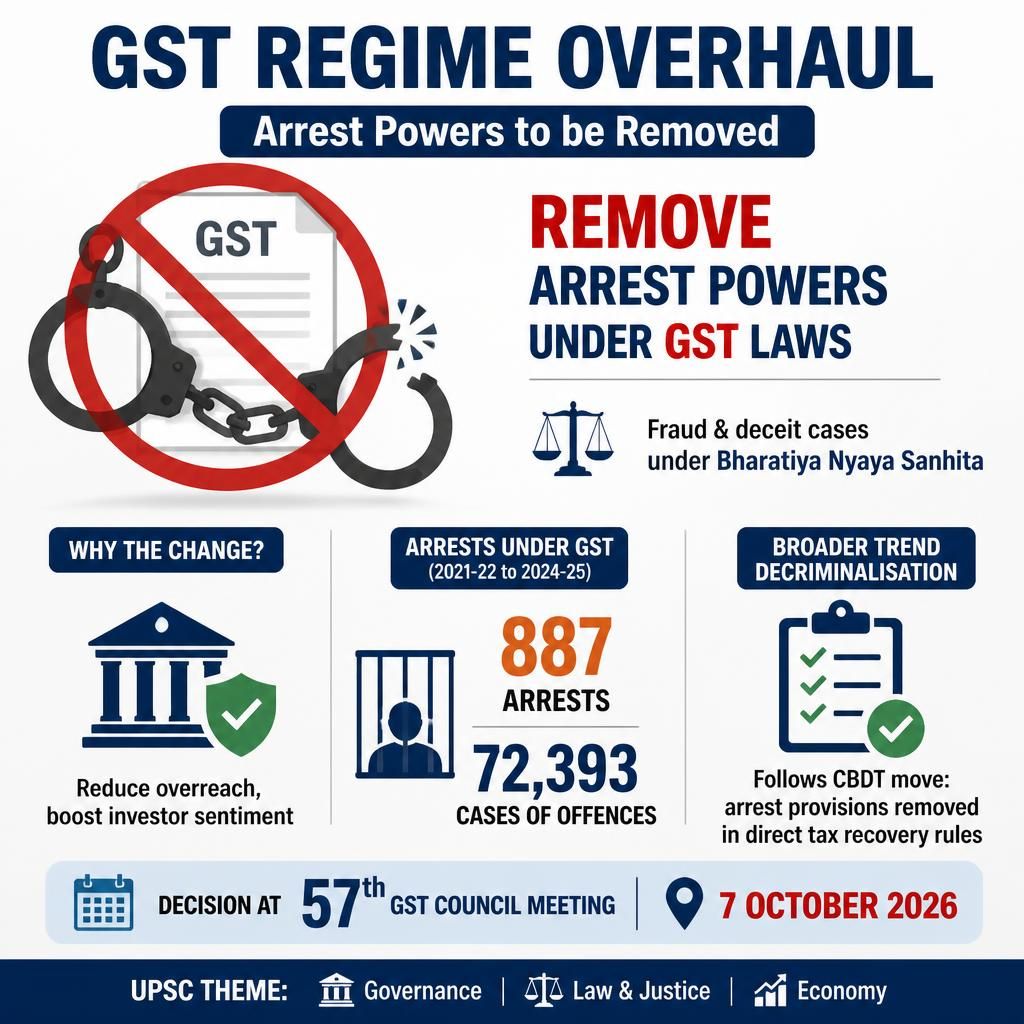
- The 57th GST Council Meeting, scheduled for October 7, 2026, will consider decriminalizing offenses under the indirect tax system.
- For intentional frauds and deceit, arrests and prosecution will be conducted under the country's criminal code, the Bharatiya Nyaya Sanhita.
- The move aims to boost investor sentiment and address concerns regarding overreach by tax authorities.
- Between 2021-22 and 2024-25, central GST formations made 887 arrests in 72,393 cases of offenses.
GST Regime Overhaul.jpg
Detailed Insights:
- The proposal to remove arrest powers is a significant process reform to be discussed at the upcoming 57th GST Council Meeting.
- Concerns about arrest powers under GST laws are not new, with several states having flagged them even before the 2017 rollout of the indirect tax regime.
- Currently, Section 69 of the Central Goods and Services Tax (CGST) Act grants the Commissioner the power to authorize arrests for specific offenses, a provision whose constitutional validity has been upheld by the Supreme Court.
- Typical GST frauds involve fake identities, mule accounts for fraudulent transactions, or availing Input Tax Credit without actual supply of goods.
- This initiative aligns with a broader government trend towards decriminalization, as seen with the Central Board of Direct Taxes (CBDT) removing arrest and detention provisions from direct tax recovery rules.
- Following the GST Council's discussion, legislative changes are expected to be introduced in the winter session of Parliament to implement the removal of arrest provisions.
Key Concepts Involved:
- Goods and Services Tax (GST): An indirect tax levied on the supply of goods and services, replacing multiple cascading taxes.
- GST Council: The governing body for GST, comprising Union and State Finance Ministers, responsible for making recommendations on GST laws and rates.
- Bharatiya Nyaya Sanhita: India's new criminal code, effective from July 1, 2024, replacing the Indian Penal Code.
- Input Tax Credit (ITC): A mechanism under GST allowing businesses to claim credit for taxes paid on inputs used for business, reducing overall tax liability.
- Central Goods and Services Tax (CGST) Act: The law governing the levy of GST by the Central Government on intra-state supplies.
- Central Board of Indirect Taxes and Customs (CBIC): The national administrative authority for GST, customs, and central excise duties.
- Central Board of Direct Taxes (CBDT): The statutory authority responsible for administering direct tax laws in India.

SuperKalam is your personal mentor for UPSC preparation, guiding you at every step of the exam journey.
Download the App


STUDY RESOURCES
CONTACT US
ⓒ Snapstack Technologies Private Limited