GS 3: Science & TechnologyGS 3: EconomyPrelimsGS 3: Infrastructure: Energy, Ports, Roads, Airports, Railways etc.GS 2: Government policies and interventions for development in various sectors
Why top scientist wants India to move early to thorium fuels, Pg15
Top scientist Anil Kakodkar advocates early thorium fuel integration into indigenous PHWRs to accelerate India's nuclear self-reliance and meet growing energy demands.
Practice MCQs
811 Students attempted
Key Highlights:
- Top nuclear scientist Anil Kakodkar advocates for introducing thorium-based fuel into India's indigenous Pressurised Heavy Water Reactor (PHWR) fleet.
- This move aims to accelerate the utilization of India's abundant thorium reserves and enhance self-reliance in nuclear fuel.
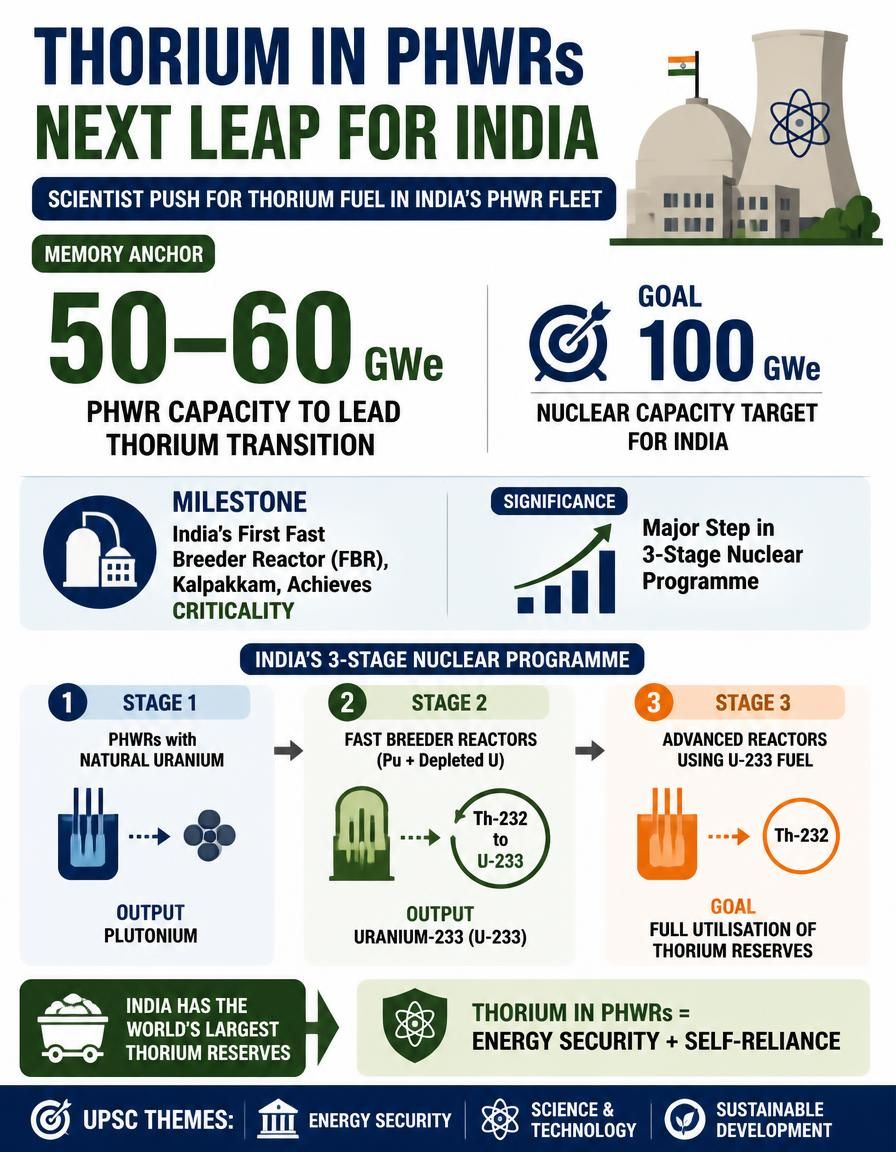
- The proposal comes as India plans to deploy around half of its targeted 100 gigawatts-electric (GWe) nuclear capacity through PHWR technology.
- India's first indigenous Fast Breeder Reactor (FBR) at Kalpakkam recently attained criticality, marking a significant milestone in the second stage of the nuclear program.
Thorium Fuel.jpg
Detailed Insights:
- India's three-stage nuclear power programme is designed to achieve long-term fuel self-reliance using its thorium reserves.
- The first stage uses PHWRs with natural uranium, producing plutonium.
- The second stage involves Fast Breeder Reactors (FBRs), which use plutonium and depleted uranium to produce Uranium-233 (U-233) from Thorium-232 (Th-232).
- The third stage will utilize U-233 as fuel in advanced reactors, converting Th-232 directly.
- Kakodkar, former chairman of the Atomic Energy Commission and Chancellor of the Homi Bhabha National Institute, suggests that the growing capacity of PHWRs (up to 50-60 GWe) presents a new opportunity for thorium introduction.
- Previously, thorium was primarily envisaged for FBRs due to limited thermal reactor capacity for efficient conversion.
- The proposal emphasizes ensuring that thorium irradiation in PHWRs does not increase electricity costs or uranium requirements.
Scientific/Technical Concepts Involved:
- Pressurised Heavy Water Reactor (PHWR): A nuclear reactor type that uses heavy water as both coolant and neutron moderator, typically fueled by natural uranium.
- Fast Breeder Reactor (FBR): A nuclear reactor that produces more fissile material than it consumes, using fast neutrons to breed new fuel.
- Thorium-232 (Th-232): A naturally occurring, fertile isotope of thorium that can be converted into fissile Uranium-233 in a nuclear reactor.
- Uranium-233 (U-233): A fissile isotope of uranium, not found in nature, produced by neutron irradiation of Thorium-232.
- Criticality: The state in a nuclear reactor where a self-sustaining nuclear fission chain reaction is achieved.

SuperKalam is your personal mentor for UPSC preparation, guiding you at every step of the exam journey.
Download the App


STUDY RESOURCES
CONTACT US
ⓒ Snapstack Technologies Private Limited