GS 1: Physical GeographyGS 3: Disaster ManagementGS 3: Environment & EcologyPrelimsGS 3: Disaster and Disaster Management
‘Supersized’ El Nino to be strongest ever recorded: UN, Pg16
UN warns 'supersized' El Nino could be strongest ever, persisting until 2027, raising global extreme weather risks significantly.
Practice MCQs
811 Students attempted
Key Highlights:
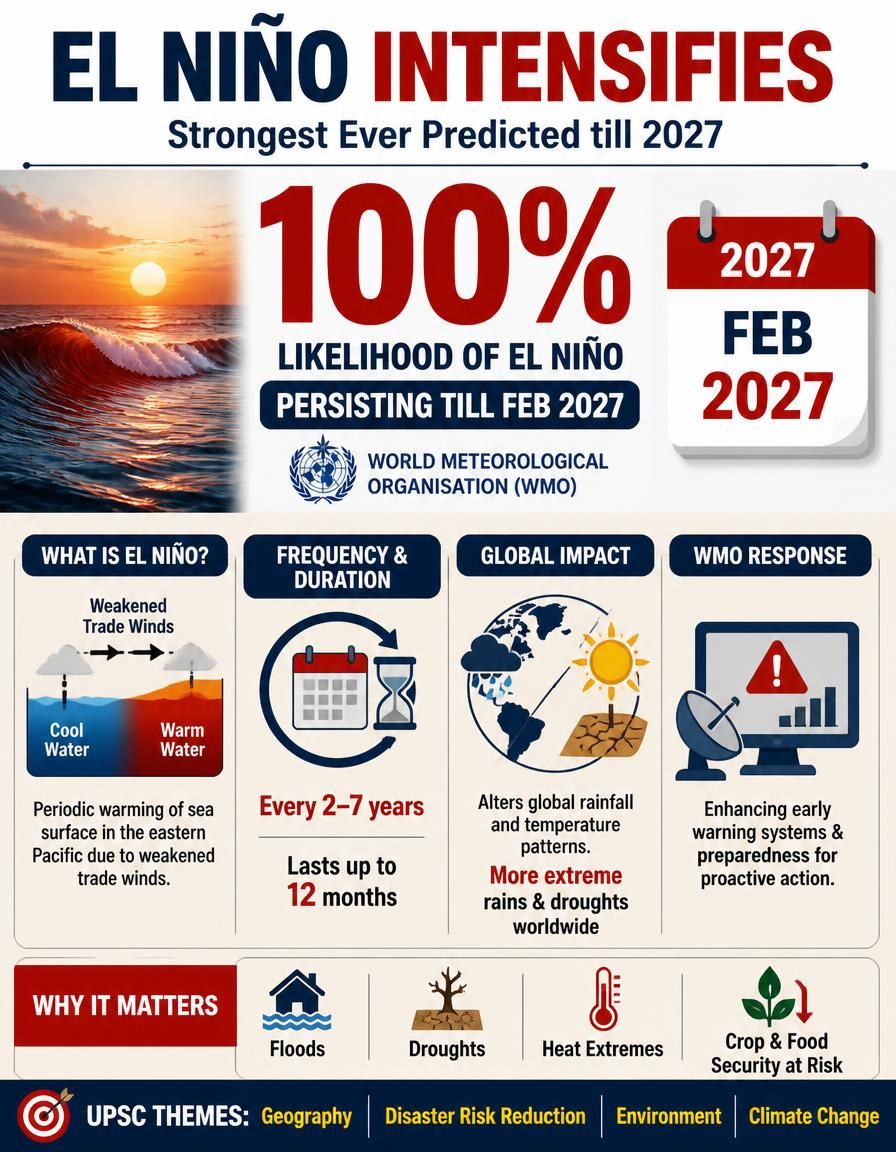
- The El Nino weather phenomenon is predicted to intensify further into 2027.
- It could become the strongest ever recorded, according to the World Meteorological Organisation (WMO).
- The WMO forecasts a near 100% likelihood of El Nino persisting through February 2027.
- This intensification is driven by exceptionally warm Pacific Ocean temperatures.
- The phenomenon raises risks of extreme weather events globally.
El Nino.jpg
Detailed Insights:
- El Nino is characterized by a periodic warming of sea surface temperatures in the eastern Pacific Ocean.
- It is caused by the weakening of trade winds in the equatorial Pacific.
- The phenomenon typically occurs every two to seven years and can last up to 12 months.
- Strong El Nino events can significantly alter global rainfall and temperature patterns.
- It often leads to intense rains and droughts in various regions, particularly across Latin America.
- The WMO is enhancing preparedness and early warning systems to enable states to take proactive measures.
Scientific/Technical Concepts Involved:
- El Nino: A climate pattern describing the unusual warming of surface waters in the eastern tropical Pacific Ocean.
- Trade Winds: Persistent easterly surface winds that blow from the subtropical high-pressure belts towards the equator.
- World Meteorological Organisation (WMO): A specialized agency of the United Nations dedicated to international cooperation and coordination on the state and behavior of the Earth’s atmosphere.

SuperKalam is your personal mentor for UPSC preparation, guiding you at every step of the exam journey.
Download the App


STUDY RESOURCES
CONTACT US
ⓒ Snapstack Technologies Private Limited