GS 3: EconomyPrelimsGS 3: Inclusive GrowthGS 3: Indian Economy, Planning, Mobilization of Resources, Growth, Development and EmploymentGS 2: Important Aspects of Governance, Transparency and Accountability
Perils of comparing GDP from different base years, Pg17
Article clarifies controversy surrounding India's Q1 GDP growth rate calculation after base year revision, emphasizing the non-comparability of data from different series.
Practice MCQs
811 Students attempted
Key Highlights:
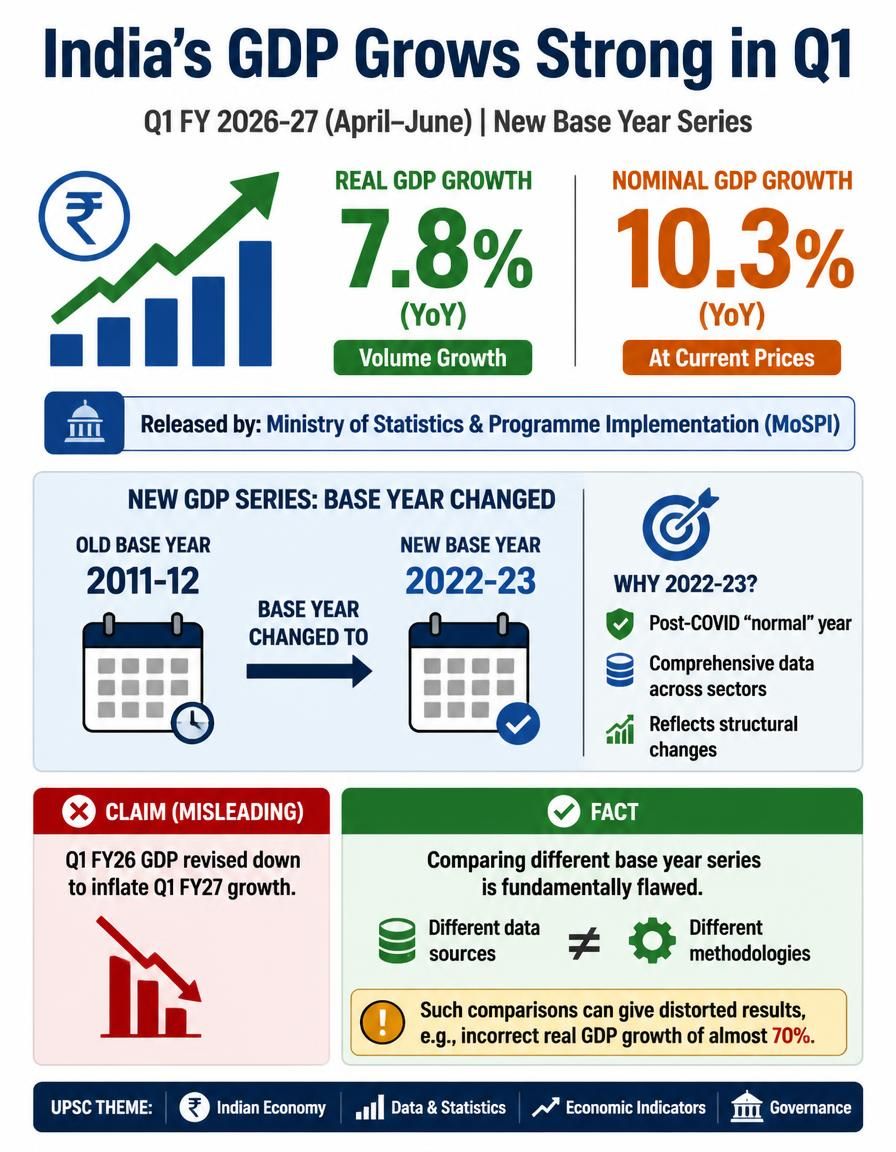
- India's Gross Domestic Product (GDP) grew by 7.8% in real terms and 10.3% in nominal terms during the first quarter (April-June) of the current financial year (Q1 FY 2026-27).
- The Ministry of Statistics and Programme Implementation (MoSPI) released this data on the last day of August.
- MoSPI had unveiled a new series of GDP data on February 27, 2026, by changing the base year from 2011-12 to 2022-23.
- This base year change resulted in a revision of past GDP figures, including a downward adjustment of the nominal GDP for 2025-26 from Rs 357 trillion to Rs 345 trillion.
- A controversy arose when former finance secretary Subhash Chandra Garg claimed the Q1 2025 GDP was revised downward to inflate the Q1 2026 growth rate.
India's GDP.jpg
Detailed Insights:
- The base year for GDP calculation is periodically revised, typically every five years, to incorporate structural changes in the economy, improve methodology, and use updated data sources.
- The 2022-23 base year was selected as it represents a recent "normal year" post-COVID-19, with comprehensive data available across economic sectors.
- The article refutes the claim of deliberate manipulation, explaining that comparing GDP figures from different base year series is fundamentally flawed due to varying data sources and methodologies.
- Such comparisons, as suggested by Garg, would lead to highly distorted growth rates, for instance, an incorrect real GDP growth of almost 70%.
- Accurate economic data is vital for effective policymaking, especially in India, which faces challenges like high informality and data gaps.
- Despite robust GDP growth, concerns persist regarding the economy's ability to generate a sufficient number of quality jobs, posing a risk to India's demographic dividend.
Key Concepts Involved:
- Gross Domestic Product (GDP): The total monetary value of all finished goods and services produced within a country's borders in a specific time period.
- Real GDP: Measures economic output adjusted for inflation, using constant prices from a base year, providing a more accurate picture of actual production growth.
- Nominal GDP: Measures economic output at current market prices, including the effects of inflation.
- Base Year: A reference year whose prices are used to calculate real economic growth, chosen to be a "normal" year to ensure accurate comparisons over time.
Previous14/14

SuperKalam is your personal mentor for UPSC preparation, guiding you at every step of the exam journey.
Download the App


STUDY RESOURCES
CONTACT US
ⓒ Snapstack Technologies Private Limited