GS 3: Science & TechnologyPrelimsGS 3: Space Technology
How Roman Telescope Can Help Decode Universe's Mysteries, Pg17
NASA launches powerful Roman Space Telescope to unravel universe's deepest mysteries, including dark matter, dark energy, and exoplanets, from Lagrange Point 2.
Practice MCQs
811 Students attempted
Key Highlights:
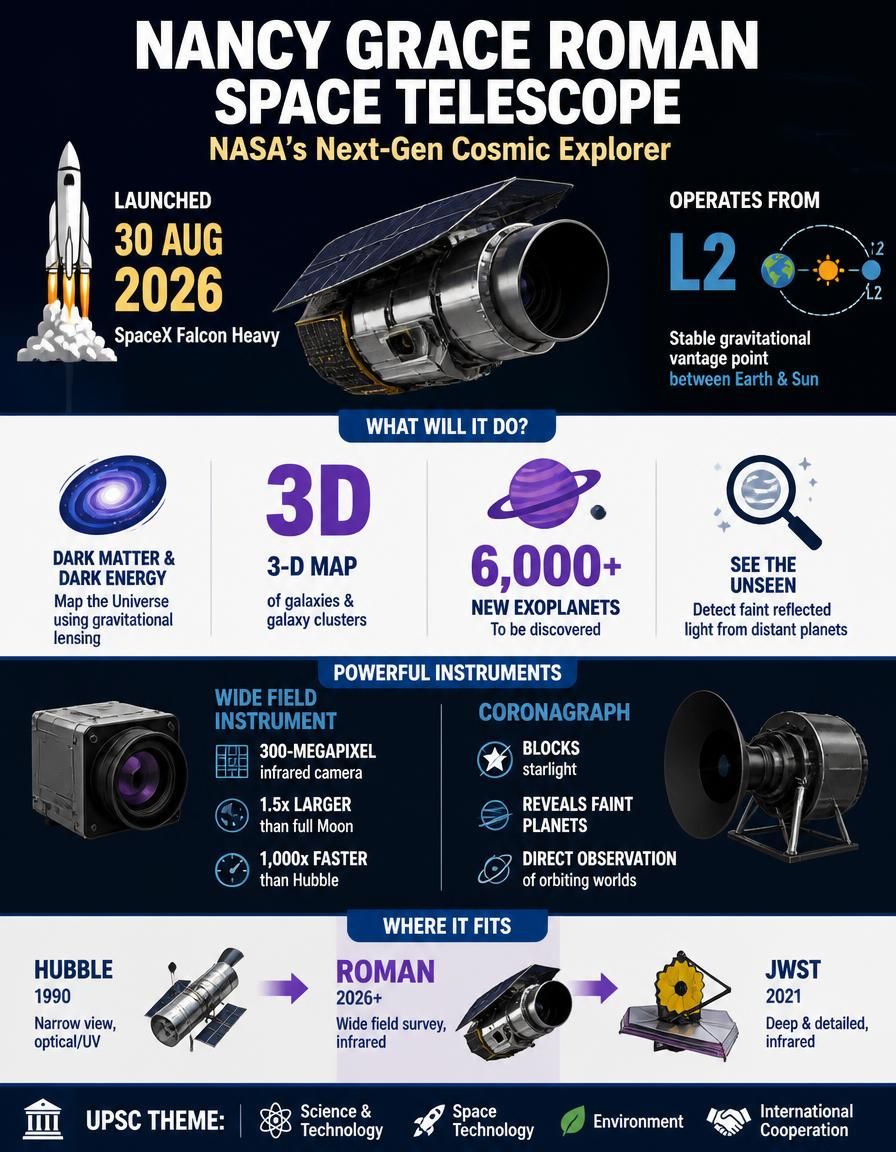
- The Nancy Grace Roman Space Telescope, named after Nancy Grace Roman ("Mother of Hubble"), was launched on August 30, 2026, by a SpaceX Falcon Heavy rocket.
- This next-generation NASA telescope aims to investigate cosmic mysteries such as dark matter, dark energy, and exoplanets.
- It operates from Lagrange Point 2 (L2), a stable gravitational vantage point between Earth and the Sun.
- The telescope is equipped with a Wide Field Instrument and a Coronagraph to achieve its scientific objectives.
Space Telescope.jpg
Detailed Insights:
- The Nancy Grace Roman Space Telescope is positioned between the capabilities of the Hubble Space Telescope and the James Webb Space Telescope.
- It will scan vast areas of the cosmos, providing new insights into the distribution and structure of dark matter and the nature of dark energy.
- The mission is expected to discover thousands of new exoplanets, significantly expanding the current count of over 6,000 identified exoplanets.
- The telescope will create a three-dimensional map of galaxies and galaxy clusters by measuring gravitational lensing.
- Its Wide Field Instrument is a 300-megapixel infrared camera, capable of imaging a sky patch 1.5 times larger than the full Moon and processing images 1,000 times faster than Hubble.
- The advanced Coronagraph will block starlight, enabling direct observation of faint reflected light from orbiting planets.
- The telescope, weighing approximately 8,000 kg, will undergo a 90-day commissioning phase before beginning its primary five-year science mission.
Scientific/Technical Concepts Involved:
- Dark Matter: An invisible form of matter, estimated to constitute about 27% of the universe, believed to hold galaxies together.
- Dark Energy: A mysterious repulsive force, making up about 68% of the universe, thought to be accelerating the universe's expansion.
- Exoplanets: Planets located outside our solar system, orbiting stars or remnant stars.
- Gravitational Lensing: The bending of light by massive objects, used to map the distribution of matter in the universe.
- Lagrange Point 2 (L2): A gravitationally stable point in space, approximately 1.5 million km from Earth, where the gravitational forces of the Sun and Earth balance.
- Coronagraph: An instrument designed to block the direct light from a star to enable observation of fainter objects nearby, such as exoplanets.

SuperKalam is your personal mentor for UPSC preparation, guiding you at every step of the exam journey.
Download the App


STUDY RESOURCES
CONTACT US
ⓒ Snapstack Technologies Private Limited