GS 2: International RelationsGS 3: EconomyPrelimsGS 3: Changes in Industrial Policy and Effects on Industrial GrowthGS 3: Indian Economy, Planning, Mobilization of Resources, Growth, Development and Employment
Exports Push GDP Growth, But Low-Margin Shipments Struggle, Pg1
India's exports drive 7.8% GDP growth despite West Asia crisis; high-margin goods thrive, but labour-intensive sectors face sharp declines.
Practice MCQs
811 Students attempted
Key Highlights:
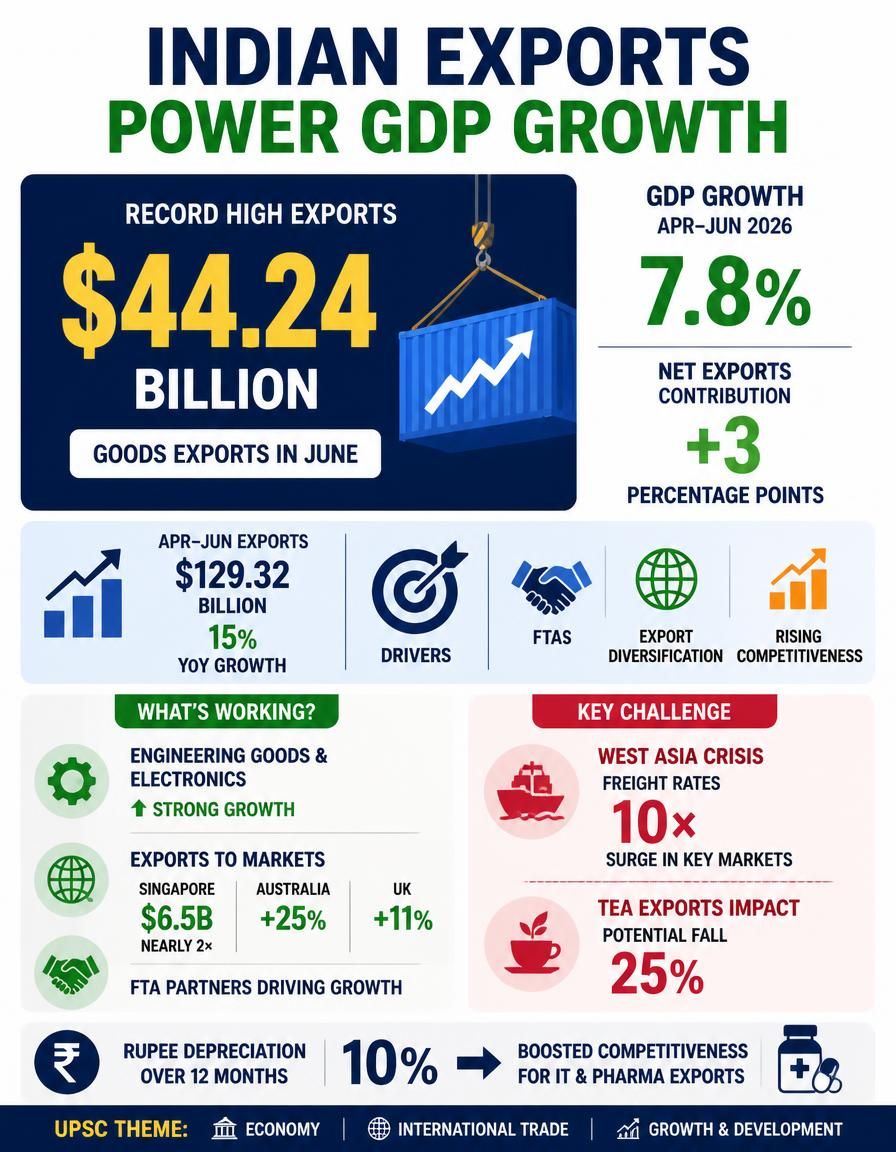
- India's goods exports reached a record $44.24 billion in June, contributing to an unexpectedly high 7.8% GDP growth in April-June.
- Overall goods exports for April-June rose 15% year-on-year to $129.32 billion.
- Chief Economic Adviser (CEA) V Anantha Nageswaran attributed this growth to Free Trade Agreements (FTAs), export diversification, and rising competitiveness.
- Net exports positively contributed 3 percentage points to GDP growth in April-June 2026, driven by a decline in real imports.
- High-end products like engineering goods and electronics saw significant growth, while labour-intensive and low-margin sectors such as textiles, leather, and tea experienced declines.
- The West Asia crisis led to a 10-fold surge in freight rates in key markets, impacting exporters' profit margins.
- A 10% depreciation of the Indian rupee over 12 months aided export competitiveness, particularly for IT and pharmaceuticals.
Indian Exports.jpg
Detailed Insights:
- The West Asia crisis significantly disrupted trade, leading to increased logistics costs that disproportionately affected low-margin export products.
- Exporters of high-margin goods could absorb the shock of higher freight rates, unlike those in sectors such as fruits, vegetables, ceramics, and jute products.
- The Indian Tea Exporters Association (ITEA) projected a potential 25% fall in tea exports due to the West Asia conflict and payment issues with Iran.
- India's export diversification efforts proved effective, with exports to Singapore nearly doubling to $6.5 billion during April-June, offsetting a decline in exports to the UAE.
- Exports to FTA partners like Australia and the UK also demonstrated robust growth, increasing by 25% and 11% respectively.
- The rupee's depreciation provided Indian exporters with a 15% advantage over China, whose yuan appreciated during the same period.
- Future export growth faces headwinds from volatile crude oil prices and potential supply disruptions, which could keep oil prices above $80 a barrel.
Key Concepts Involved:
- Free Trade Agreements (FTAs): Pacts between countries to reduce or eliminate tariffs and non-tariff barriers on goods and services.
- Net Exports: The value of a country's total exports minus the value of its total imports.
- Rupee Depreciation: A market-driven fall in the value of the Indian rupee against foreign currencies, making exports cheaper.
- GDP Growth: The rate at which a country's Gross Domestic Product, the total value of goods and services produced, increases over time.

SuperKalam is your personal mentor for UPSC preparation, guiding you at every step of the exam journey.
Download the App


STUDY RESOURCES
CONTACT US
ⓒ Snapstack Technologies Private Limited