GS 2: GovernanceGS 3: Science & TechnologyGS 3: Environment & EcologyGS 3: EconomyPrelims
Why Lab-Grown Diamonds Are Sustainable Alternative To Mined Stones, Pg9
Lab-grown diamonds emerge as a sustainable, ethical alternative to mined stones, addressing environmental damage, conflict, and worker exploitation with advanced technology and government support.
Practice MCQs
804 Students attempted
Key Highlights:
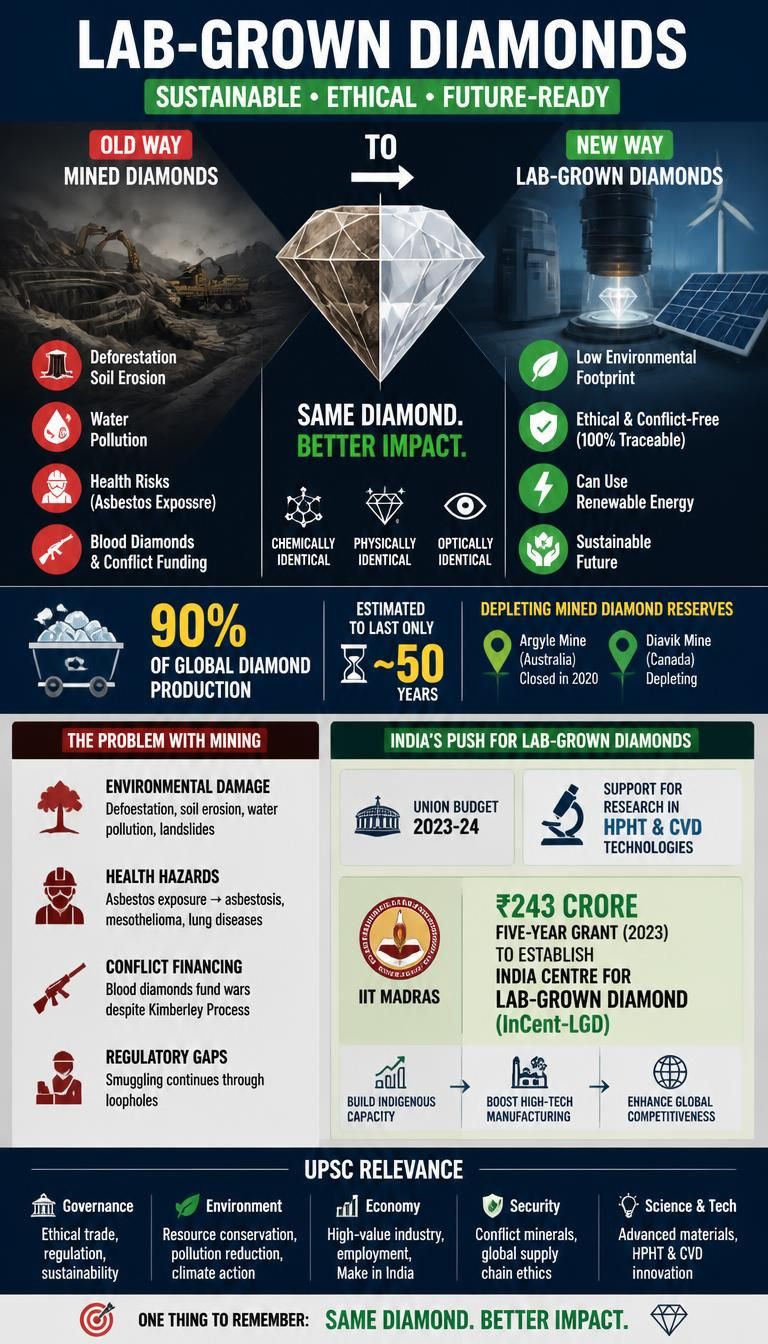
- Lab-grown diamonds are emerging as a sustainable alternative to mined diamonds, addressing issues like forced labor, civil violence, and environmental damage associated with traditional mining.
- Mined diamond reserves, including major sites like the Argyle mine and Diavik mine, are depleting, with an estimated lifespan of 50 years for 90% of global production.
- India is actively promoting indigenous production of lab-grown diamonds, with the Union Budget 2023-24 announcing support for research in HPHT and CVD technologies.
- The Indian Institute of Technology Madras (IIT Madras) received a five-year grant of approximately ₹243 crore to establish the India Centre for Lab-Grown Diamond (InCent-LGD) in 2023.
- Lab-grown diamonds are chemically, physically, and optically identical to natural diamonds but offer traceability and reduced environmental impact, especially when produced using renewable energy.
Lab Grown Diamond.jpg
Detailed Insights:
- Traditional diamond mining causes significant environmental damage, including deforestation, soil erosion, water pollution, and can trigger landslides.
- Workers in diamond mines face health risks such as asbestos exposure, leading to diseases like asbestosis and mesothelioma.
- Blood diamonds, used to fund military actions, persist despite the Kimberley Process, due to regulatory gaps allowing smuggling.
- The first synthetic diamonds were created by GE (General Electric) in 1954 using the High Pressure, High Temperature (HPHT) process.
- The Chemical Vapour Deposition (CVD) method for growing diamonds was introduced in 1962, involving carbon-rich gases.
- The cost of lab-grown diamonds has decreased significantly due to improved efficiency in production, making them more affordable.
- Production of lab-grown diamonds using renewable energy sources aligns with the United Nations Sustainable Development Goals (SDGs) and principles of a circular economy.
- Diamonds have diverse applications beyond jewelry, including heavy-duty industrial processes, quantum computing, and semiconductor manufacturing.
Scientific/Technical Concepts Involved:
- High Pressure, High Temperature (HPHT): A method for growing diamonds by mimicking the natural conditions of extreme pressure and heat found in the Earth's mantle.
- Chemical Vapour Deposition (CVD): A process where diamond material is deposited onto a substrate from a gas phase, typically involving carbon-rich gases.
- Asbestosis: A chronic lung disease caused by inhaling asbestos fibers, leading to scarring of lung tissue.
- Circular Economy: An economic system aimed at eliminating waste and the continual use of resources, promoting reuse, repair, and recycling.

SuperKalam is your personal mentor for UPSC preparation, guiding you at every step of the exam journey.
Download the App


STUDY RESOURCES
CONTACT US
ⓒ Snapstack Technologies Private Limited