GS 2: GovernanceGS 2: PolityGS 2: Social JusticePrelimsGS 2: Government policies and interventions for development in various sectors
Top court asks govt. to ensure safe footpaths, Pg12
Supreme Court mandates Union government to provide broad, clear footpaths, affirming the right to walk as a fundamental right for all citizens.
Practice MCQs
804 Students attempted
Key Highlights:
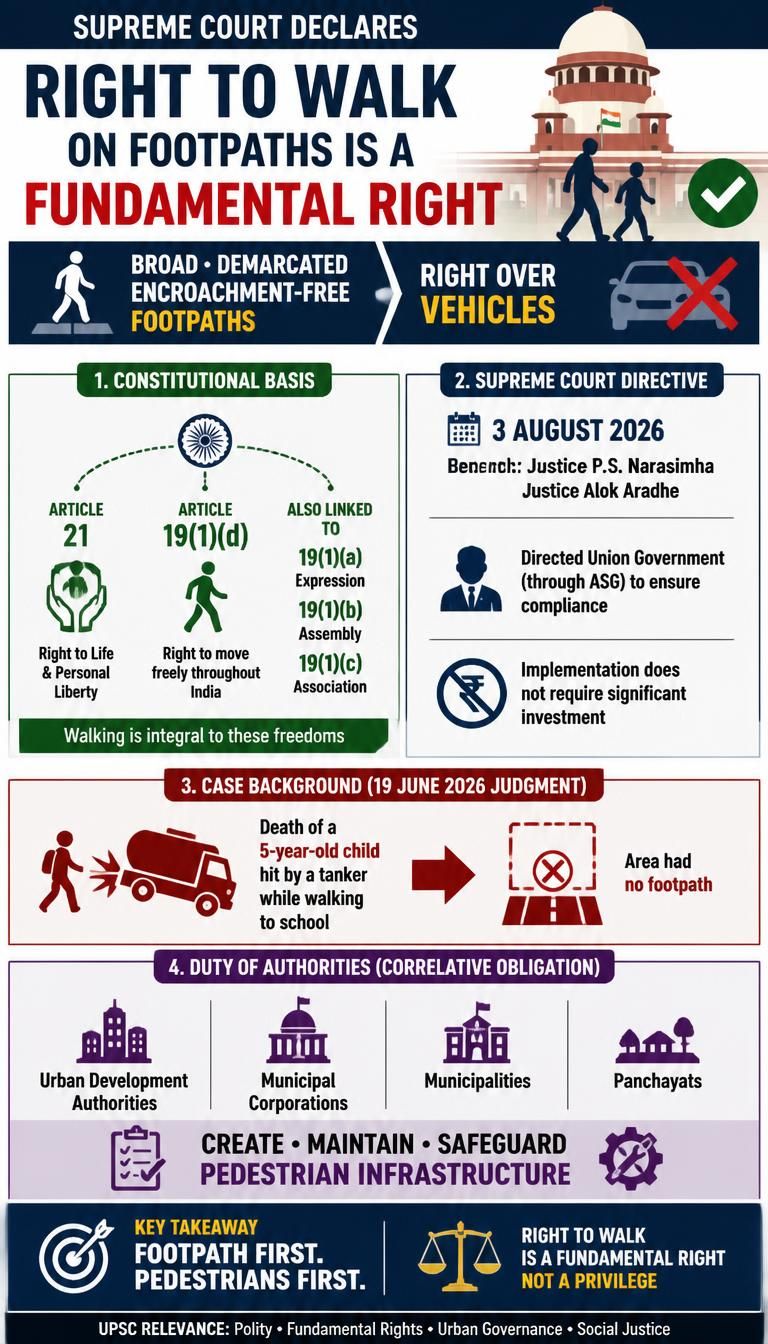
- The Supreme Court directed the Union government to ensure broad, clearly-marked, and encroachment-free footpaths for pedestrians.
- A Bench headed by Justice P.S. Narasimha emphasized that the right to a clean and broad footpath is a Fundamental Right.
- This directive reinforces the Supreme Court's earlier ruling on June 19, 2026, which formally declared the right to walk on demarcated footpaths as a Fundamental Right.
- The court stated that this right takes precedence over the movement of motorized vehicles and does not require significant investment for implementation.
Right to Walk.jpg
Detailed Insights:
- The Supreme Court's directive on August 3, 2026, was issued by a Bench comprising Justice P.S. Narasimha and Justice Alok Aradhe, instructing the Additional Solicitor-General to ensure compliance.
- The Fundamental Right to walk on footpaths is rooted in Article 21 (Right to Life and Personal Liberty) and Article 19(1)(d) (Right to move freely throughout the territory of India) of the Constitution.
- This right also encompasses aspects of Article 19(1)(a) (freedom of expression), Article 19(1)(b) (assembly), and Article 19(1)(c) (association), as walking is integral to these freedoms.
- The June 19, 2026, judgment originated from a case concerning the death of a five-year-old child who was struck by a tanker while walking to school in an area lacking a footpath.
- The ruling places a correlative duty on urban development authorities, municipal corporations, municipalities, and panchayats to create, maintain, and safeguard pedestrian infrastructure.
- The Supreme Court has also urged the government to formulate a specific law and establish a regulatory body to protect pedestrian rights and ensure accountability.
- The court critiqued the Motor Vehicles Act, 1988, for primarily focusing on vehicles while neglecting pedestrian rights, highlighting a civilizational problem of subjugating pedestrian spaces to motor transport.
Key Concepts Involved:
- Fundamental Right: Basic human rights enshrined in the Constitution, enforceable by courts, including the right to life, liberty, and freedom of movement.
- Article 21: Guarantees the Right to Life and Personal Liberty, broadly interpreted by the Supreme Court to include a dignified life, safe environment, and access to basic conditions.
- Article 19(1)(d): Enshrines the right of all citizens to move freely throughout the territory of India, which is rendered ineffective without safe pedestrian spaces.
- Judicial Expansion of Article 21: The Supreme Court has consistently broadened the scope of Article 21 through landmark judgments like the Maneka Gandhi Case (1978) and the Olga Tellis Case (1985), linking it to various aspects of dignified living.

SuperKalam is your personal mentor for UPSC preparation, guiding you at every step of the exam journey.
Download the App


STUDY RESOURCES
CONTACT US
ⓒ Snapstack Technologies Private Limited