GS 2: GovernanceGS 1: Indian GeographyGS 3: Disaster ManagementGS 3: Environment & EcologyPrelims
Listening to rivers, learning from fires, Pg10
Climate change impacts unfold distinctly across diverse ecologies, demanding proactive governance, ecological stewardship, and localized disaster preparedness beyond mere relief efforts.
Practice MCQs
804 Students attempted
Key Highlights:
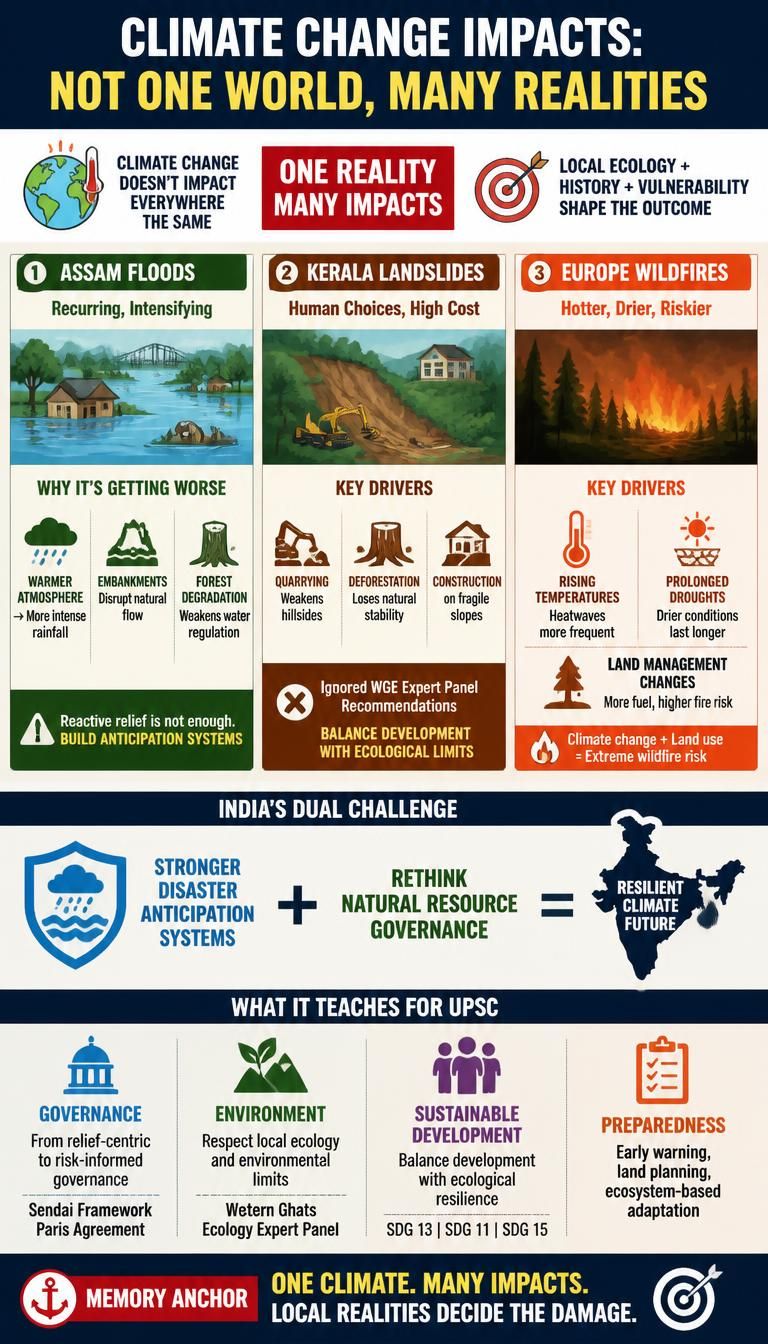
- Recent global events, including floods in Assam and Kerala, and wildfires in Europe, underscore the diverse impacts of climate change.
- The article emphasizes that climate change consequences are profoundly shaped by distinct local ecologies, histories, and vulnerabilities.
- Assam Chief Minister Himanta Biswa Sarma highlighted the limitations of a reactive, relief-centric approach to recurring floods.
- Human activities such as quarrying, deforestation, and construction on fragile hillsides exacerbate landslide damage in Kerala.
- European wildfires are intensified by rising temperatures and prolonged droughts, alongside changes in land management practices.
- India faces the dual challenge of building stronger disaster anticipation systems and rethinking natural resource governance in a changing climate.
Climate change impact.jpg
Detailed Insights:
- The Brahmaputra river system's natural dynamism in Northeast India is intensified by a warmer atmosphere leading to more intense rainfall.
- Embankments and forest degradation in river catchments further weaken the landscape's ability to regulate water flows, increasing flood vulnerability.
- Kerala's increased susceptibility to landslides is partly due to its resistance to recommendations from the Western Ghats Ecology Expert Panel.
- The Western Ghats Ecology Expert Panel had advocated for greater caution in ecologically sensitive areas to balance development with environmental limits.
- Mediterranean ecosystems, historically evolved with fire, now face intensified risks due to prolonged droughts and the accumulation of unmanaged combustible vegetation.
- Scientific advances, including climate attribution studies and satellite monitoring, enhance the understanding of global warming's influence on specific events.
- Disaster risk is a complex outcome influenced by governance, ecological stewardship, and social vulnerabilities, not solely by meteorological factors.
- India's adaptation strategies must be locally grounded, providing specific responses to regional risks rather than a single, uniform blueprint.
Key Concepts Involved:
- Climate Attribution Studies: Scientific methods used to determine the extent to which human-induced climate change influences specific extreme weather events.
- Hydrological Cycle: The continuous movement of water on, above, and below the surface of the Earth, intensified by a warming atmosphere.
- Ecological Stewardship: The responsible management and protection of the natural environment through conservation and sustainable practices.
- Western Ghats Ecology Expert Panel: A committee formed by the Indian government to assess and recommend conservation measures for the ecologically sensitive Western Ghats region.

SuperKalam is your personal mentor for UPSC preparation, guiding you at every step of the exam journey.
Download the App


STUDY RESOURCES
CONTACT US
ⓒ Snapstack Technologies Private Limited