GS 3: Environment & Ecology
Why collared Kuno cheetahs cannot be live-tracked, Pg14
The article explains the technical limitations of satellite collars used to monitor Kuno's cheetahs and why they cannot provide continuous live tracking.
Practice MCQs
819 Students attempted
Key Highlights:
- Kuno National Park Director Uttam Kumar Sharma said satellite collars are not a "live telecast" and cannot provide continuous live tracking.
- His note followed the suspension of six forest department officials over the death of KNG22, a male cheetah found seriously injured in the Sheopur territorial forest division on October 25.
- Monitoring teams track around 15 cheetahs at Kuno using satellite collars and very high frequency (VHF) radio receivers.
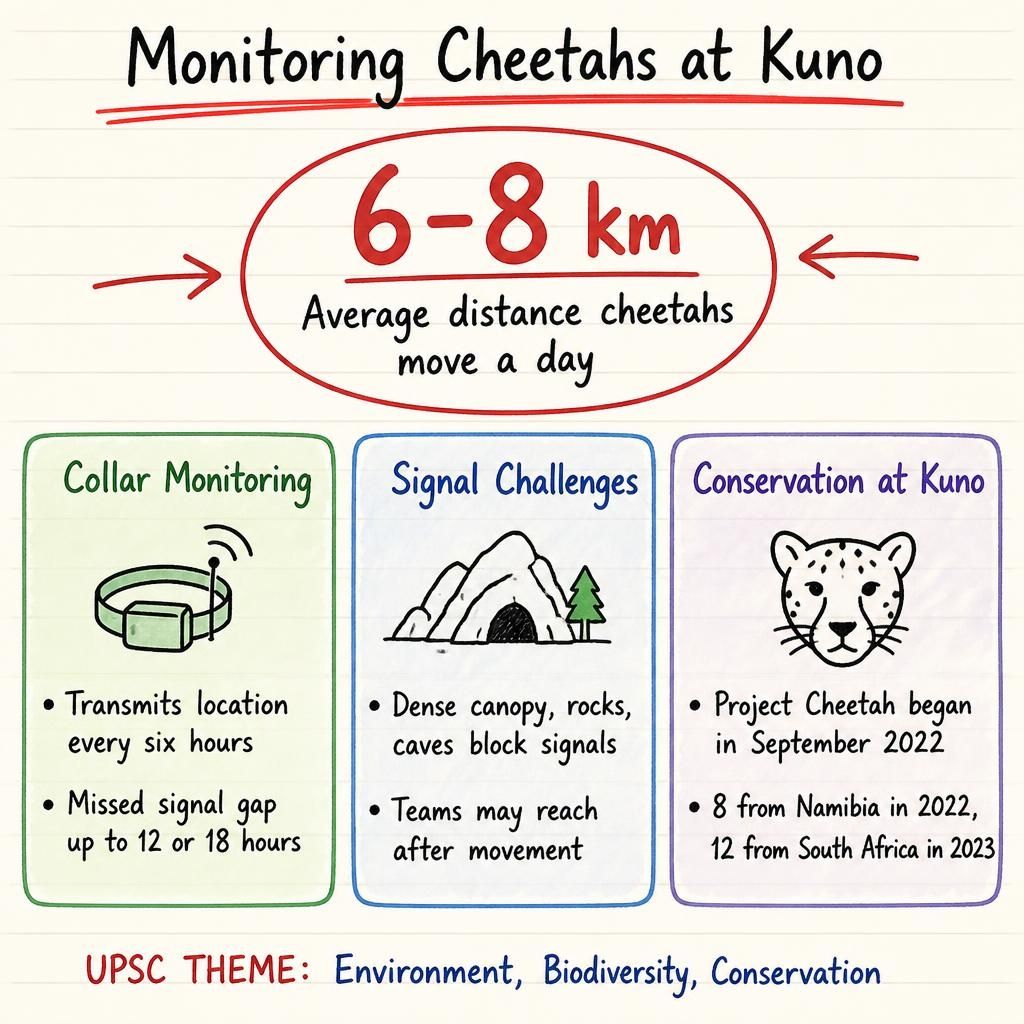
- Collars are generally programmed to transmit location every six hours; a missed transmission can extend the gap to 12 or even 18 hours.
- Satellite collars are expensive, generally costing around Rs 4-5 lakh each.
Cheetah in Kuno.jpg
Detailed Insights:
- Dense forest canopy, rocky terrain, caves and deep valleys can block GPS fixes or satellite visibility, so temporary signal loss is not unusual.
- Cheetahs move an average of 6-8 km a day, often 12-15 km, mostly in early morning and late evening, so teams may reach a location after the animal has moved on.
- Transmission frequency balances monitoring needs against battery life and the expected duration of collar use.
- Project Cheetah began reintroducing African cheetahs at Kuno National Park, Madhya Pradesh, in September 2022; the species went extinct in India in 1952.
- Eight cheetahs from Namibia were released in 2022, followed by twelve from South Africa in 2023.
- Vehicles cannot follow cheetahs in straight lines through forests, so field teams rely on VHF equipment to locate animals precisely.
Scientific/Technical Concepts Involved:
- Satellite telemetry collar: A GPS collar that transmits an animal's location at set intervals via satellite.
- Very High Frequency (VHF) tracking: Ground-based radio tracking used to pinpoint collared animals over shorter ranges.
- Project Cheetah: India's programme to reintroduce African cheetahs, launched at Kuno National Park in 2022.
- Extirpation: The local extinction of a species from part of its range, as with the cheetah in India in 1952.
Previous11/11

SuperKalam is your personal mentor for UPSC preparation, guiding you at every step of the exam journey.
Download the App


STUDY RESOURCES
CONTACT US
ⓒ Snapstack Technologies Private Limited