GS 3: Environment & Ecology
Smaller cities can lead the way on climate resilience, Pg11
The authors argue that smaller cities can lead climate-resilient development by including heat and flood planning in everyday urban decisions.
Practice MCQs
819 Students attempted
Key Highlights:
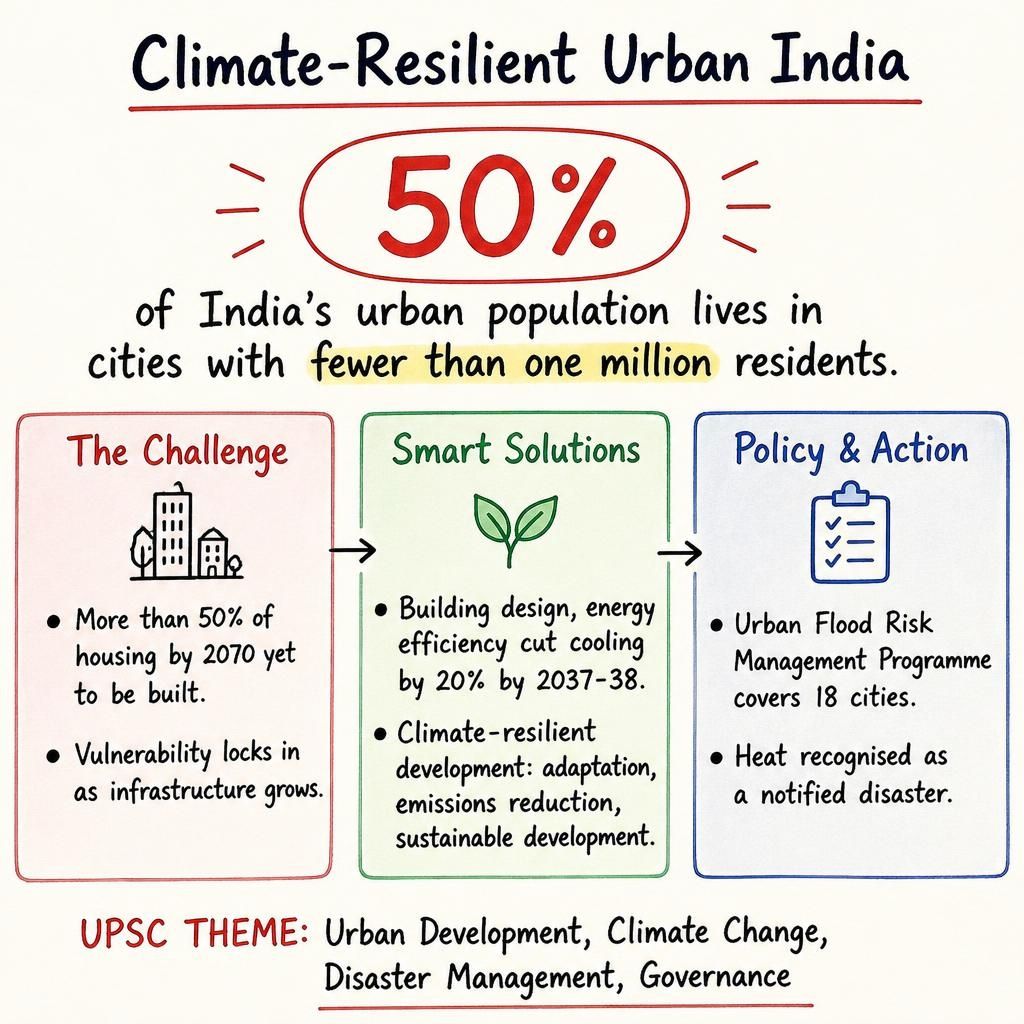
- More than half of India's urban population lives in cities with fewer than one million residents.
- Estimates indicate that more than 50% of the housing needed by 2070 is yet to be built.
- The authors invoke the Intergovernmental Panel on Climate Change framework of climate-resilient development, which combines adaptation, emissions reduction and sustainable development.
- India's Long-Term Low Emissions Development Strategy and the National Mission on Sustainable Habitat provide the policy framework for such integration.
- The India Cooling Action Plan estimates building design, energy efficiency and thermal comfort practices could cut cooling demand by 20% by 2037-38.
- Recent steps include the Urban Flood Risk Management Programme covering 18 cities and the recognition of heat as a notified disaster.
Climate Resilient Urban India.jpg
Detailed Insights:
- A study across 88 Indian cities found that land use, building density, urban expansion and green cover shape cooling demand, not temperatures alone.
- The authors argue smaller cities can avoid costly retrofitting by shaping expansion now, before roads, drainage and buildings lock in vulnerability.
- They recommend making climate part of routine planning, project appraisal and investment, with stronger coordination between departments.
- They suggest using existing municipal revenues, government transfers and scheme grants, complemented by CSR funding, impact investment and development finance.
- Spatial data, vulnerability assessments and scenario modelling work best when combined with local knowledge and lived experience, they say.
- Recognition of heat as a notified disaster enables the use of disaster funds for heat resilience.
Key Concepts Involved:
- Climate-resilient development: The IPCC framework combining adaptation, emissions reduction and sustainable development.
- National Mission on Sustainable Habitat: One of the eight missions under India's National Action Plan on Climate Change, focused on sustainable urbanisation.
- Notified disaster: A hazard officially recognised under the Disaster Management Act, 2005, unlocking disaster-response funds.
- India Cooling Action Plan: The 2019 roadmap to cut cooling demand, refrigerant use and cooling-related energy needs over two decades.

SuperKalam is your personal mentor for UPSC preparation, guiding you at every step of the exam journey.
Download the App


STUDY RESOURCES
CONTACT US
ⓒ Snapstack Technologies Private Limited