GS 3: Environment & EcologyPrelims
PM: India to add 500 GW non-fossil fuel capacity in the next 10-11 years, Pg8
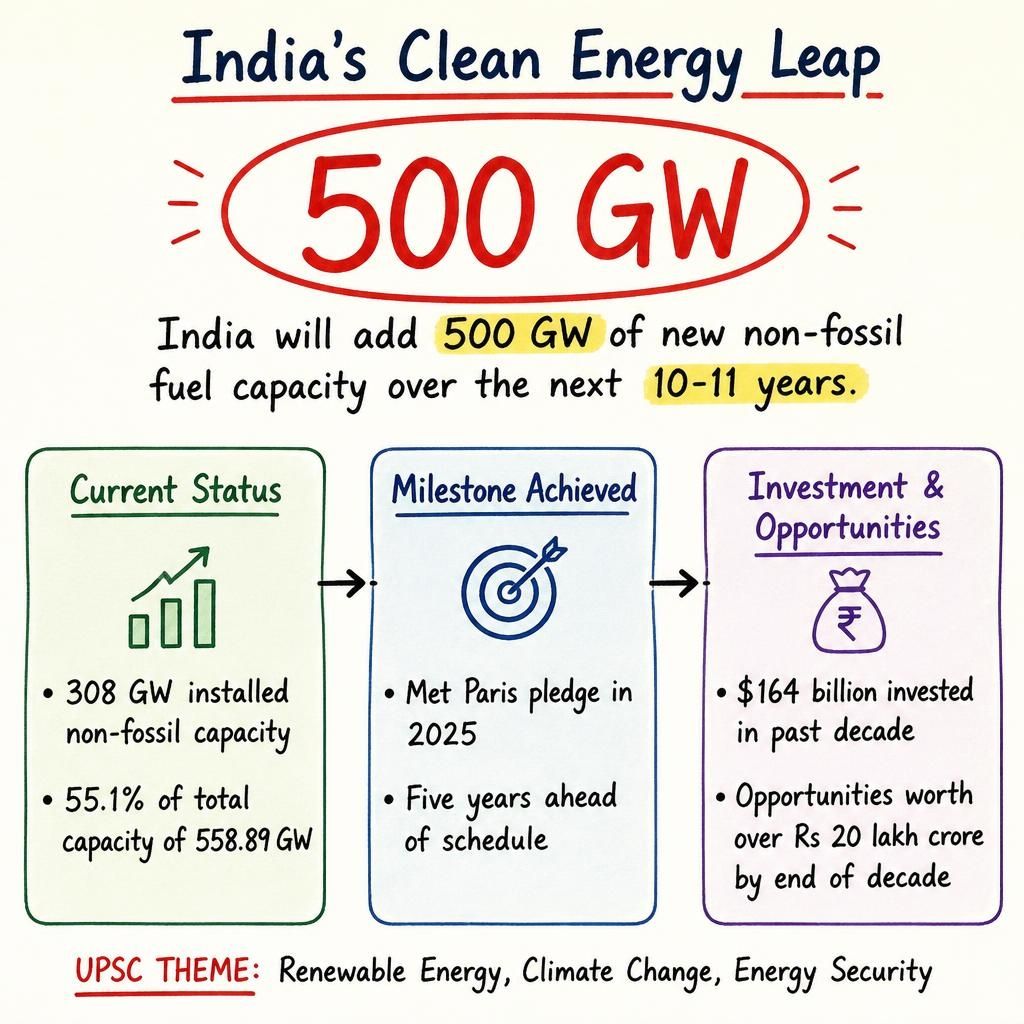
Prime Minister Narendra Modi said India will add 500 GW of new non-fossil fuel capacity over the next 10-11 years, speaking at the Bharat Renewable Energy Summit and Expo 2026.
Practice MCQs
819 Students attempted
Key Highlights:
- Prime Minister Narendra Modi said India will add 500 GW of new non-fossil fuel capacity over the next 10-11 years.
- He was speaking at the inaugural session of the Bharat Renewable Energy Summit and Expo 2026 in New Delhi.
- India currently has 308 GW of installed non-fossil capacity, about 55.1% of its total power generation capacity of 558.89 GW (Central Electricity Authority).
- Modi said India met its Paris pledge of half its installed power capacity from non-fossil sources in 2025, five years ahead of schedule.
- More than $164 billion has been invested in the renewable energy sector over the past decade, and about $63 billion since the RE-INVEST Summit 2024.
- He estimated investment opportunities worth over Rs 20 lakh crore, or around $220 billion, in the sector by the end of this decade.
Clean Energy.jpg
Detailed Insights:
- The new pledge is distinct from the existing target of 500 GW non-fossil capacity by 2030, under which nearly 300 GW has been achieved.
- These targets flow from India's updated Nationally Determined Contribution under the Paris Agreement, submitted in 2022.
- Modi credited clean-energy investment with helping India avert an energy crisis during the West Asia war, arguing fossil-fuel dependence keeps disrupting the global economy.
- India is among the top three countries in the world in solar and renewable energy capacity, the Prime Minister said.
- India has announced a broader goal of becoming a net-zero emitter by 2070, declared at COP26 in Glasgow.
- Non-fossil capacity spans solar, wind, hydro, nuclear and bio-energy; the expansion is central to India's energy security strategy.
Key Concepts Involved:
- Nationally Determined Contribution: A country's self-set climate action plan under the Paris Agreement, updated every five years.
- Non-fossil fuel capacity: Power generation capacity from solar, wind, hydro, nuclear and biomass sources.
- Paris Agreement: The 2015 UN climate treaty aiming to hold global warming well below 2 degrees Celsius, pursuing 1.5 degrees.
- Net zero: Balancing greenhouse gas emissions with removals; India's announced target year is 2070.

SuperKalam is your personal mentor for UPSC preparation, guiding you at every step of the exam journey.
Download the App


STUDY RESOURCES
CONTACT US
ⓒ Snapstack Technologies Private Limited