GS 3: Science & TechnologyPrelimsGS 3: Space Technology
Milky Way grew by devouring galaxies, leaving ghost stars, Pg II
New research reveals Milky Way's violent growth through absorbing smaller galaxies, leaving behind 'ghost stars' and altering its structure over billions of years.
Practice MCQs
819 Students attempted
Key Highlights:
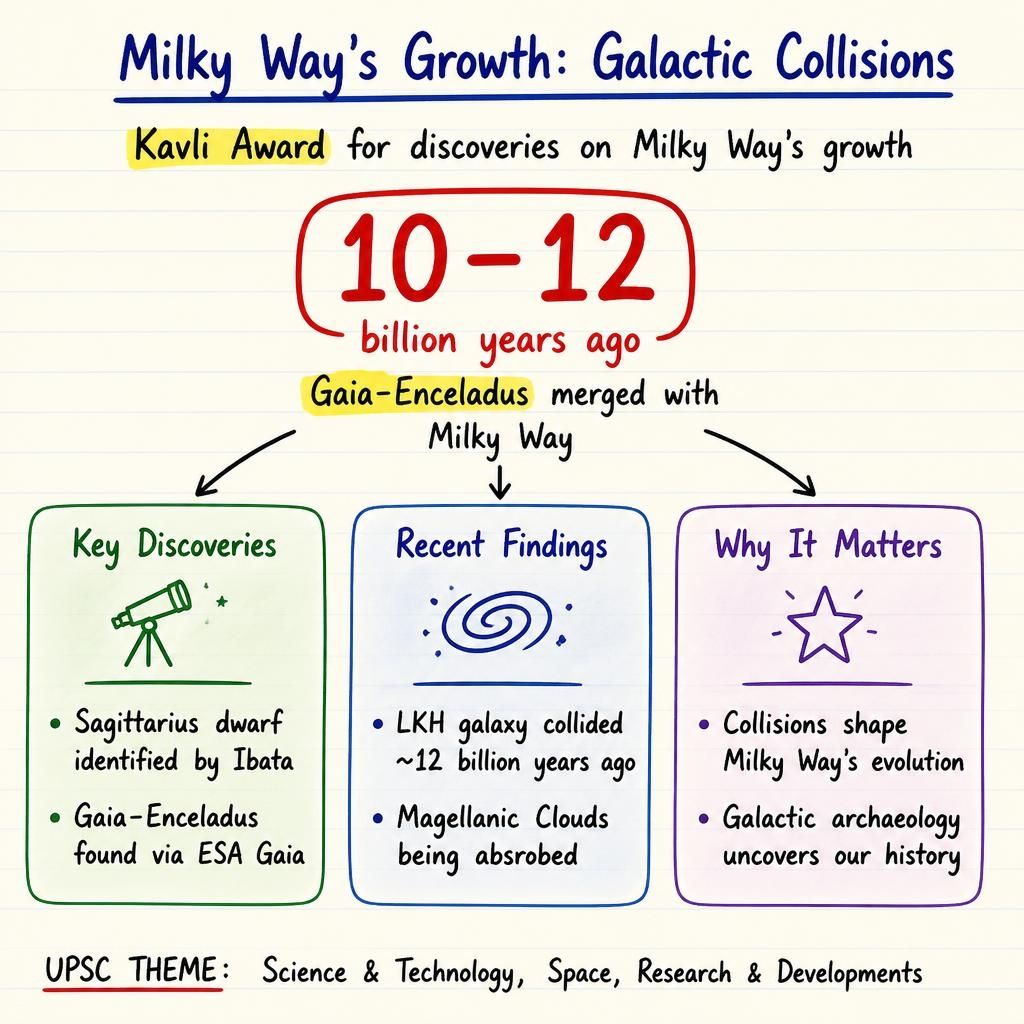
- Astronomers Vasily Belokurov, Amina Helmi, and Rodrigo Ibata received the Kavli Award for their discoveries on the Milky Way's growth through galactic collisions.
- Rodrigo Ibata first identified the Sagittarius dwarf galaxy being absorbed by the Milky Way over three decades ago.
- Amina Helmi utilized data from the European Space Agency's (ESA) Gaia mission to identify Gaia-Enceladus, a galaxy that merged with the Milky Way 10-12 billion years ago.
- Recent research confirmed the Low-energy-Kraken-Heracles (LKH) galaxy collided with the Milky Way around 12 billion years ago, potentially marking its first major merger.
- The Small and Large Magellanic Clouds, two of the closest galaxies, are currently in the process of being absorbed by the Milky Way.
Milky Way Galaxy.jpg
Detailed Insights:
- Galaxies evolve through a "snowball effect" of violent collisions, where larger galaxies gravitationally tear apart smaller ones.
- Remnants of absorbed galaxies are identifiable by streams and clusters of stars with distinct motions and chemical compositions.
- Galactic archaeology is a field that uses precise measurements of stellar age, chemistry, and motion to reconstruct the Milky Way's evolutionary history.
- Dr. Ibata's discovery of the Sagittarius dwarf galaxy provided the first direct evidence of galactic absorption, stimulating further research into the Milky Way's past mergers.
- Dr. Helmi's theoretical models predicted the visible star streams left behind by destroyed galaxies, which were later confirmed by ESA Gaia mission data.
- The collision with Gaia-Enceladus was significant enough to have altered the Milky Way's overall shape.
- Studying very old collisions, such as with LKH, is challenging due to the young state of the merging galaxies and obscuring stardust in the galactic bulge.
- Researchers analyze globular clusters, which are groups of millions of stars born together, to trace the origins of ancient mergers.
- Upcoming instruments like 4MOST and the MOONS telescope are expected to provide more detailed data, further enhancing our understanding of galactic history.
Scientific/Technical Concepts Involved:
- Tidal Forces: Gravitational forces exerted by a larger celestial body that stretch and deform a smaller body.
- Galactic Archaeology: The study of the formation and evolution of galaxies by analyzing the properties and distribution of their stars.
- Globular Clusters: Dense, spherical collections of hundreds of thousands to millions of stars, gravitationally bound together.
- Photometry: The measurement of the intensity of light from celestial objects, used to determine their brightness and color.
- Spectroscopy: The study of light emitted or absorbed by celestial objects to determine their chemical composition, temperature, and velocity.

SuperKalam is your personal mentor for UPSC preparation, guiding you at every step of the exam journey.
Download the App


STUDY RESOURCES
CONTACT US
ⓒ Snapstack Technologies Private Limited