GS 3: Science & TechnologyPrelims
Binance sees $4.7 billion in withdrawals after heist raises security concerns, Pg2
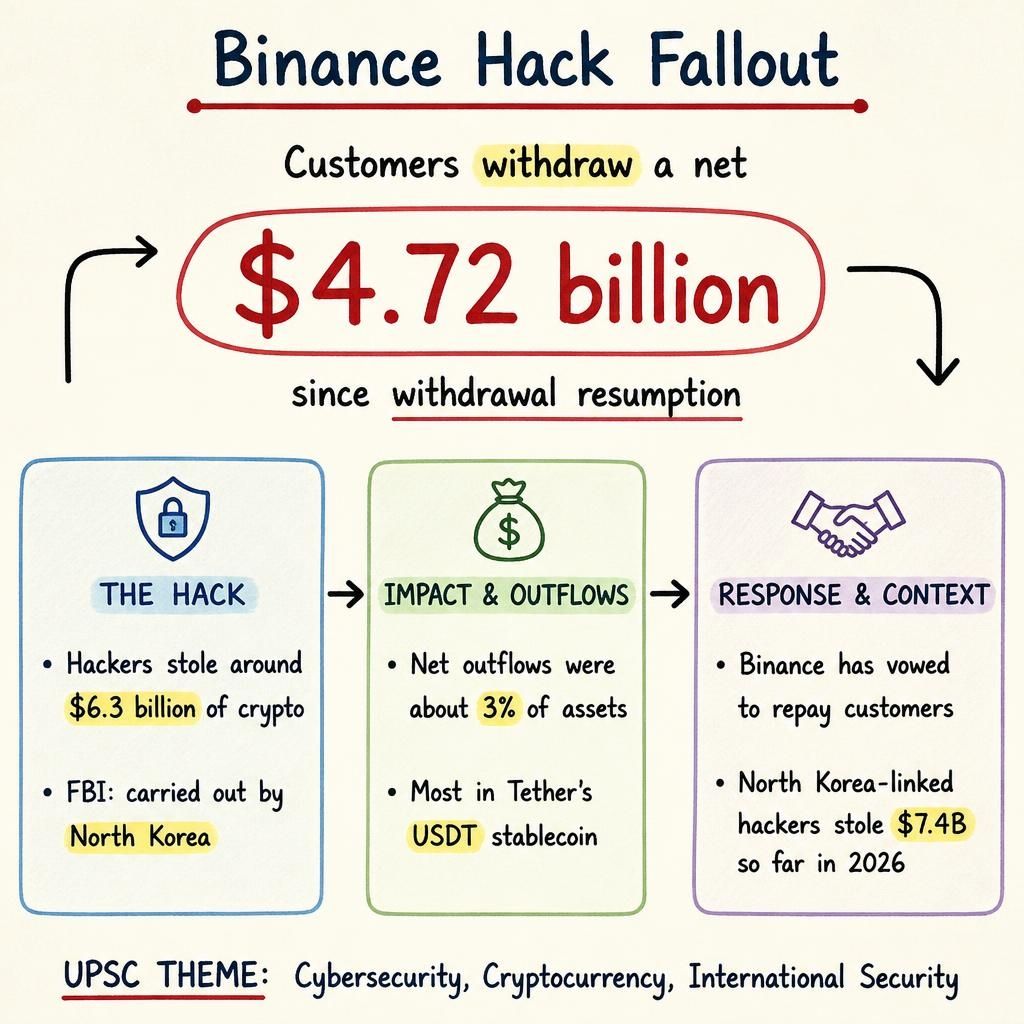
Customers withdrew a net $4.72 billion from Binance after hackers, which the FBI said were linked to North Korea, stole around $6.3 billion in what could be the largest financial heist in history.
Practice MCQs
819 Students attempted
Key Highlights:
- Customers have withdrawn a net $4.72 billion from Binance, the world's biggest cryptocurrency exchange, since it reopened withdrawals after the hack.
- Hackers stole around $6.3 billion of crypto from the platform in what could be the largest financial heist in history.
- The Federal Bureau of Investigation said the theft was carried out by North Korea; withdrawals were frozen for about 48 hours and resumed on Sunday.
- Net outflows were about 3% of assets on the platform, most in Tether's USDT stablecoin; Binance has vowed to repay customers in full.
- Blockchain analytics firm TRM Labs said North Korea-linked hackers have stolen $7.4 billion so far in 2026.
Binance Hack.jpg
Detailed Insights:
- The theft occurred on or about October 29; the FBI tracks this North Korean cyber activity as TraderTraitor, saying stolen assets are being converted mainly into Ether.
- North Korea denied involvement through state media, calling the US attribution a "grave political provocation."
- Elliptic put the stolen amount at $6.43 billion and said about $2.85 billion has been frozen or seized, including stablecoins frozen by issuers such as Tether and Circle.
- Elliptic said the laundering is slower than after the $1.5 billion Bybit hack in February 2025, when North Korean hackers moved all the stolen ether within 10 days.
- Binance said it has covered about 95% of the affected amount and is working with partners to source the remaining less-liquid tokens.
- The outflow compares with about $7 billion withdrawn from Circle's USDC after the Silicon Valley Bank collapse in 2023, and about $6 billion of Binance net outflows after the FTX collapse in 2022.
Scientific/Technical Concepts Involved:
- Cryptocurrency exchange: An online platform where users buy, sell and store digital assets such as Bitcoin and Ether.
- Stablecoin: A cryptocurrency pegged to a reserve asset, usually the US dollar, such as USDT and USDC.
- Blockchain analytics: Tracing transactions on public blockchain ledgers to follow the movement of stolen funds.
- DeFi laundering: Converting stolen crypto through decentralised finance and instant-swap services to hide its origin.

SuperKalam is your personal mentor for UPSC preparation, guiding you at every step of the exam journey.
Download the App


STUDY RESOURCES
CONTACT US
ⓒ Snapstack Technologies Private Limited