GS 2: GovernanceGS 2: PolityGS 2: Social JusticeGS 3: EconomyPrelims
India's twin mechanism for governing drug prices, Pg13
Supreme Court slams 'carnage' in drug pricing, questioning 16% retailer margin and inflated MRPs, urging stricter enforcement of price controls.
Practice MCQs
811 Students attempted
Key Highlights:
- The Supreme Court recently criticized the significant markup in medicine prices, terming the difference between retailer cost and Maximum Retail Price (MRP) as "carnage" and "broad daylight dacoity".
- A bench of Justices Vikram Nath and Sandeep Mehta questioned why the 16% retailer margin under the Drugs (Prices Control) Order (DPCO), 2013, should not apply to all medicines.
- The remarks were made during hearings on petitions seeking regulation of drug prices, generic prescriptions, and medical devices.
- The court highlighted an essential cancer drug sold to retailers for ₹2,700 but with an MRP of nearly ₹27,000, questioning the 10-fold difference.
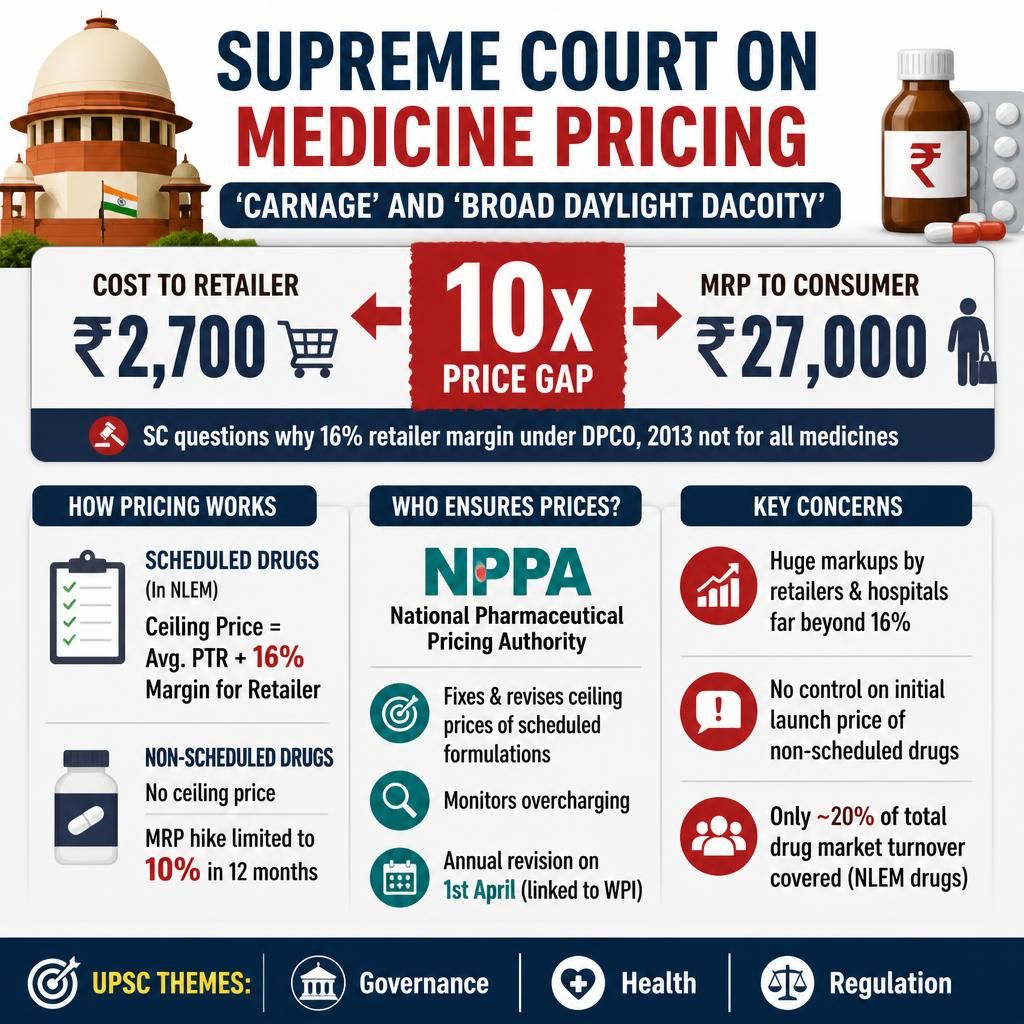
Medicine Pricing.jpg
Detailed Insights:
- The Essential Commodities Act of 1955 grants the Union government powers to regulate essential goods, including medicines, to ensure equitable distribution and fair prices.
- The DPCO is the primary framework for governing medicine prices in India, issued under Section 3(2)(c) of the Essential Commodities Act.
- The National Pharmaceutical Pricing Authority (NPPA), established in 1997, is responsible for fixing and revising ceiling prices of scheduled formulations and monitoring overcharging.
- Medicines are categorized into scheduled and non-scheduled formulations, with scheduled drugs listed in Schedule I of the DPCO based on the National List of Essential Medicines (NLEM).
- The NLEM identifies medicines crucial for the country's healthcare needs, but these account for only about 20% of the total drug market turnover.
- Ceiling prices for scheduled formulations are calculated by the NPPA based on the average Price to Retailer (PTR) of versions with significant market share, plus a 16% retailer's margin.
- Ceiling prices are revised annually on April 1, linked to changes in the Wholesale Price Index (WPI), allowing manufacturers to adjust prices accordingly.
- Non-scheduled formulations, not on the NLEM, do not have price ceilings, though their MRP cannot be increased by more than 10% in 12 months.
- Petitions challenge the lack of control over initial launch prices for non-scheduled drugs, arguing it allows inflated pricing from the outset.
- Concerns have been raised about significant markups by retailers and hospitals, with some claiming profits far exceeding the permissible 16% margin for scheduled drugs.
- The right to health, guaranteed under Article 21 (Right to Life), is cited in pleas challenging the lack of comprehensive price control.
- Branded medicines are often significantly more expensive than their generic counterparts, with differences ranging from 50% to 90%.
Key Concepts Involved:
- Essential Commodities Act, 1955: Legislation empowering the government to control production, supply, and distribution of essential goods to ensure fair prices.
- Drugs (Prices Control) Order (DPCO): A statutory order issued under the Essential Commodities Act to regulate the prices of essential drugs in India.
- National Pharmaceutical Pricing Authority (NPPA): An independent body under the Department of Pharmaceuticals responsible for fixing and enforcing drug prices.
- National List of Essential Medicines (NLEM): A list of medicines identified by the Ministry of Health and Family Welfare as essential for public health needs.

SuperKalam is your personal mentor for UPSC preparation, guiding you at every step of the exam journey.
Download the App


STUDY RESOURCES
CONTACT US
ⓒ Snapstack Technologies Private Limited