GS 2: GovernanceGS 2: International RelationsGS 3: EconomyPrelimsGS 3: Effects of Liberalization on the Economy
India’s Model BIT — a decade later, amid changes, Pg6
India revises its Model Bilateral Investment Treaty, announced in Budget 2025-26, to create an investor-friendly framework adapting to evolving international investment regimes.
Practice MCQs
811 Students attempted
Key Highlights:
- India is revising its Model Bilateral Investment Treaty (BIT), nearly a decade after the previous model was approved in 2015.
- The Union Budget 2025-26 announced the revamp, aiming for a more investor-friendly framework.
- The revision is prompted by evolving international investment regimes and changes in India's own treaty practices.
- The 2015 Model BIT adopted a cautious approach, influenced by the White Industries Australia Limited vs Republic of India award (2011).
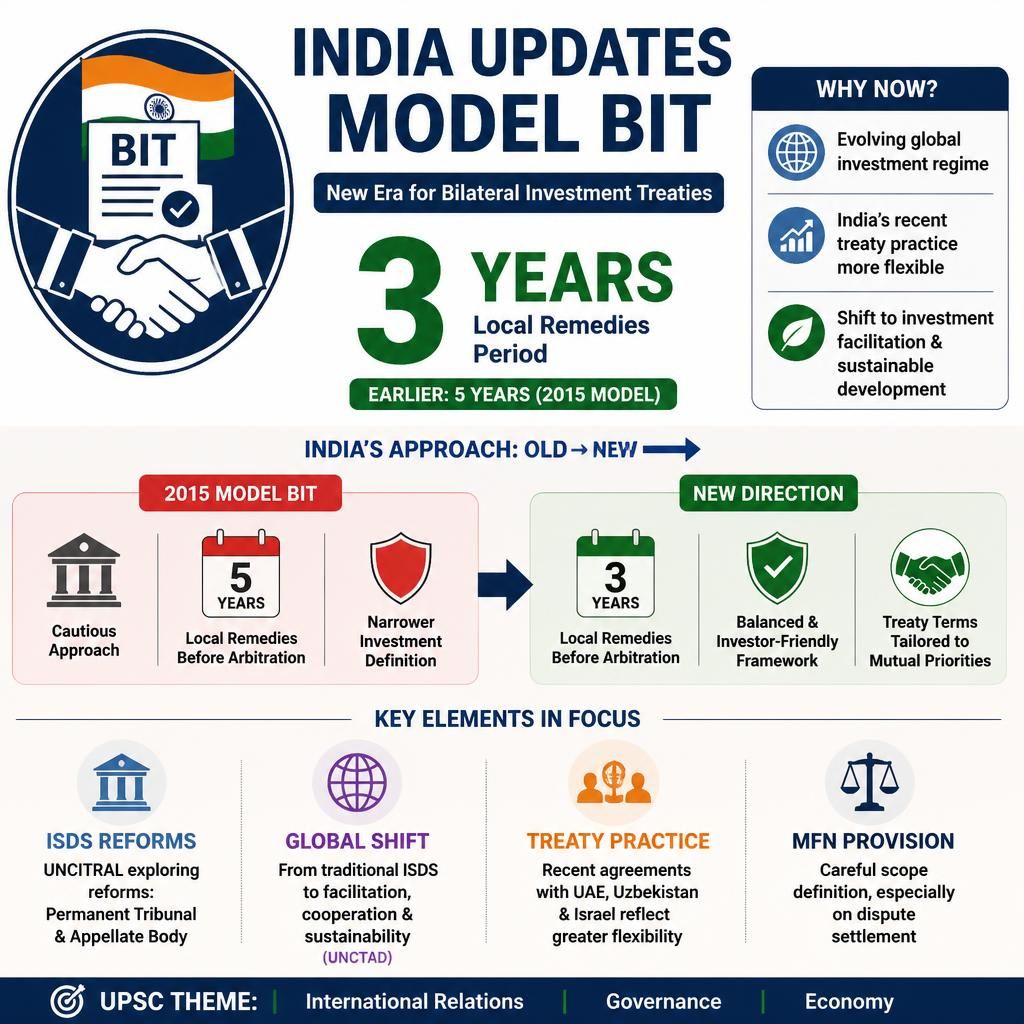
Model BIT.jpg
Detailed Insights:
- The 2015 Model BIT included a narrower definition of investment and mandated a five-year period for exhausting local judicial and administrative remedies before treaty arbitration.
- Recent investment agreements with the UAE, Uzbekistan, and Israel demonstrate India's increased flexibility, reducing the local remedies period to three years.
- A Model BIT acts as a foundational framework for negotiations, allowing for specific adjustments in individual treaties based on mutual priorities.
- The international investment landscape, as noted by UNCTAD, is shifting towards investment facilitation, cooperation, and sustainable development, with reduced reliance on traditional Investor-State Dispute Settlement (ISDS).
- UNCITRAL is actively exploring reforms to the ISDS mechanism, including the potential for a permanent tribunal and appellate body.
- The new model must carefully define the scope of the Most Favoured Nation (MFN) provision, particularly concerning dispute settlement, to prevent unintended interpretations.
- It should also incorporate investor obligations and the circumstances under which counterclaims can be asserted, drawing lessons from agreements like the India-Uzbekistan BIT.
- Precision in defining substantive protections such as expropriation and Fair and Equitable Treatment (FET) is crucial to balance investor rights with the state's regulatory authority for public good.
Key Concepts Involved:
- Bilateral Investment Treaty (BIT): An agreement between two countries on the terms for private foreign direct investment by investors from one country into the other.
- Investor-State Dispute Settlement (ISDS): A system allowing foreign investors to sue host states directly for alleged breaches of investment treaty obligations.
- Most Favoured Nation (MFN): A clause in treaties requiring a country to provide the same favorable treatment to all trading partners as it gives to its "most favored" one.
- Fair and Equitable Treatment (FET): A common standard in investment treaties requiring host states to treat foreign investors justly and equitably, often interpreted broadly.

SuperKalam is your personal mentor for UPSC preparation, guiding you at every step of the exam journey.
Download the App


STUDY RESOURCES
CONTACT US
ⓒ Snapstack Technologies Private Limited