GS 2: International RelationsGS 3: Environment & EcologyGS 3: EconomyPrelimsGS 3: Indian Economy, Planning, Mobilization of Resources, Growth, Development and Employment
Global South must be paid for climate damage, but only if it prices carbon, argues economist, Pg10
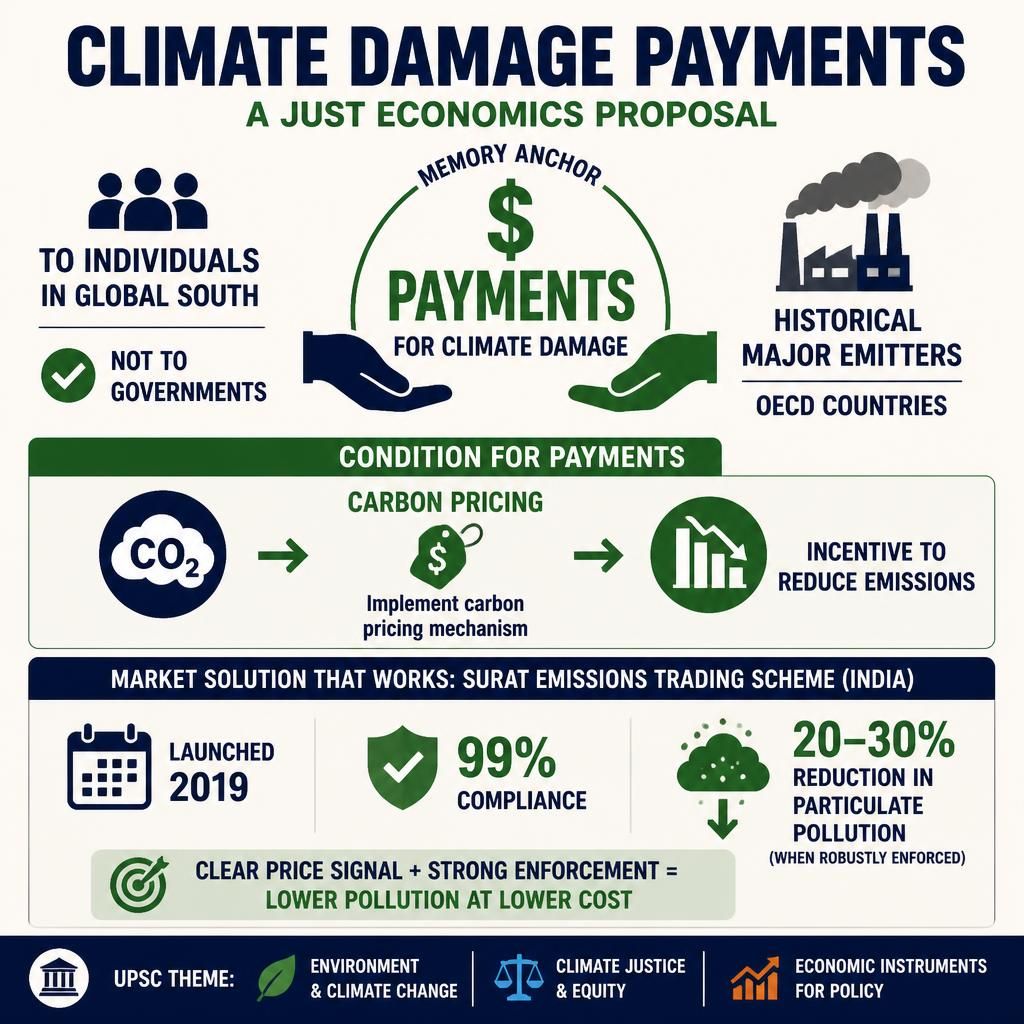
Economist proposes rich nations pay Global South for climate damage, conditional on carbon pricing, advocating direct payments to people.
Practice MCQs
811 Students attempted
Key Highlights:
- Economist Michael Greenstone, alongside Nobel laureates Abhijit Banerjee and Esther Duflo, proposes that wealthy nations compensate developing countries for climate damage.
- The central idea, detailed in their forthcoming book Just Economics, suggests direct payments to individuals in the Global South, not governments.
- These payments are contingent upon the recipient countries implementing carbon pricing mechanisms.
- The Organisation for Economic Co-operation and Development (OECD) countries are identified as major historical contributors to atmospheric carbon.
- Greenstone advocates for market-based solutions, citing the success of the Surat Emissions Trading Scheme in India for pollution control.
Climate Damage Payment.jpg
Detailed Insights:
- The proposal aims to address climate justice by acknowledging the disproportionate impact of historical emissions from developed nations on the Global South.
- Payments would be "unencumbered," allowing individuals in developing countries to utilize funds as they deem fit, bypassing governmental channels.
- The condition of carbon pricing is designed to incentivize emission reduction efforts in rapidly industrializing economies.
- The Surat Emissions Trading Scheme, launched in 2019, demonstrated high compliance (99%) and reduced particulate pollution by 20-30% when robustly enforced.
- This market-based approach suggests that effective enforcement and clear pricing signals can significantly reduce pollution at a lower cost.
- The proposal suggests that such agreements could be bilateral, for instance, between the European Union and India, rather than requiring global consensus.
Key Concepts Involved:
- Carbon Pricing: A mechanism that assigns a monetary cost to greenhouse gas emissions, making polluters pay for the climate damage they cause.
- Emissions Trading Scheme (ETS): A market-based approach, also known as "cap-and-trade," where a limit is set on total emissions, and permits to pollute are traded among entities.
- Global South: A term referring to low- and middle-income countries, primarily across Asia, Africa, and Latin America, sharing common developmental and historical concerns.
- Organisation for Economic Co-operation and Development (OECD): An intergovernmental economic organization of mostly high-income, democratic countries that promotes economic progress and world trade.

SuperKalam is your personal mentor for UPSC preparation, guiding you at every step of the exam journey.
Download the App


STUDY RESOURCES
CONTACT US
ⓒ Snapstack Technologies Private Limited