GS 2: GovernanceGS 3: Environment & EcologyPrelimsGS 3: Conservation, Pollution and DegradationGS 2: Government policies and interventions for development in various sectors
Buxa Reserve regains its stripes with the release of a three-year-old tigress, Pg1
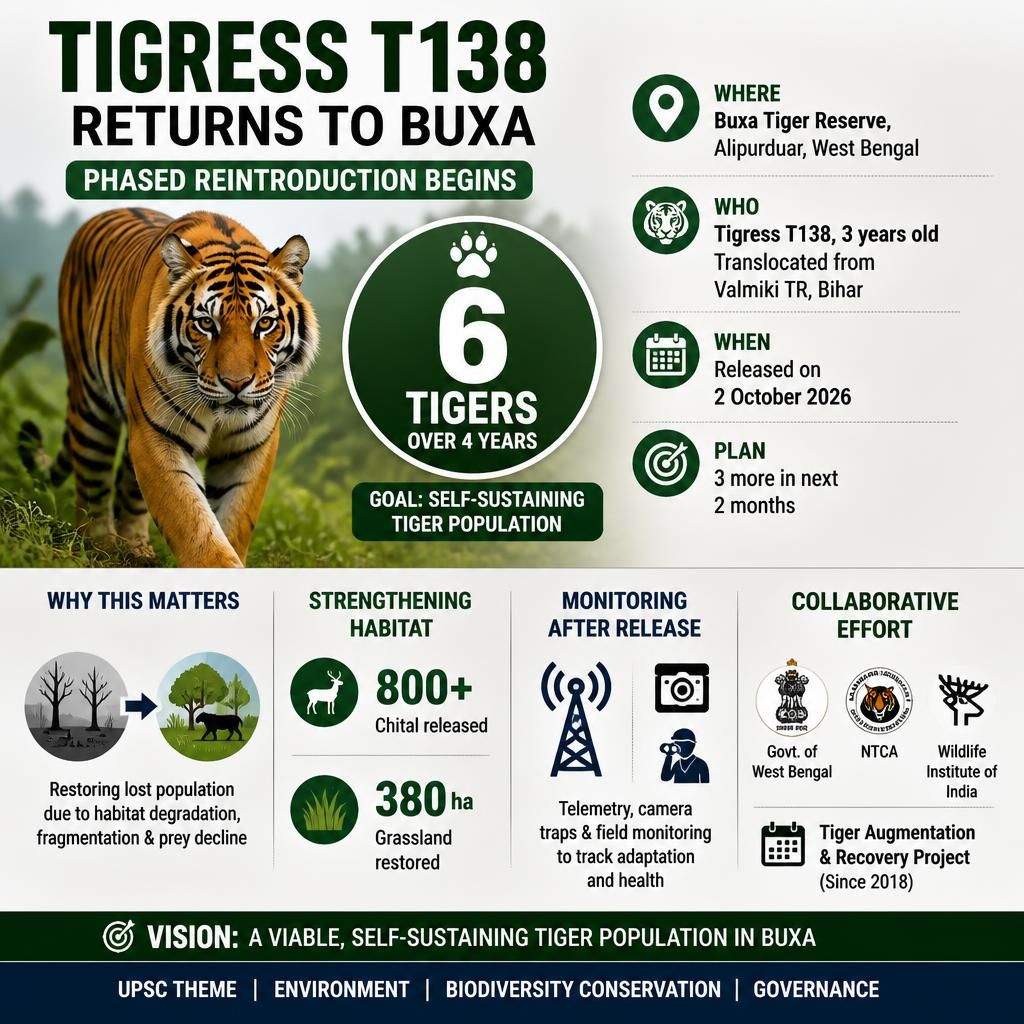
Buxa Tiger Reserve regains its stripes as a three-year-old tigress is released, initiating a phased reintroduction program to establish a self-sustaining tiger population.
Practice MCQs
811 Students attempted
Key Highlights:
- A three-year-old tigress, T138, was released into the Buxa Tiger Reserve in West Bengal on Friday, October 2, 2026.
- This marks the beginning of a phased program to reintroduce tigers and establish a viable, self-sustaining population in the reserve.
- The tigress was translocated from Bihar’s Valmiki Tiger Reserve.
- Union Environment Minister Bhupender Yadav and West Bengal Chief Minister Suvendu Adhikari were present at the release.
- Three more tigers are planned for release in Buxa within the next two months, with a total of six over four years.
- Buxa Tiger Reserve, declared in 1983, had previously lost its stable resident tiger population due to habitat degradation and lack of prey.
Buxa Tiger Reserve.jpg
Detailed Insights:
- Buxa Tiger Reserve is located in the Alipurduar district of West Bengal, forming part of a larger ecological landscape connected to Bhutan and Assam.
- The decline in Buxa's tiger population was attributed to habitat degradation, fragmentation, changes in land use, and reduced prey availability.
- The reintroduction is part of the Tiger Augmentation and Recovery Project, a collaborative effort by the Government of West Bengal, National Tiger Conservation Authority (NTCA), and Wildlife Institute of India (WII) since 2018.
- Post-release, the tigress will undergo intensive monitoring using telemetry, camera trapping, and field-based methods to assess her adaptation and health.
- Efforts to strengthen the prey base in Buxa include releasing over 800 chital and restoring approximately 380 hectares of grassland.
- Valmiki Tiger Reserve, Bihar's only tiger reserve, is located in the West Champaran district and borders Nepal's Chitwan National Park.
- The reintroduction program aims to boost tourism in the region and restore the ecological balance of the reserve.
Key Concepts Involved:
- Tiger Reintroduction Program: The process of establishing a tiger population in an area where it was historically present but became locally extinct.
- National Tiger Conservation Authority (NTCA): A statutory body established in 2006 under the Wildlife (Protection) Act, 1972, responsible for tiger conservation in India.
- Project Tiger: A flagship wildlife conservation program launched in 1973 by the Government of India to protect the Bengal tiger and its habitats.
- Telemetry: A method using radio signals from transmitters attached to animals to track their movement and behavior for scientific study.
- Camera Trapping: The use of remote, motion-activated cameras to capture images or videos of wildlife for monitoring and research without human interference.

SuperKalam is your personal mentor for UPSC preparation, guiding you at every step of the exam journey.
Download the App


STUDY RESOURCES
CONTACT US
ⓒ Snapstack Technologies Private Limited